
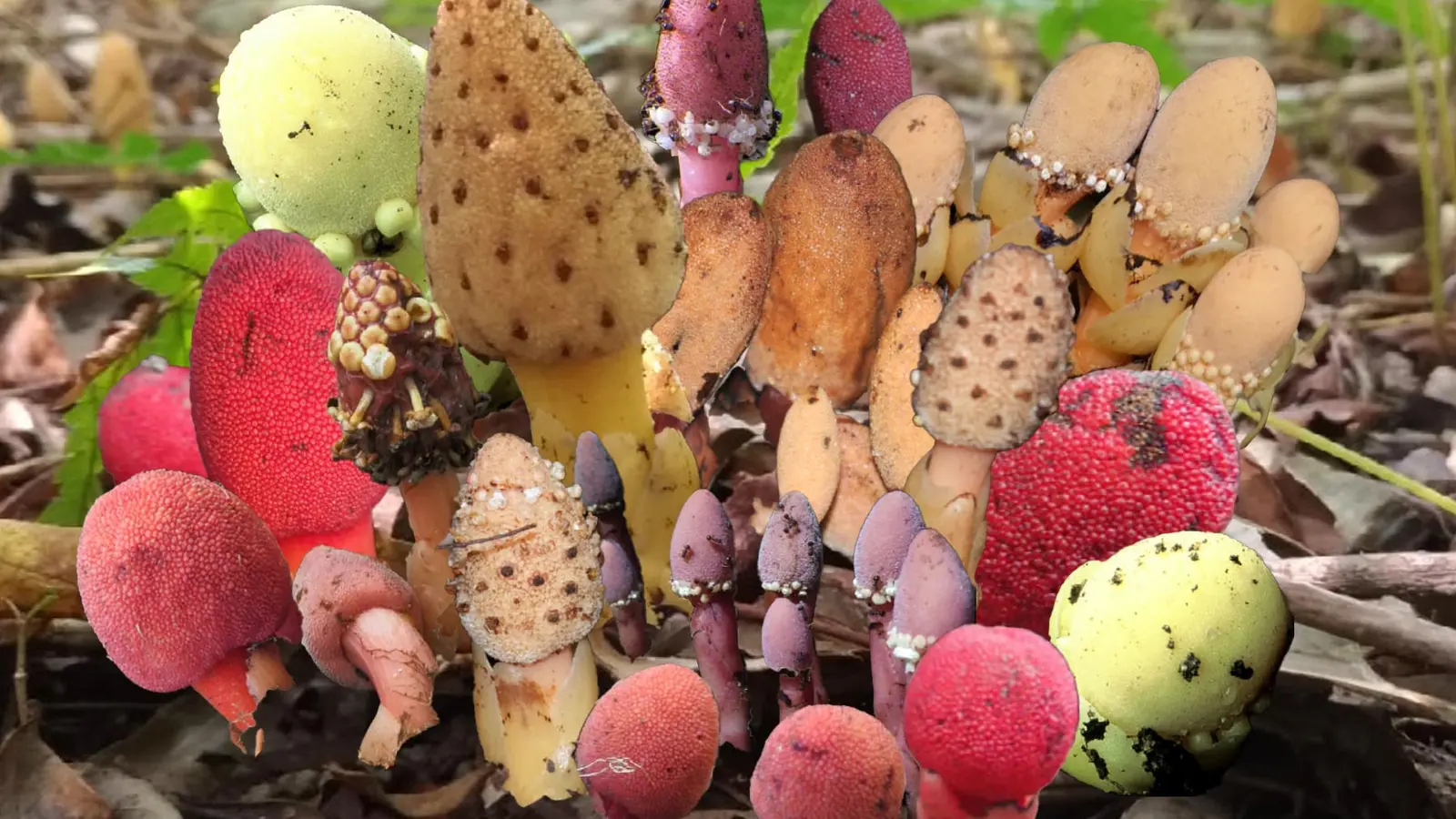
Some plants abandoned sunlight long ago and kept going. A recent genetic study reveals that members of the parasitic genus Balanophora have pared down the genomes that normally power photosynthesis to a tiny, remnant plastome — yet these unusual plants survive by siphoning nutrients from tree roots, behaving more like a fungus than a leafy green.
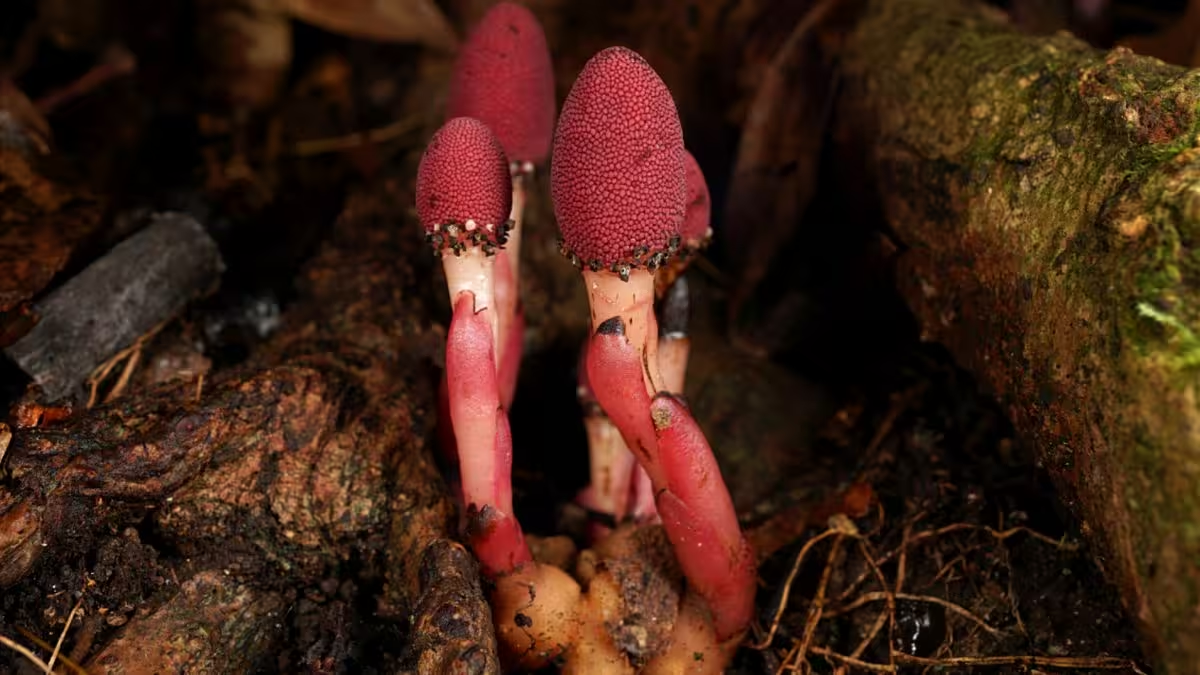
Balanophora subcupularis, one of the species studied by the researchers.
What the team discovered
Researchers sampled seven Balanophora species from 12 remote populations across Taiwan and Japan and sequenced their plastid genomes (plastomes). Plastids are the cell organelles that usually carry the genes for photosynthesis. In Balanophora the plastome has been reduced by roughly tenfold: where most land plants retain 120,000–170,000 base pairs, these parasites keep only about 14,000–16,000 base pairs.
That tiny sequence is not useful for converting light into chemical energy. Instead, the remaining plastid genes appear to support non-photosynthetic metabolism essential to a parasitic lifestyle. In other words, Balanophora has shed much of the genetic machinery that defines a green plant yet retained enough plastid function to survive without producing its own food.
"Balanophora has lost much of what defines it as a plant, but retained enough to function as a parasite," says botanist Petra Svetlikova of the Okinawa Institute of Science and Technology in Japan, one of the study authors. Her observation underscores how dramatic genomic reduction can be compatible with persistence when an organism switches ecological strategies.
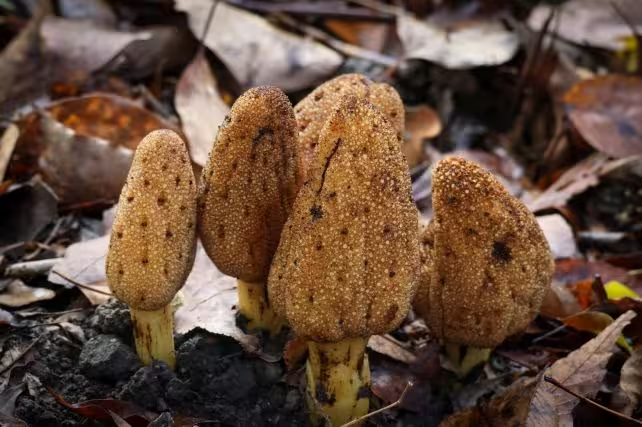
Balanophora tobiracola, another species included in the study.
How Balanophora survives without photosynthesis
Instead of producing sugars with chlorophyll, Balanophora taps into host trees. It forms intimate connections with tree roots and extracts water, carbohydrates and other nutrients directly — a strictly parasitic relationship. This lifestyle superficially resembles mycorrhizal fungi, which also link to roots, but Balanophora is not mutualistic: fungi typically trade nutrients for carbon, whereas Balanophora provides nothing in return.
The resemblance to mushrooms is an example of convergent evolution: unrelated organisms evolve similar forms or behaviours when faced with similar ecological challenges. Balanophora’s compact, often fungal-like appearance and its root-feeding habit make it easy to mistake for a fungus at first glance.
Plastome loss and evolutionary timing
Genetic analysis shows that plastome reduction occurred in a common ancestor of the sampled species before Balanophora diversified. That implies the dramatic shift away from photosynthesis is not a recent, species-by-species event but a shared evolutionary step that set the stage for later adaptations.
Island populations of Balanophora have also evolved asexual reproduction. For some island species, that method now appears to be the only way they reproduce. Asexual reproduction can be advantageous in isolated environments where mates or suitable hosts are scarce, increasing the parasite’s ability to establish new populations from a single colonizer.
Why this matters to evolutionary biology
Plastome reduction in Balanophora provides a concrete model for studying how photosynthesis can be lost in land plants. The findings published in New Phytologist suggest that plastid genomes may be pared back to a minimal, metabolically active core rather than being discarded completely. That helps researchers understand which plastid functions are indispensable even when a plant abandons photosynthesis.
Beyond plant biology, Balanophora raises broader questions about the limits of what makes a plant. It produces flowers and seeds and is clearly a flowering plant (angiosperm), but genomically and ecologically it occupies a space that challenges simple categories. Studying such extremes sharpens our picture of evolutionary flexibility and the multiple ways life can solve the problem of obtaining energy.
Expert Insight
Dr. Elena Marquez, an evolutionary botanist not involved in the study, comments: "Balanophora is a striking example of evolutionary minimalism. When organisms abandon a major metabolic pathway like photosynthesis, they reveal which genes and structures are truly essential. These parasites show that plastids are not just photosynthesis factories; they retain core metabolic roles that even a parasitic lifestyle cannot dispense with."
The Balanophoraceae family now stands as a useful system for reconstructing the genomic steps that accompany loss of photosynthesis. For ecologists and evolutionary geneticists, these plants offer a living laboratory to test hypotheses about organelle reduction, host–parasite coevolution, and island colonization dynamics.

“The cosmos has always fascinated me. I write about space missions, astronomy, and the technologies pushing humanity beyond Earth.”

Discussion
Leave a Comment