
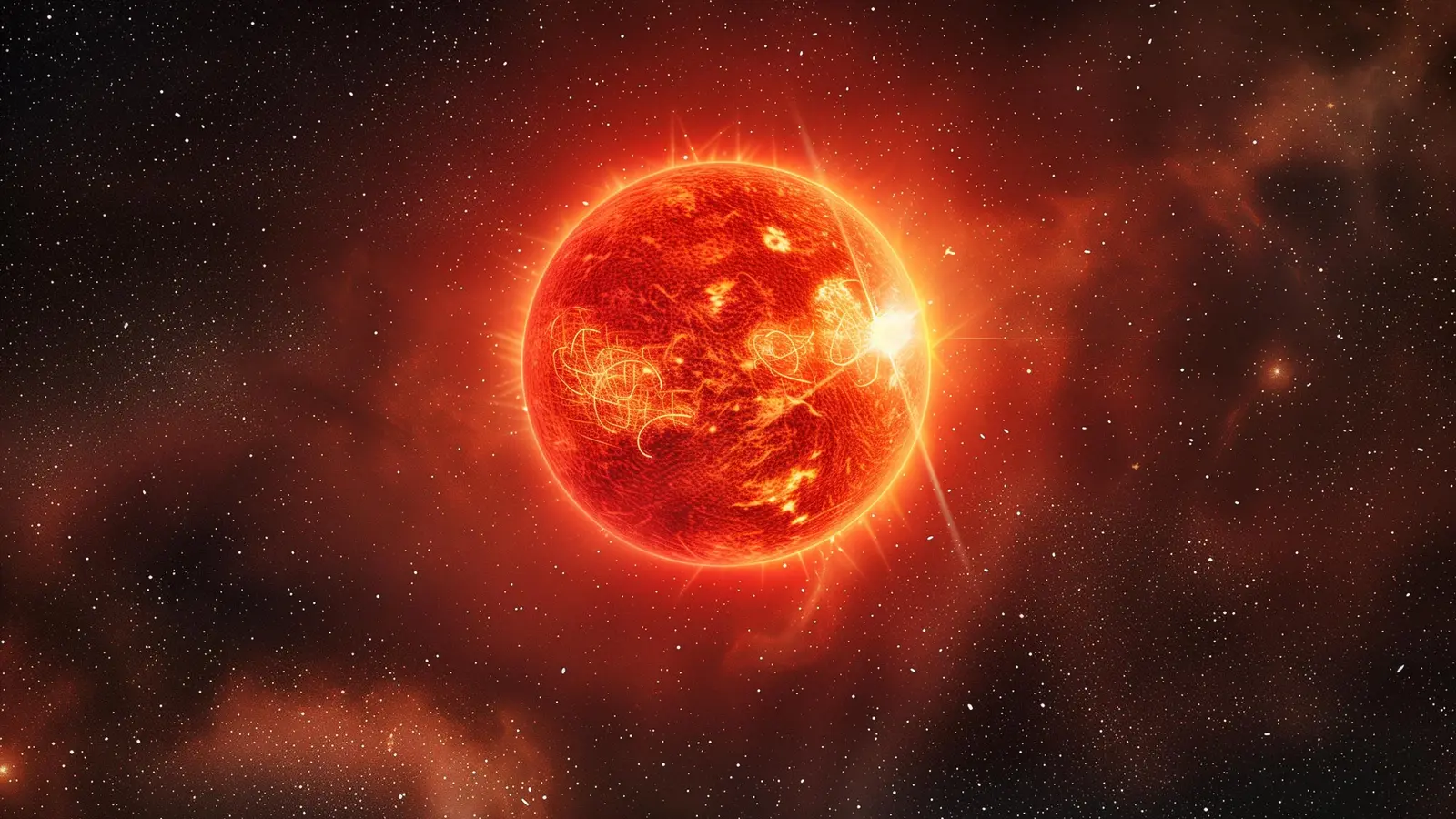
Starlight may not be the engine behind galactic recycling
New, high-resolution observations of the nearby red giant R Doradus have forced astronomers to rethink a decades-old idea about how massive stars seed the galaxy with the elements life needs. The long-standing picture—where radiation pressure from starlight pushes on dust grains and launches dense stellar winds—looks incomplete. The dust grains around R Doradus are simply too small to feel a strong enough push from photons to account for the powerful outflows observed.
This finding comes from a team at Chalmers University of Technology in Sweden, using ESO’s Very Large Telescope (VLT) with the SPHERE instrument and drawing on complementary ALMA imaging and advanced simulations. For astrophysicists, it’s a rare case of a clear observational result overturning a neat theoretical shortcut. For car and technology enthusiasts, the study offers an intriguing analogy to automotive engineering: the right shape, size and coupling between components matter if you want thrust or performance.
Why this matters — and why car people should care
Red giants like R Doradus play a central role in the cosmic materials cycle. During their late life stages, they surrender large amounts of gas and dust to interstellar space; those elements later coalesce into planets and ultimately into the chemistry that supports biology. Understanding how winds are launched determines how efficiently carbon, oxygen, nitrogen and metals are distributed across the Milky Way.
.avif)
If you follow automotive trends, think of it like aerodynamics and drivetrain: a car’s body shape and surface materials must interact with airflow to create downforce or reduce drag. If a design assumption is wrong—say, the expected airflow attachment fails—the vehicle’s performance and fuel economy suffer. Similarly, if starlight cannot couple effectively to dust, then other processes must supply the missing thrust.
A closer look at R Doradus
R Doradus sits about 180 light-years from Earth in the southern constellation Dorado. It’s an asymptotic giant branch (AGB) star: once similar in mass to the Sun, now swollen to many times its original size and cooling at the surface. As an AGB star nears the end of its life, it sheds mass in dense winds of gas and dust. R Doradus is a convenient laboratory—bright, close, and typical of many red giants—so astronomers have targeted it repeatedly.
.avif)
Using polarized visible light measured by VLT/SPHERE across several wavelengths, the team probed dust within a region roughly the size of our Solar System around the star. The color and degree of polarization constrain grain sizes and composition. The results point to common stardust species—silicates and alumina—but with grain radii around 0.0001 millimetres (about one ten-thousandth of a millimetre): far smaller than needed for radiation pressure to take them on a ride into interstellar space.
"We thought we had a good idea of how the process worked. It turns out we were wrong," said Theo Khouri, co-leader of the study. "For us as scientists, that’s the most exciting result."
How the team tested the theory
- Observations: Polarised light imaging from VLT/SPHERE captured dust-scattered light and its wavelength dependence.
- Modeling: Detailed radiative transfer and dynamical simulations tested whether photons could impart sufficient momentum to grains of the measured sizes.
- Cross-check: ALMA images reveal convective structures and large-scale dynamics at the star’s surface that might contribute to mass loss.
The conclusion was clear: starlight alone cannot provide enough push on grains this small to launch the observed wind.
What likely replaces the simple picture?
With the textbook mechanism under strain, researchers point to more complex and dynamic processes:
- Giant convective cells: Observations reveal enormous bubbles rising and falling on the star’s surface. These convective motions can eject material to larger radii and may create shock fronts that help launch winds.
- Stellar pulsations: Rhythmic expansions and contractions in an AGB star can levitate gas and create conditions favorable for dust condensation in denser, cooler pockets.
- Episodic dust production: Transient events could briefly generate larger grains or clumps that couple more effectively to radiation pressure.
Wouter Vlemmings, a co-author at Chalmers, summed it up: "Giant convective bubbles, stellar pulsations, or dramatic episodes of dust formation could all help explain how these winds are launched."

Quick technical snapshot — a star ‘spec sheet’
Think of this as a vehicle specification block translated to stellar terms:
- Object: R Doradus (AGB red giant)
- Distance: ~180 light-years
- Origin mass: similar to the Sun
- Current state: expanded, cooler surface, intense mass loss
- Mass-loss rate: roughly one-third of Earth’s mass every decade (varies among AGB stars)
- Dust composition: silicates, alumina
- Typical grain size: ~0.0001 mm
If engineers compare fuel consumption, R Doradus “burns” stellar material at rates that put most cars’ consumption into perspective: astronomically large in mass terms but extremely slow on human timescales. Translating mass-loss to an automotive analogy helps readers familiar with specifications visualize scale and impact.
Implications for models and for technology-minded readers
Astrophysicists must now refine models of stellar mass loss to include hydrodynamic, pulsational and convective effects, not just straightforward radiative acceleration. For an audience tuned to cars and engineering, this is like moving from 1D fuel-efficiency calculations to full 3D CFD (computational fluid dynamics) of a vehicle in real-world conditions.
The study also underlines a recurring lesson for designers: coupling mechanisms matter. Whether it’s photon momentum acting on dust grains or airflow acting on body panels, size, shape and timing govern performance.
Takeaways and broader context
- The classic picture—starlight pushing dust to seed the galaxy—doesn’t tell the whole story, at least for R Doradus.
- Small dust grains measured around the star are too tiny to be driven away by photon pressure alone.
- More complex, dynamic processes such as convection, pulsations and episodic dust events are likely key contributors.
Quote to remember:
"Dust is definitely present, and it is illuminated by the star, but it simply doesn’t provide enough force to explain what we see," said Thiébaut Schirmer, a member of the team.
Why this matters for the future of astronomy and beyond
Refining how stars return material to the interstellar medium impacts our understanding of planet formation, galactic chemistry, and the lifecycle of matter in the cosmos. For industries and readers attuned to design and performance, the research is a reminder that simple mechanisms often give way to richer, multivariable dynamics—whether in engines, EV drivetrains or in the atmospheres of aging stars.
As telescopes and instruments become more sensitive, astronomers will continue to map these complex interactions. The eventual outcome will be improved models that better predict how elements travel, assemble, and, in the great timescale of the galaxy, help build new worlds.

“The cosmos has always fascinated me. I write about space missions, astronomy, and the technologies pushing humanity beyond Earth.”

Discussion
Leave a Comment