
New research from McGill University challenges a central idea about dopamine and movement. Instead of acting as a moment-to-moment controller of how fast or forceful a movement is, dopamine may provide the steady background conditions that allow movement to occur at all — a finding with direct implications for Parkinson’s treatment.
A shift in thinking about motor vigor
For decades, neuroscientists have linked dopamine to motor vigor — the speed and force of voluntary actions. In Parkinson’s disease, the progressive loss of dopamine-producing neurons is associated with slowed movements, tremor and balance problems. Clinically, this connection has driven therapies aimed at restoring dopamine signaling, most notably levodopa, which remains the most effective symptomatic treatment.
But the new study, published in Nature Neuroscience and led by Nicolas Tritsch at McGill’s Douglas Research Centre, suggests a different role. Rather than acting as a real-time "throttle" that sets how fast each movement is executed, dopamine may function more like engine oil: essential for the system to run but not the momentary signal that determines individual action vigor. "Our findings suggest we should rethink dopamine’s role in movement," said Tritsch. "Restoring dopamine to a normal level may be enough to improve movement. That could simplify how we think about Parkinson’s treatment."
How the experiment tested dopamine’s role
The team measured dopamine dynamics in real time while mice performed a simple motor task: pressing a weighted lever. They combined sensitive recordings with optogenetics, a light-driven method that can turn dopamine-producing cells on or off at precise moments during an action.
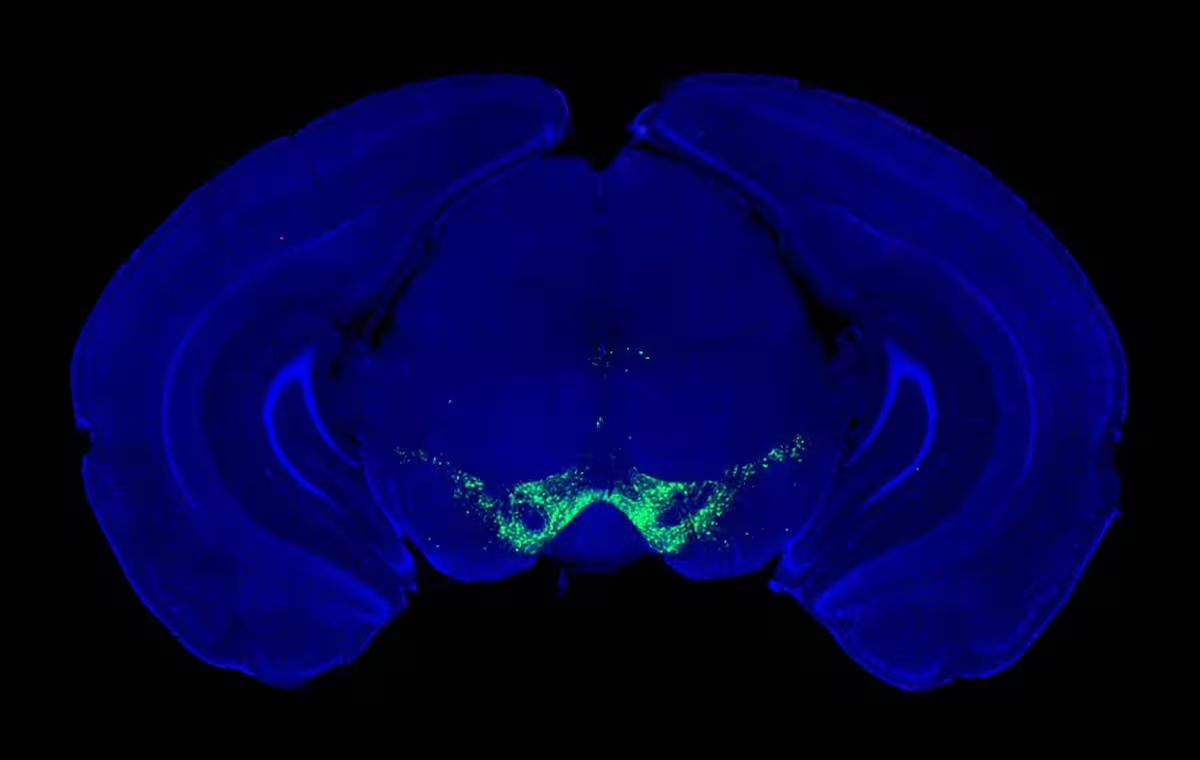
Fluorescence microscopy image of dopamine-producing neurons (green) in the midbrain of a mouse.
If fast dopamine surges were directly controlling movement vigor, artificially boosting or suppressing those bursts at the moment of movement should change speed or force. Surprisingly, brief manipulations had no consistent effect on the vigor of individual presses. Instead, the researchers found that levodopa improved movement by elevating the brain’s baseline level of dopamine — the steady-state signal — without necessarily restoring rapid, movement-linked spikes.
Implications for Parkinson’s therapy and research
This reinterpretation reframes several open questions in Parkinson’s research. If baseline dopamine availability is the key permissive factor for movement, then therapies that stabilize tonic dopamine levels could be as — or more — important than interventions aimed at mimicking phasic bursts. That insight may explain why levodopa, which raises overall dopamine availability, remains so effective in improving mobility.
The finding also offers a clearer target for drug development. Dopamine receptor agonists have been tested before but often caused side effects because they acted broadly across brain circuits. Designing treatments that restore or maintain appropriate baseline dopamine in specific motor pathways could reduce side effects while preserving benefit.
What comes next for researchers?
Further work will need to test whether the same principles hold in primates and humans, and how baseline dopamine interacts with other neuromodulators and circuit-level changes in Parkinson’s disease. For clinicians and drug developers, the study encourages a renewed focus on therapies that preserve tonic dopamine tone and on biomarkers that reflect baseline — not just phasic — dopamine function.
Conclusion
By shifting the focus from rapid dopamine spikes to the supporting role of baseline dopamine, this study reframes how we understand motor control and suggests more targeted strategies for treating Parkinson’s disease. The result is a clearer mechanistic picture and, potentially, a simpler path toward safer, more effective therapies.

“The cosmos has always fascinated me. I write about space missions, astronomy, and the technologies pushing humanity beyond Earth.”

Discussion
Leave a Comment