
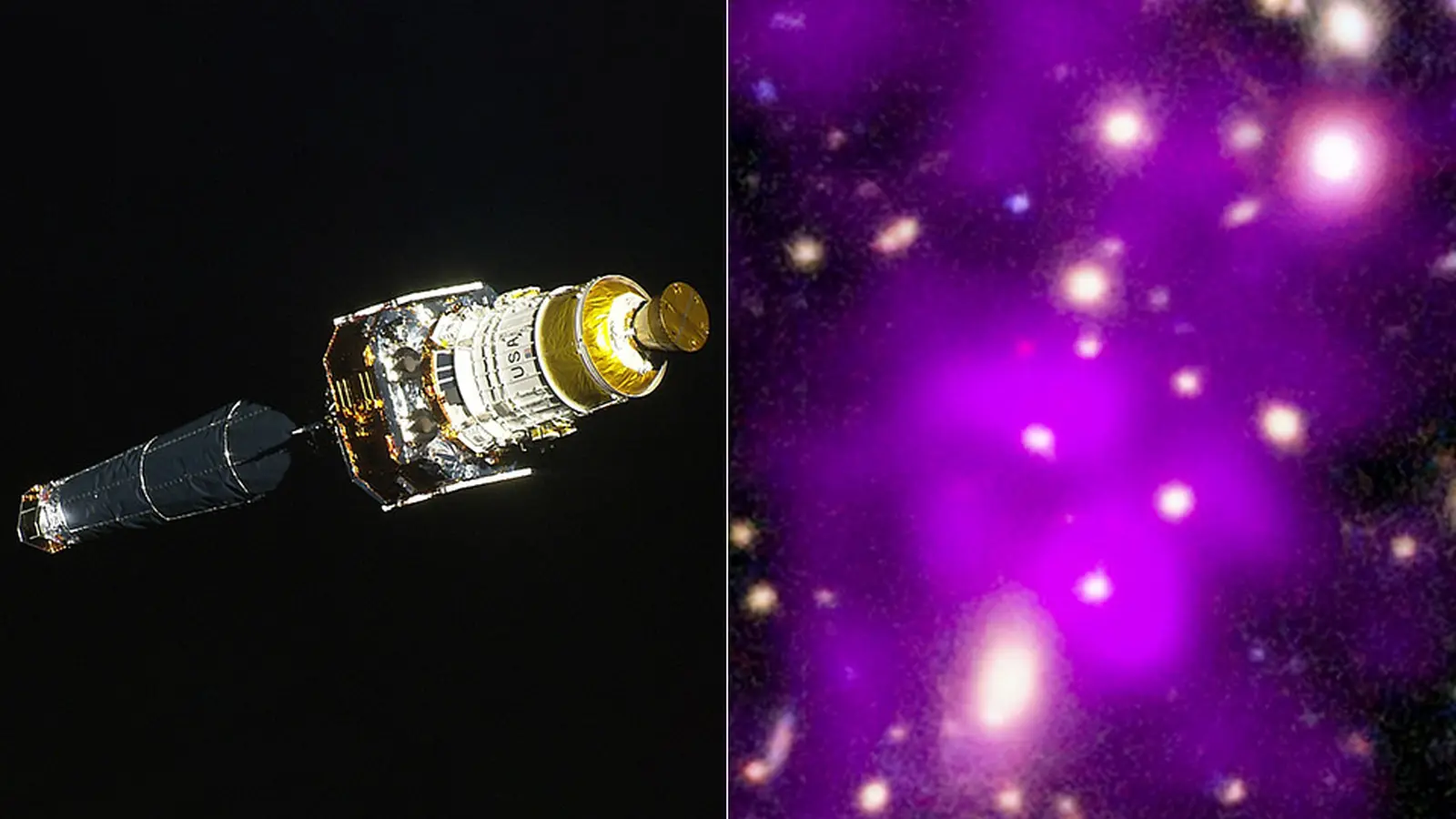
On New Year’s Eve 2020 astronomers spotted a striking, bubbly galaxy system now nicknamed the Champagne Cluster. New composite images combining X-ray and optical data reveal two massive galaxy clusters in the act of merging — a rare laboratory to study how hot gas and invisible dark matter behave during high‑speed collisions.

This image shows that the Champagne Cluster is actually two galaxy clusters in the process of merging to form an even larger cluster. Bubbles of multimillion-degree gas in galaxy clusters detected by Chandra (purple) are spread throughout the cluster of more than a hundred galaxies, seen in optical light data (red, green, and blue). The hot gas outweighs the combined mass in the individual galaxies of the newly forming cluster. Researchers think further studies of the Champagne Cluster can potentially teach them how dark matter in galaxy clusters reacts to a high-speed collision.
A bubbly collision in the deep sky
Catalogued as RM J130558.9+263048.4, the Champagne Cluster earned its festive name because astronomers first identified it on December 31, 2020, and because the arrangement of galaxies and superheated gas resembles a spray of bubbles. The Chandra X-ray Observatory reveals pockets of multimillion‑degree plasma as purple structures, while optical data from the Legacy Surveys (shown in red, green and blue) map more than a hundred member galaxies.
Rather than a single, relaxed cluster, the composite image clearly shows two galaxy concentrations — one above and one below the center — and an elongated distribution of hot gas stretched along the collision axis. That morphology signals an active merger: the two clusters have already interacted or are in the process of doing so, reshaping their gas, stars and dark matter halos.
Observations, instruments and what they reveal
The discovery draws on complementary datasets. Chandra’s X-ray imaging detects the glowing, multimillion‑degree intracluster medium (the hot gas that fills galaxy clusters) while the Legacy Surveys combine optical imaging from several telescopes in Arizona and Chile to chart the galaxies themselves. Together, they reveal a system where the hot gas mass exceeds the combined stellar mass of the member galaxies — and where most of the total mass remains unseen because it is bound up in dark matter.
Comparisons with well-known collisions, such as the Bullet Cluster, help astronomers interpret what they see. In those rare, high‑velocity mergers the hot gas can be slowed or displaced by ram pressure, while collisionless components (galaxies and dark matter) pass through more freely. Detecting offsets between gas, galaxies and dark matter — measured via gravitational lensing in follow-up studies — is the key to probing dark matter’s behavior during violent interactions.
Two timelines, one opportunity to test dark matter
Integrating the observed structure with computer simulations gives two plausible histories for the Champagne Cluster. In the first scenario the clusters collided more than two billion years ago, separated, and are now being pulled back together by gravity toward a second encounter. In the second scenario a single collision occurred about 400 million years ago and the system is now moving apart following that event. Each timeline predicts different separations and offsets between gas, galaxies and dark matter — measurable differences that make further observations valuable.
Why does this matter? If dark matter interacts only gravitationally, its distribution should remain largely aligned with the galaxies, while the collisional hot gas lags behind or is smeared out. Any measurable displacement or non‑gravitational interaction would constrain dark matter models, including self‑interacting dark matter scenarios that have been proposed to resolve small-scale structure puzzles.
Implications and next steps
Follow‑up work will combine deeper X-ray exposures, optical imaging for weak gravitational lensing maps, and spectroscopic redshift surveys to pin down member galaxy velocities. Those datasets will sharpen mass maps and help determine which collision timeline better matches reality. The Champagne Cluster therefore represents a promising testbed for astrophysicists seeking to probe the microphysics of dark matter on galaxy‑cluster scales.
Expert Insight
“Systems like the Champagne Cluster are cosmic crash tests,” says Dr. Elena Morales, an astrophysicist specializing in cluster dynamics. “They let us separate the behavior of collisional gas from the largely collisionless dark matter. With targeted X‑ray and lensing observations we can measure offsets and timescales — and those measurements feed directly into models of what dark matter can and cannot do.”
As telescopes and analysis techniques improve, clusters such as this one will continue to provide unique constraints on the nature of dark matter and the physics of the intracluster medium, helping researchers turn visual fireworks into quantitative tests of fundamental physics.

“The cosmos has always fascinated me. I write about space missions, astronomy, and the technologies pushing humanity beyond Earth.”

Discussion
Leave a Comment