
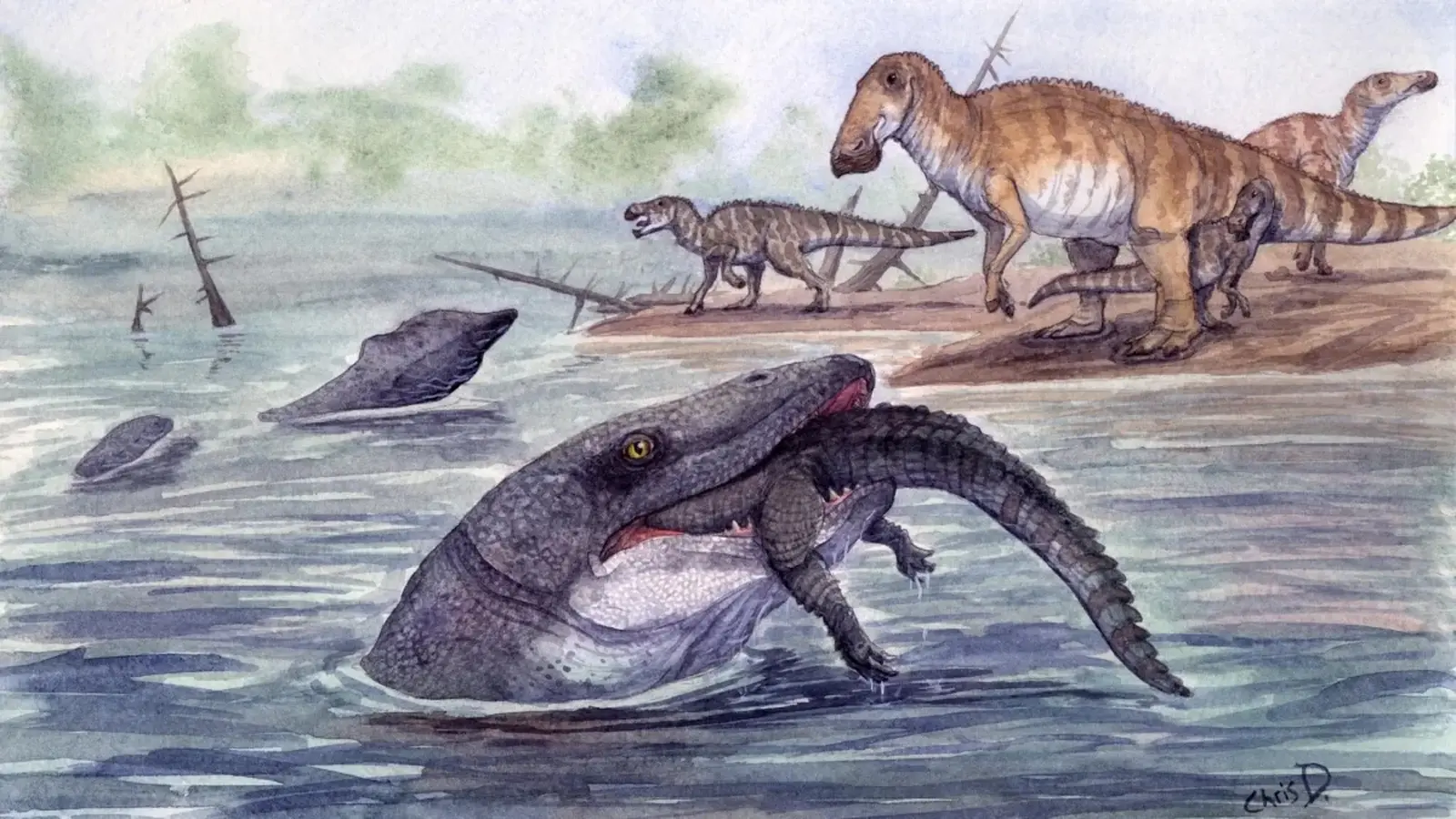
New isotope evidence shows that some mosasaurs—once thought to be strictly oceanic apex predators—regularly entered and even lived in freshwater rivers. Fossils from North Dakota reveal these giant marine reptiles were part of river ecosystems that also supported dinosaurs like Tyrannosaurus rex.
Freshwater mosasaurs: a surprising river predator
Mosasaurs are best known as Cretaceous ocean hunters, but recent analyses by international teams of paleontologists suggest that their ecological reach extended far beyond open seas. Teeth recovered from inland floodplain deposits in North Dakota—one found alongside a T. rex tooth and a crocodylian jawbone—prompted a key question: had the mosasaur lived in the river system, or was its tooth transported there after death?
To answer that, researchers tested isotopes preserved in tooth enamel. The ratios of oxygen, strontium and carbon isotopes act like a chemical passport, recording the water an animal lived in and the food it consumed. In this case, the mosasaur teeth consistently carried a freshwater signature: lower proportions of the heavy oxygen isotope (18O), and strontium ratios matching local riverine geology rather than seawater.
How isotope forensics reveal habitat and diet
Isotopes are elemental variants with different numbers of neutrons. Because physical processes separate isotopes in predictable ways, animal tissues lock in environmental and dietary information. Oxygen isotopes distinguish marine and freshwater habitats because evaporation and precipitation change the balance of 16O and 18O. Strontium isotopes reflect the local rocks dissolved into waterways. Carbon isotopes can indicate feeding depth and the types of prey consumed.
In the North Dakota specimens, oxygen and strontium values point to a life spent at least in part in rivers. The carbon isotope ratio adds a striking behavioral clue: one tooth shows a higher 13C signature than typical deep-diving mosasaurs, suggesting this animal fed in shallow water and may have eaten terrestrial animals that drowned or waded—possibly even dinosaurs.
Estimated from tooth size and morphology, the riverine mosasaur that left one of these teeth could have reached roughly 11 meters (36 feet) long—comparable to the largest modern killer whales. That scale reimagines Cretaceous riverbanks as dangerous meeting grounds where dinosaurs and other land animals risked ambush by bus-sized aquatic predators.
Scientific context and broader implications
The results, published in BMC Zoology, suggest a behavioral and ecological shift among mosasaurs in the final million years before their extinction. Moving into freshwater habitats may have been an adaptive response to ecological pressures or opportunities late in the Cretaceous. Such habitat flexibility would change how we reconstruct food webs and predator–prey dynamics at the end of the Mesozoic.
"The size of these animals means they would rival the largest killer whales today, making them extraordinary predators in river systems not previously associated with such giants," says Per Ahlberg of Uppsala University, noting the newfound scale of risk for terrestrial fauna. Melanie During, also at Uppsala, adds that additional teeth from nearby, slightly older sites show the same freshwater isotopic pattern, strengthening the case that mosasaurs occupied riverine niches across a span of time rather than representing a one-off occurrence.
The discovery underscores how chemical analyses complement traditional paleontology. Teeth—dense and chemically resilient—are especially valuable for reconstructing life histories. Comparing mosasaur isotopes with those from shark teeth, ammonites and other fossils from the same strata allowed researchers to rule out simple transport from the sea and build a consistent picture of river usage.
Research directions and ecological questions
Open questions remain. What drove mosasaurs into freshwater—competition, prey availability, juvenile nursery habitats, or changing coastlines? Did whole populations make the transition, or were freshwater excursions undertaken by only a few adaptable species? Ongoing fieldwork and expanded isotope surveys across North America and Europe will be critical to answering these questions.

The mosasaur tooth from different angles (left), and (right) the location where it was found (red box) near a T. rex tooth.
Expert Insight
"Evidence that mosasaurs used rivers reshapes how we imagine late Cretaceous ecosystems," says Dr. Sonia Patel, a paleoecologist not involved with the study. "It suggests greater ecological plasticity among large marine reptiles and forces us to reconsider interactions between aquatic and terrestrial predators. Future work combining isotopes with ancient biogeography will help clarify whether these were seasonal visitors or resident river predators."
As isotope techniques become more precise and more teeth and bones are sampled from inland deposits, the picture of Cretaceous life will grow richer—and more dangerous. Rivers that once looked tranquil in fossil reconstructions may now have been stages for fierce cross-kingdom encounters between dinosaurs and giant aquatic hunters.

“The cosmos has always fascinated me. I write about space missions, astronomy, and the technologies pushing humanity beyond Earth.”

Discussion
Leave a Comment