
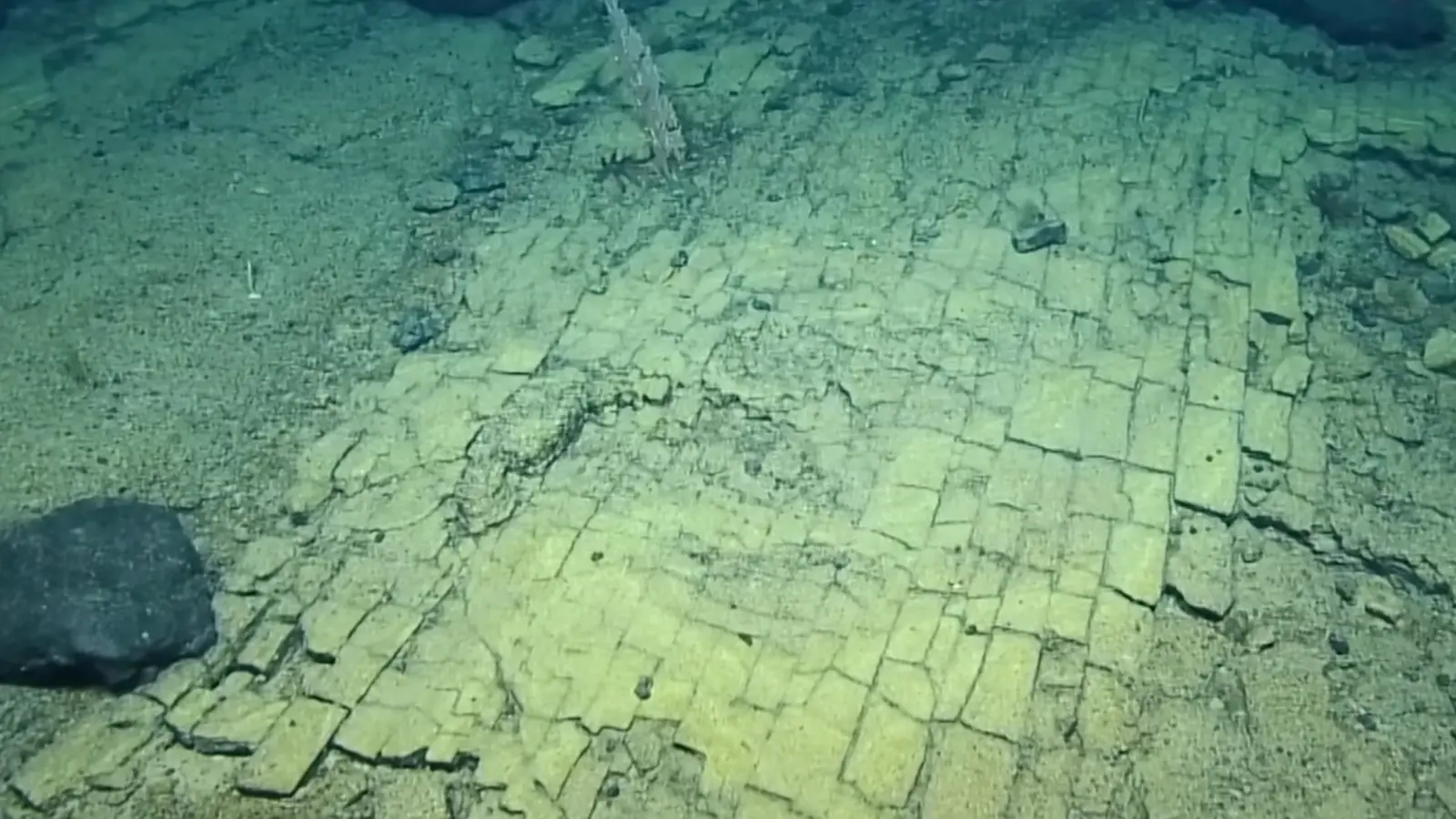
During a 2022 deep-ocean survey north of the Hawaiian Islands, explorers found something uncanny: a stretch of seafloor that looks like a yellow brick road. The discovery, on the summit of the Nootka seamount within Papahānaumokuākea Marine National Monument, offers a rare glimpse into volcanic processes and the hidden landscapes of the deep seafloor.
What the Nautilus team found
The exploration vessel E/V Nautilus, operated by the Ocean Exploration Trust, was surveying the Liliʻuokalani Ridge when remotely operated vehicle footage revealed a flat, pale surface interrupted by a grid of nearly rectangular fractures. At more than 3,000 meters (about 9,843 feet) deep, the area appears unusually dry and rigid — like an ancient lakebed cracked into tidy blocks.

Red pencil urchin (Heterocentrotus mamillatus) at Papahānaumokuākea Marine National Monument.
Onboard audio captured the human reaction: laughter, surprise and a stream of analogies. "It's the road to Atlantis," one researcher joked. "The yellow brick road?" another replied. The moment underscored how unfamiliar and theatrical the deep seafloor can appear when seen up close.
A baked crust of volcanic glass: hyaloclastite explained
Geologists examining the video and sample notes identified the formation as a fractured flow of hyaloclastite — a volcanic rock produced when hot lava shatters on contact with water or ice, sending angular fragments to settle and weld together on the seafloor. When repeated eruptions and rapid temperature changes act on these deposits, the margins can bake and crack, producing angular, often right-angled fractures that resemble paving stones.
One member of the team described the surface as a "baked crust" that could be peeled off in places. Captioning from the Nautilus footage suggests the 90-degree fracture patterns result from heating and cooling stress during multiple eruptive episodes at a hardened margin. In short: it's an underwater portrait of violent volcanic activity frozen into blocky geometry.
Why this small discovery matters
On its own, a cracked patch of hyaloclastite is a neat field note. But set within the context of global ocean exploration, it becomes a reminder of how much remains unknown. Papahānaumokuākea Marine National Monument is one of the planet's largest marine protected areas, yet only a sliver of its seafloor has been visually surveyed. A 2025 analysis by researchers affiliated with the Ocean Discovery League, Scripps Institution of Oceanography and Boston University estimated that visual exploration of the deep seafloor spans between 0.0006 and 0.001 percent of its total area — the upper estimate equates to about 3,823 square kilometers, roughly the size of Rhode Island.
That scarcity of direct observation means routine surprises. Features that look cinematic — a "yellow brick road," a golden orb, or the ruins-like chimneys of hydrothermal systems — often turn out to be important geological markers. They tell us about eruption history, fluid flow, mineral formation and the habitats that can develop on and inside ancient seamount slopes.

The researchers found the discovery of a 'yellow brick road' to be very unusual.
Implications for seafloor science and exploration
Hyaloclastite deposits are windows into how oceanic volcanoes erupt and cool. Mapping their distribution helps scientists reconstruct eruption sequences, estimate past thermal regimes, and assess how substrates age to host biological communities. For conservation and management inside protected areas like PMNM, understanding rock types and geomorphology also supports biodiversity assessments and informs where fragile ecosystems might exist.
Technologies such as remotely operated vehicles (ROVs), high-resolution cameras, and multibeam sonar make these discoveries possible — and, importantly, accessible. The Nautilus program streams many of its dives publicly, inviting scientists and the general public to witness real-time exploration and to contribute observations that can spark follow-up research.
Expert Insight
"Seeing hyaloclastite fractures at this scale is a potent reminder that the seafloor records violent, rapid processes we rarely witness directly," says Dr. Lina Morales, a marine geologist (fictional) who studies volcanic seamounts. "Each cracked surface preserves thermal and eruption histories. When we combine visual data with sampling and geophysical surveys, we can read those histories and better predict where unusual mineralization or biological communities might occur."
Discoveries like the yellow brick road are also outreach moments: simple, evocative visuals that help people appreciate how alien and varied Earth's submerged landscapes are, and why continued deep-sea exploration matters.

“My work centers on sustainability, energy, and environmental science — examining how innovation can lead to a greener future.”

Discussion
Leave a Comment