
Solana finishes 2025 with record tokenization momentum
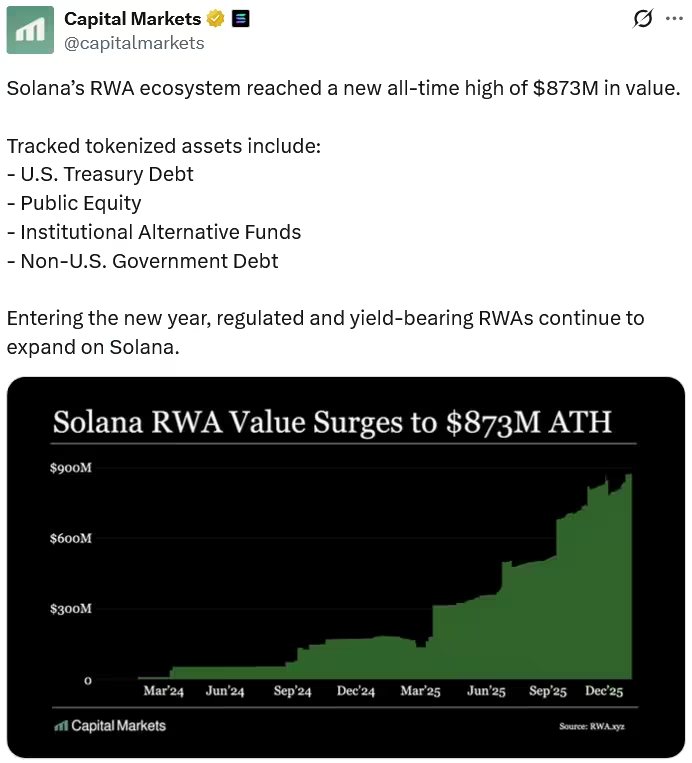
Solana ended the year gaining traction beyond its memecoin and retail reputation, posting record activity in real-world asset (RWA) tokenization and drawing institutional interest via new Solana ETFs. On-chain data from RWA.xyz shows tokenized RWAs on Solana climbed nearly 10% in December to a new high of $873.3 million, while the number of RWA token holders on the network rose more than 18.4% to 126,236.
Dominant asset types and tokenized funds
The bulk of Solana's RWA inventory is tied to US Treasuries, led by large institutional liquidity vehicles such as the BlackRock USD Institutional Digital Liquidity Fund and the Ondo US Dollar Yield, with market caps of about $255.4 million and $175.8 million respectively. Tokenized stocks are also appearing on Solana, with Tesla xStock and Nvidia xStock reaching approximately $48.3 million and $17.6 million. Institutional funds continue to be wrapped and issued on the chain, expanding Solana's tokenization use cases.
How tokenization and regulation could lift SOL in 2026
Crypto asset manager Bitwise suggested Solana could reach a fresh all-time high in 2026 if the US enacts market-structure reforms such as the CLARITY Act. The firm expects tokenization and stablecoin growth to be major, long-term trends that will disproportionately benefit high-throughput blockchains. Bitwise explicitly named Ethereum and Solana as likely primary beneficiaries of expanding tokenized real-world assets and stablecoin infrastructure.
Why the CLARITY Act matters
Regulatory clarity around tokenized securities and market structure would reduce friction for institutional issuers and custodians. If the CLARITY Act or similar legislation eases on-chain tokenization and trading rules, issuers may accelerate deploying tokenized funds and debt instruments — a tailwind for blockchains with low fees and high throughput like Solana.
ETF inflows, institutional partnerships, and remittances
Solana's institutional narrative strengthened in late 2025 when the US Securities and Exchange Commission approved the first tranche of spot Solana exchange-traded funds. Those products have seen combined inflows of roughly $765 million, according to Farside Investors, reinforcing demand for SOL from institutional channels.
In another major win for adoption, Western Union selected Solana to build a stablecoin settlement platform to serve over 150 million customers across more than 200 countries and territories. The remittance rollout is expected in the first half of 2026 and could materially boost on-chain payment volume and stablecoin utility on Solana's network.
SOL price context and market positioning
SOL started 2026 trading near $125, below its 2025 starting price of about $190 and still more than 57% below the all-time high near $293 set on Jan. 19, 2025. While Bitcoin and Ethereum have traded closer to their peaks, Solana's growing RWA supply, ETF inflows, and enterprise use cases present a narrative for renewed upside if institutional demand continues to rise.
On-chain health: app revenue and network fundamentals
Solana led all chains in application revenue over the most recent 30-day window, generating over $110 million in app fees — outpacing second-place Hyperliquid at $61.1 million and nearly doubling Ethereum's $47.2 million, per DeFiLlama. That revenue performance suggests the network can produce meaningful economic activity even when speculative memecoin volume cools, strengthening Solana's case as infrastructure for tokenization and payments.
.avif)
Blockchains by app revenue over the last 30 days.
Outlook for 2026
Solana's mixture of growing RWA totals, ETF inflows, high app revenue, and enterprise partnerships positions it as one of the most compelling chains for real-world asset tokenization and institutional payments in 2026. Key catalysts to watch include regulatory developments like the CLARITY Act, further adoption from global remittance and financial firms, and continued issuance of tokenized funds and securities. If those trends accelerate, SOL could see renewed upward momentum as tokenized assets and stablecoins scale on-chain.

Discussion
Leave a Comment