
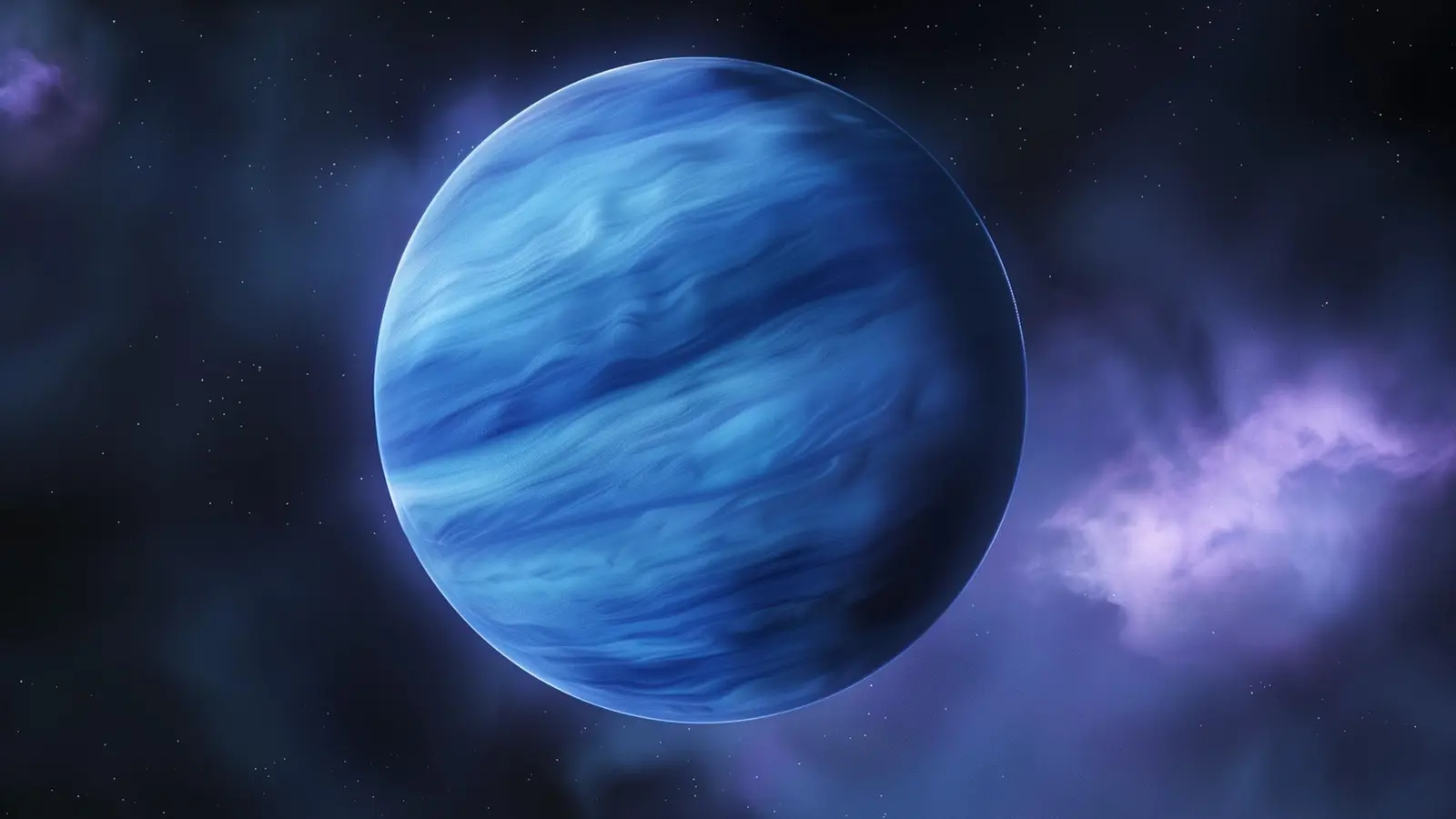
Astronomers have for the first time measured the mass and distance of a solitary, Saturn-sized planet roaming the Milky Way. The discovery relied on a rare, simultaneous microlensing observation from Earth and space that let researchers pin down properties usually lost in a fleeting gravitational flash.
How they weighed a wandering world
Most planets stay bound to a host star, but a growing catalog of so-called free-floating or rogue planets travels between the stars with no visible sunlight of their own. Because these objects are cold and faint, astronomers normally detect them only when their gravity briefly magnifies the light of a distant background star — an effect called gravitational microlensing. Microlensing events are short and subtle, and from a single viewpoint they usually fail to reveal the planet's distance and therefore its mass.
In this case, a team led by Subo Dong combined data from multiple ground-based surveys with observations from the Gaia space telescope. The same microlensing flash reached observers at different locations at slightly different times. Those tiny timing and geometry offsets — the microlensing parallax — allowed the team to solve the degeneracy that typically leaves mass estimates uncertain. By pairing the parallax with finite-source point-lens modeling, they derived both the planet's mass and its location in the Galaxy.
Key measurements and instruments
- Microlensing detections from ground surveys provided the initial light-curve signature.
- Gaia's space-based vantage point supplied the necessary parallax baseline.
- Modeling combined event duration, peak magnification, and source-size effects to estimate mass and distance.

A lonely Saturn and what it implies
The object has roughly 22 percent of Jupiter's mass — comparable to Saturn — and sits about 3,000 parsecs from the Galactic center. That mass range strongly suggests the planet formed in a protoplanetary disk around a star rather than by direct collapse like a brown dwarf. The most plausible origin scenarios involve dynamical ejection: gravitational encounters with sibling planets, or perturbations from a passing star or unstable stellar companion, can hurl a planet out of its birth system and into interstellar space.
Finding low-mass rogue planets helps answer broader questions about planetary system evolution. How common are violent instabilities that eject planets? Do most stars produce such wanderers early in their lives? This detection supports theories that low-mass free floaters are remnants of normal planetary systems, not failed stars, and it offers a direct constraint on how frequently systems reorganize catastrophically.
Gavin Coleman, writing in a related Perspective, emphasized the value of combined ground- and space-based microlensing: he noted that simultaneous observations can refine mission planning and expand our understanding of planet formation across the Galaxy.
Looking ahead: surveys and the Roman Space Telescope
Although relatively few free-floating planets have been confirmed so far, the discovery rate is expected to climb. NASA's Nancy Grace Roman Space Telescope, due to begin its microlensing survey campaign in the late 2020s, will monitor dense star fields with wide-field infrared imaging and is optimized to catch short, faint microlensing events. When Roman's data are coordinated with ground telescopes and astrometric satellites like Gaia, astronomers will have more opportunities to measure parallax and pin down masses and distances for many more rogue planets.
Beyond census-building, precise measurements of mass and space density will inform models of planet formation and migration, and help quantify the contribution of ejected worlds to the Galaxy's planetary inventory. Instruments and techniques developed for these campaigns will also refine our ability to detect smaller, Earth- to Neptune-mass free floaters, should they exist in large numbers.
Expert Insight
Dr. Elena Marquez, an observational astrophysicist familiar with microlensing surveys, commented: 'This kind of parallax measurement is a game-changer. It turns a fleeting brightness spike into a physical measurement of mass and distance. With Roman and coordinated ground follow-up, we'll move from hopeful detections to a statistical census of rogue planets.'
As observational networks mature, the Galaxy's population of lonely worlds will come into sharper focus — and each new measurement will refine our picture of how planetary systems live, quarrel, and sometimes eject members into the dark between the stars.

“The cosmos has always fascinated me. I write about space missions, astronomy, and the technologies pushing humanity beyond Earth.”

Discussion
Leave a Comment