
New observations from NASA’s James Webb Space Telescope (JWST) reveal compelling evidence that the ultra-hot super-Earth TOI-561 b — a rocky world so close to its star it completes a year in just over ten hours — is enveloped in a substantial atmosphere. The discovery challenges long-held assumptions about how small, intensely irradiated planets lose volatiles and reshapes our view of rocky exoplanets orbiting old, metal-poor stars.
.avif)
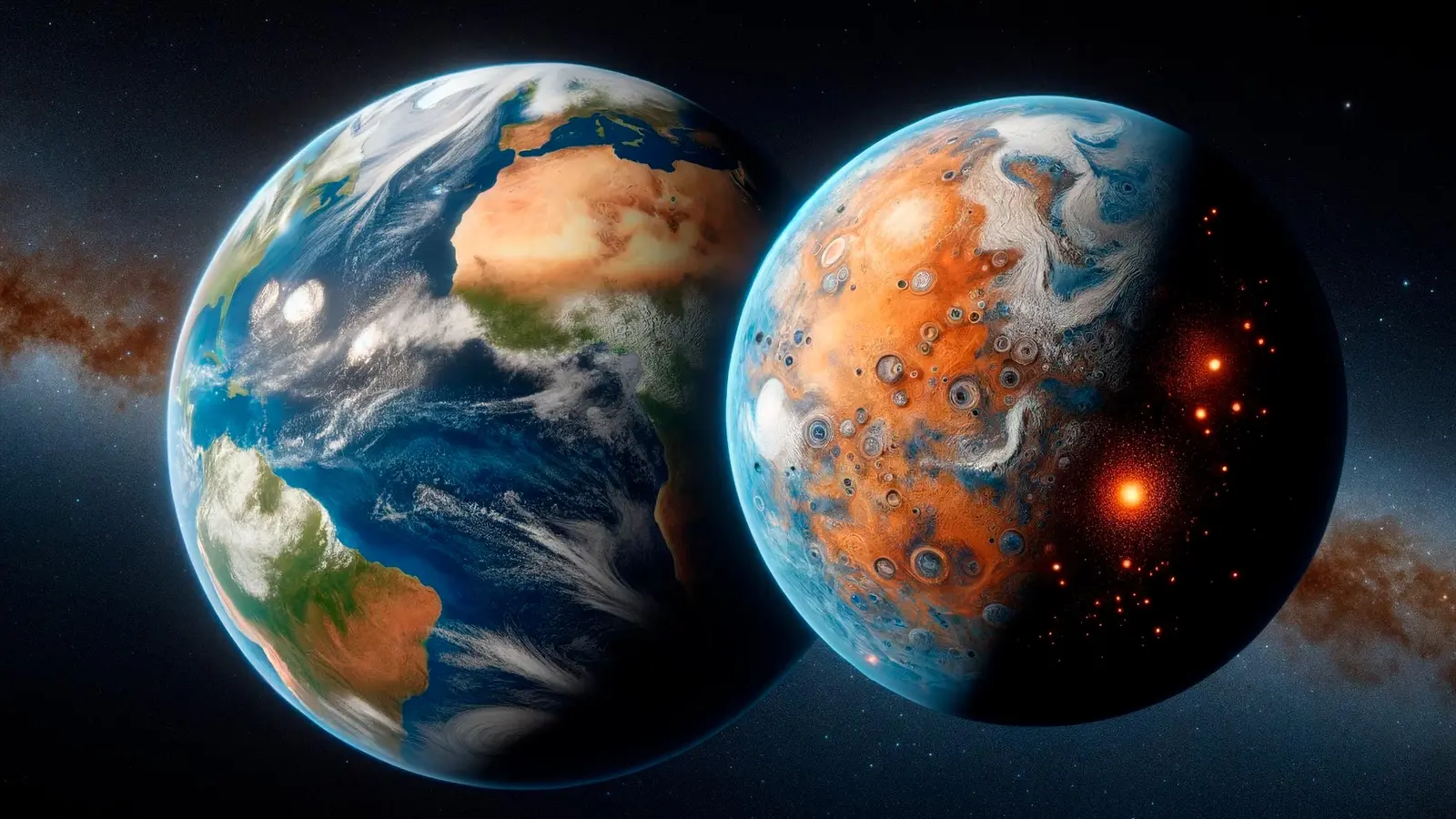
This artist’s concept shows what a thick atmosphere above a vast magma ocean on exoplanet TOI-561 b could look like. Measurements of light captured from the planet’s dayside by NASA’s James Webb Space Telescope suggest that in spite of the intense radiation it receives from its star, TOI-561 b is not a bare rock.
Why TOI-561 b is unexpected
TOI-561 b is no ordinary rocky planet. At roughly twice Earth’s mass, it sits in the “super-Earth” category, but its environment is extreme: it orbits a star slightly smaller and cooler than the Sun at just one-fortieth the distance from Mercury to our star. That tight orbit yields a blistering orbital period of 10.56 hours and forces one hemisphere into perpetual daylight. In such a regime, standard planetary evolution models predict efficient stripping of primordial atmospheres by stellar radiation and winds, leaving behind bare, molten or solid rock.
Yet new JWST NIRSpec measurements of the planet’s dayside emission indicate something different. If TOI-561 b were a bare rock with no atmosphere to redistribute heat, its dayside temperature should approach about 4,900°F (≈2,700°C). Instead, the telescope records a much cooler apparent dayside brightness closer to 3,200°F (≈1,800°C). That discrepancy points to a mechanism cooling the dayside — most plausibly a thick, volatile-rich atmosphere transporting heat to the nightside and absorbing or scattering infrared light before it escapes to space.
How the Webb observations were made
The team used JWST’s Near-Infrared Spectrograph (NIRSpec) to capture an emission spectrum across 3–5 micron wavelengths while the planet moved behind its star — a technique called a secondary eclipse. By measuring how the combined light of the star-plus-planet drops when the planet disappears, astronomers can isolate the planet’s thermal emission and infer temperatures and spectral features of its atmosphere or surface.
.avif)
An emission spectrum captured by NIRSpec (the Near-Infrared Spectrograph) on NASA’s James Webb Space Telescope in May 2024 shows the brightness of different wavelengths of 3- to 5-micron light coming from the ultra-hot super-Earth exoplanet TOI-561 b. Comparisons of the data to theoretical models suggest that the planet is not a bare rock, but is instead surrounded by a volatile-rich atmosphere.
Observations were intensive and precise: as part of JWST General Observers Program 3860, the team monitored the system continuously for over 37 hours so that TOI-561 b completed nearly four full orbits. That extended coverage helped the researchers measure the dayside brightness reliably and begin mapping thermal properties around the planet.
Interpreting the data: atmosphere, magma, and clouds
Several physical explanations were considered. A molten surface — a global magma ocean — could redistribute heat via convection, and a thin rock-vapor layer above the lava could modify the observed emission. However, model comparisons show these effects alone are unlikely to produce the observed cooling of the dayside to the degree measured.
Instead, the data are best explained by a thick, volatile-rich atmosphere. Such an atmosphere would transport heat through strong winds to the nightside, reducing the dayside temperature. Molecular species like water vapor, if present, would also absorb specific near-infrared wavelengths emitted by the hot surface before the photons traverse the entire atmospheric column, making the planet appear cooler to JWST detectors. The presence of bright silicate clouds is another plausible factor: clouds composed of rock-forming minerals can reflect starlight and change the outgoing thermal emission, further cooling measured brightness.
"We really need a thick volatile-rich atmosphere to explain all the observations," said co-author Anjali Piette (University of Birmingham). Piette highlights that both absorption by gases and cloud scattering could contribute to the spectrum’s shape and the reduced apparent temperature.
Composition clues from density and stellar chemistry
TOI-561 b’s bulk density is another puzzle. Although classified as rocky, it is less dense than an Earth-like composition would predict. Two leading explanations are:
- a relatively small iron core combined with a mantle composed of lower-density rock; or
- a substantial gaseous envelope that increases the planet’s measured radius, lowering bulk density estimates derived from mass and radius.
Both options are linked to the planet’s formation environment. The host star is twice the Sun’s age and belongs to the Milky Way’s thick disk, with an iron-poor chemical signature. Planets that coalesced in that ancient, chemically distinct region of the galaxy could inherit compositions unlike those familiar from our Solar System. "TOI-561 b must have formed in a very different chemical environment from the planets in our own system," notes Johanna Teske, lead author and Carnegie Earth and Planets Laboratory researcher. That environment could yield rock types and volatile budgets that permit a lower-density interior or supply the elements necessary to sustain an atmosphere today.
How can an atmosphere survive so long?
One of the most intriguing questions raised by this discovery is how any atmosphere can persist on such a small, intensely irradiated world, especially when the star is ancient. The team proposes a dynamic equilibrium between the magma ocean and the atmosphere: as volatiles evaporate from molten rock and replenish the atmosphere, the magma can also sequester gases back into the interior. This continual exchange could slow net atmospheric loss to space and maintain a steady, albeit escaping, envelope over geological timescales.
"This planet must be much, much more volatile-rich than Earth to explain the observations," says Tim Lichtenberg (University of Groningen), part of the AEThER (Atmospheric Empirical Theoretical and Experimental Research) collaboration. "It’s really like a wet lava ball." That evocative image captures the idea of a continuous coupling: the planet’s surface feeds the atmosphere, which carries heat and partially shields the surface even as some gases are stripped away.
Broader implications for exoplanet science
If confirmed, TOI-561 b’s atmosphere would be the clearest detection yet of a substantial gaseous envelope around a rocky exoplanet beyond our Solar System. The result challenges simple narratives that ultra-short-period planets must inevitably become bare rocks and suggests a more complex set of outcomes governed by formation chemistry, interior structure, and ongoing surface-atmosphere exchange.
These findings also expand the kinds of worlds JWST can characterize. While much attention has focused on temperate, potentially habitable rocky planets or gas-rich mini-Neptunes, TOI-561 b exemplifies hot, extreme end-member cases where high-temperature chemistry, magma oceans, and refractory clouds shape observables. Each of these processes leaves spectral fingerprints that next-generation observations can disentangle.
Next steps and future observations
The research team is now mining the full JWST dataset to produce a thermal map around the planet and to constrain the atmospheric composition more tightly. Additional eclipse observations, phase-curve monitoring that follows brightness changes across an orbit, and comparisons across different JWST modes can help identify molecular absorbers (water, silicates, metal oxides) and clouds. Ground-based follow-up, along with theoretical work on magma-atmosphere chemistry, will refine models of volatile loss and retention.
Carnegie scientists leading the project emphasize that this is a starting point: the initial NIRSpec results open new questions even as they provide a surprising answer. Michael Walter, director of the Earth and Planets Laboratory, framed the work as part of a continuum; Carnegie teams have been involved with JWST science from the mission’s earliest planning through the current observing cycles, and many more discoveries are expected.
Expert Insight
"Findings like this force us to rethink the end-states of rocky planet evolution," says Dr. Elena Ruiz, a planetary scientist not on the paper. "We used to draw fairly direct lines: high irradiation means efficient atmosphere loss. But when you have an active surface, magma-atmosphere exchange and refractory clouds, the picture becomes richer. Webb gives us the spectral sensitivity to start teasing apart those processes, and TOI-561 b looks like a textbook case for studying high-temperature atmospheres and surface chemistry."
Dr. Ruiz emphasizes that future modeling work must couple interior dynamics, surface vaporization, and atmospheric escape to predict observables accurately. "Only by linking those systems can we understand whether TOI-561 b is an anomaly or a previously invisible class of surviving atmospheres."
Conclusion
JWST’s detection of a cooler-than-expected dayside on TOI-561 b points strongly to a thick, volatile-rich atmosphere atop a global magma ocean — a surprising discovery for an ancient super-Earth in an extreme orbit. The result challenges simplistic models of atmospheric loss on small, hot planets and highlights the role of formation environment and interior composition. Continued JWST observations and theoretical work will be crucial to decode the atmosphere’s composition, persistence mechanisms, and implications for planet formation across the galaxy.
.avif)
This artist’s concept shows what the ultra-hot super-Earth exoplanet TOI-561 b could look like based on observations from NASA’s James Webb Space Telescope and other observatories. Webb data suggests that the planet is surrounded by a thick atmosphere above a global magma ocean.

“My work centers on sustainability, energy, and environmental science — examining how innovation can lead to a greener future.”

Discussion
Leave a Comment