
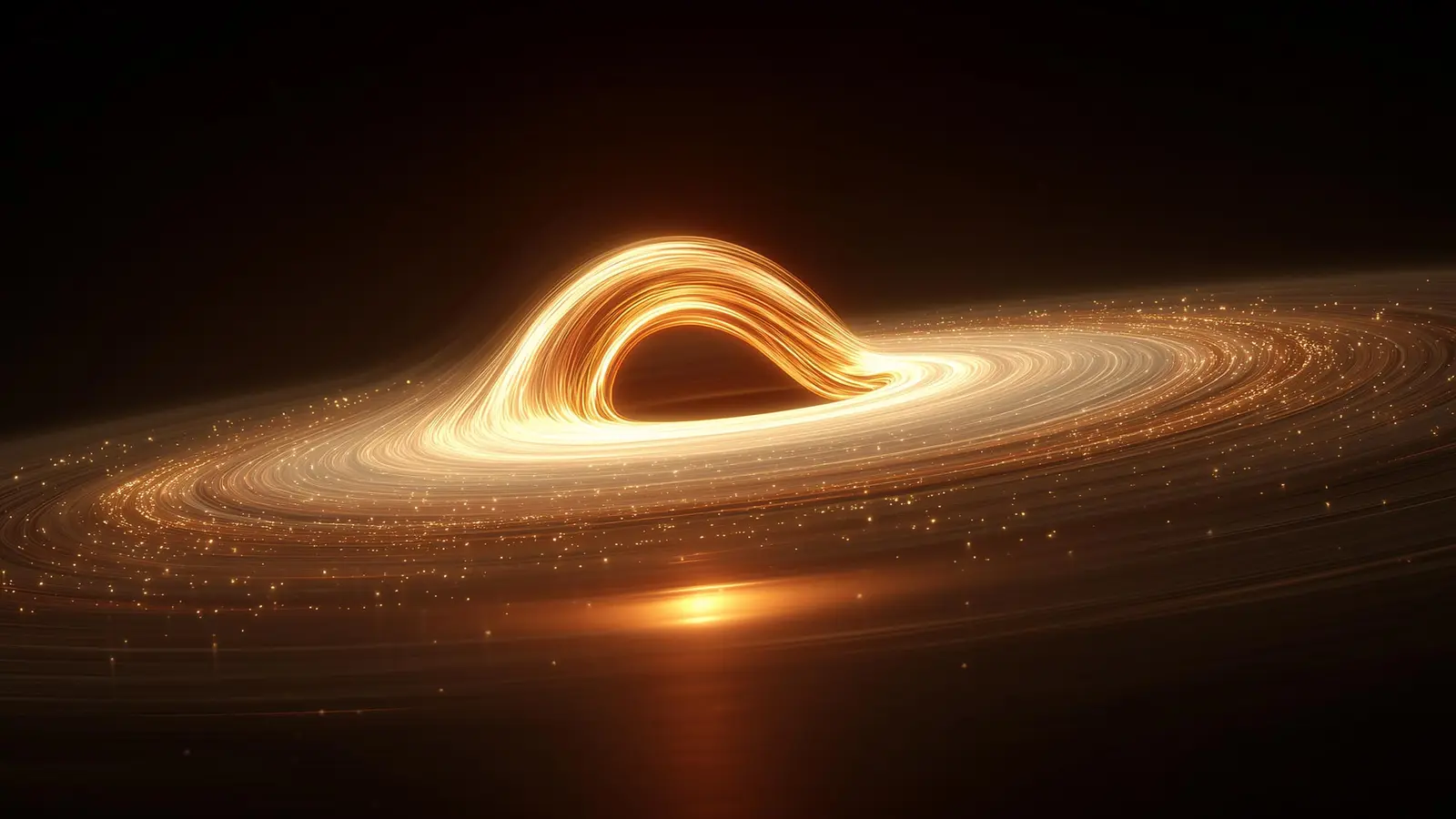
Astronomers have, for the first time, caught a fast-spinning black hole literally twisting the fabric of spacetime around it. The signal emerged while scientists watched a star be shredded and its debris form a luminous, rapidly rotating disk and narrow jets that began to wobble in a coordinated rhythm.
Observation and discovery: a wobbling disk and jet
The event, labeled AT2020afhd, is a tidal disruption event (TDE) — a rare circumstance in which a star wanders too close to a supermassive black hole and is torn apart by tidal forces. As the star’s material falls inward, it forms an accretion disk around the black hole and, in some cases, launches relativistic jets. For AT2020afhd, astronomers detected repeating modulations in both X-ray and radio emission with a roughly 20-day cycle, a clear signature that both the inner disk and emerging jet were precessing together.
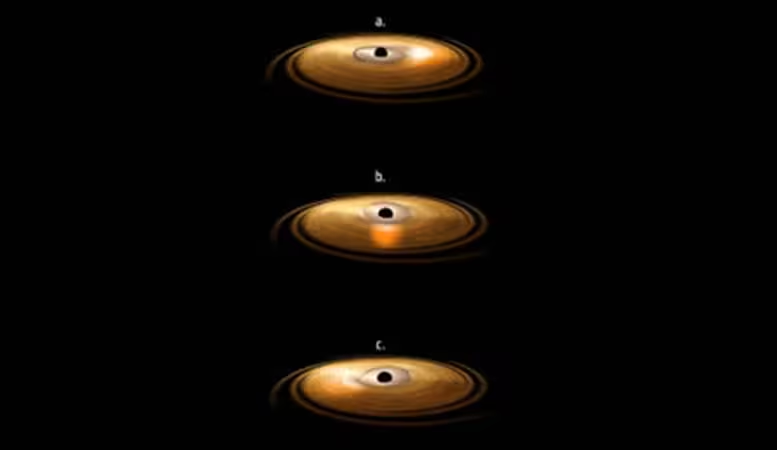
An artist’s impression depicts the accretion disc surrounding a black hole, in which the inner region of the disc wobbles. In this context, the wobble refers to the orbit of material surrounding the black hole changing orientation around the central object.
How the wobble was measured
Scientists combined X-ray observations from the Neil Gehrels Swift Observatory (Swift) with radio monitoring from the Karl G. Jansky Very Large Array (VLA). The X-ray light curve showed periodic changes in intensity, matched by short-term variations in the radio flux. Spectroscopic analysis of the electromagnetic emission helped map the physical properties of the debris and confirmed the geometry expected from a misaligned, precessing accretion flow.
- Instruments: Swift (X-ray), VLA (radio)
- Event type: Tidal disruption event (AT2020afhd)
- Observed period: ~20 days repeating modulation
What frame-dragging is — and why this matters
The observed wobble is best explained by Lense-Thirring precession, commonly called frame-dragging. In Einstein’s general relativity, a rotating mass — especially an extreme mass like a spinning black hole — drags spacetime around with it. Imagine a spinning top in honey: as it turns, nearby fluid is pulled and twisted. A rotating black hole produces a gravitomagnetic effect that forces nearby orbits to precess, changing their orientation over time.
This phenomenon was predicted more than a century ago: Einstein sketched the idea around 1913, and Josef Lense and Hans Thirring formalized it in 1918. Directly observing Lense-Thirring precession near a black hole has been difficult because the effect is subtle and requires a specific geometry — a misaligned disk and a bright, well-monitored TDE are ideal.
Confirming frame-dragging in AT2020afhd provides multiple scientific gains: it directly measures aspects of black hole spin, reveals how accretion disks respond when their angular momentum is not aligned with the hole, and sheds light on jet-launching physics. The coordinated wobble of disk and jet also gives a new observable to test models of relativistic accretion and black hole magnetohydrodynamics.
Instruments and methodology
The research was led by the National Astronomical Observatories of the Chinese Academy of Sciences with contributions from Cardiff University and other institutions. Teams analyzed high-cadence X-ray data to extract periodicities and compared them with multi-frequency radio monitoring. Electromagnetic spectroscopy was used to identify emission lines and continuum properties, constraining the density, velocity, and orientation of the disrupted stellar debris.
Because radio emission from previous TDEs often appears steady, the short-term variability observed in AT2020afhd was especially telling. Researchers ruled out alternative explanations tied solely to changes in accretion rate or shock interactions and concluded that a precessing inner flow, driven by the rotating black hole’s frame-dragging, best fit the combined datasets.
Expert Insight
Dr. Cosimo Inserra of Cardiff University, a co-author on the study, summarized the result: "Our study shows the most compelling evidence yet of Lense-Thirring precession — a black hole dragging space time along with it in much the same way that a spinning top might drag the water around it in a whirlpool."
Dr. Maria Alvarez, a fictional but realistic astrophysicist at the Institute for Theoretical Astronomy, adds: "This detection is a milestone. By tracking the synchronized wobble of disk and jet we can probe black hole spin and the coupling between magnetic fields and accreting gas. Future TDE surveys with coordinated X-ray and radio coverage will let us measure these effects across a population of black holes."
Implications and next steps
Beyond confirming a key prediction of general relativity, this result opens practical pathways for studying black hole properties. Frame-dragging signatures can be used to estimate spin magnitude and direction, test models of jet formation, and improve simulations of relativistic accretion physics. Planned and existing facilities — from upgraded radio arrays to sensitive X-ray satellites — will expand the sample of well-observed TDEs, helping to map how common and how strong frame-dragging signals are among supermassive black holes.
In short, the detection of spacetime wobble in AT2020afhd gives astronomers a new diagnostic for the dynamics of extreme gravity — and a reminder that even century-old theoretical predictions can yield fresh empirical rewards.
Conclusion
The coordinated precession of disk and jet in AT2020afhd provides the first direct observational evidence that a spinning black hole can twist spacetime in its immediate surroundings. This observational breakthrough strengthens general relativity’s predictions on astrophysical scales and supplies a new tool to probe the spin and magneto-hydrodynamics of black holes.

“My work centers on sustainability, energy, and environmental science — examining how innovation can lead to a greener future.”

Discussion
Leave a Comment