

Measurements taken across metropolitan Tel Aviv show a clear link between daily traffic patterns and short-term changes in the atmospheric electric field near the ground. By matching electric field data with local air quality readings, researchers uncovered how rush-hour emissions briefly reshape the electrical properties of the urban atmosphere.
How city traffic tweaks the atmospheric electric field
Atmospheric electricity is a continuous, planet-spanning circuit driven largely by thunderstorm activity and the natural separation of charge between Earth's surface and the upper atmosphere. Near the ground, this circuit is measured as the Potential Gradient (PG) — a practical proxy for the atmospheric electric field. In quiet, fair-weather conditions, the PG remains relatively stable, but it is also sensitive to local factors such as humidity, weather changes and air pollution.
A team from The Hebrew University of Jerusalem deployed an electric field mill in Holon, a city in the Tel Aviv metropolitan area, and collected matched air quality and meteorological data over seven months in 2024. To minimize confounding effects, the analysis was restricted to fair weather days only, filtering out storms or rain that could otherwise dominate electrical signals.
The study tracked common urban pollutants: nitrogen oxides (NOx) from combustion, fine particulate matter (PM2.5) from exhaust and tire wear, and the secondary chemical compounds those emissions create in the atmosphere. What emerged was a reliable pattern: NOx peaks and traffic congestion during morning and evening rush hours produced an almost instantaneous change in the PG, while PM2.5 showed a similar but delayed influence.
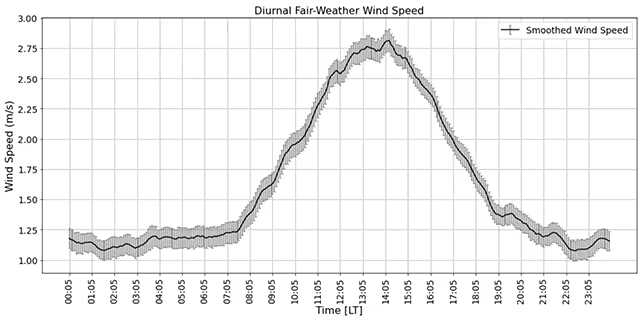
The researchers linked electric field strength with traffic rush hours
Study design and key findings
By aligning high-resolution air-quality time series with simultaneous PG measurements, the team observed two related but distinct responses. First, nitrogen oxides — chemically reactive gases emitted directly by vehicles — reduced atmospheric conductivity almost immediately by capturing atmospheric ions. When conductivity falls, the PG compensates by increasing, producing a measurable spike during traffic peaks. Roy Yaniv, one of the geoscientists on the project, summarized the result concisely: 'What we observe is a direct physical link between emission peaks and electrical variability.'
Second, PM2.5 particles were associated with PG changes that lagged by around two-and-a-half hours. This delay likely reflects differences in particle size, chemical aging in the atmosphere, and how long particles remain suspended. Smaller particles and freshly emitted aerosols behave differently from aged particulates, and those differences show up in their electrical interactions.
The dataset also revealed a pronounced weekend effect: lower traffic volumes corresponded with weaker PG anomalies, reinforcing the causal relationship between anthropogenic emissions and local electrical behavior. Importantly, authors stressed that these fluctuations are subtle and not hazardous — they are far too small to disrupt weather systems or electronic devices — but they are scientifically meaningful.
Why ions matter and what this means for monitoring
At the core of the electrical response are ions: charged molecules and small particles that carry current in air. Urban pollutants act as ion sinks. When emissions bind with these ions, atmospheric conductivity drops and the electric field near the surface strengthens to maintain the global circuit. This mechanism explains why traffic congestion, even on otherwise fair-weather days, leaves a reproducible electrical fingerprint.
One practical implication is that inexpensive electric field monitors could complement traditional air-quality networks. Because PG responds rapidly to NOx and to PM2.5 (on slightly different timescales), combining electrical measurements with gas and particle sensors offers a more complete, dynamic picture of urban pollution. That could aid public health assessments, providing additional data streams to detect episodic emission events and their timing.
Implications and future prospects
The Tel Aviv results add to a growing body of research showing that human activity alters not only chemical but also electrical properties of the lower atmosphere. For densely populated coastal regions — where Mediterranean weather patterns and urban emissions interact — integrating atmospheric electricity into air-quality studies may uncover new signals useful for epidemiology, urban planning and environmental monitoring.
Looking ahead, researchers suggest expanding long-term deployments across varied climates and urban settings, and testing how electrical measurements perform during pollution episodes like heatwaves or large-scale traffic disruptions. Paired with meteorological data and chemical speciation, PG monitoring could become a low-cost, rapid-response tool that flags pollution spikes complementary to conventional sensors.
Expert Insight
'This study is a neat demonstration of how physical and chemical processes in the urban atmosphere are intertwined,' says Dr. Mira Cohen, an atmospheric physicist not involved with the research. 'Electric field measurements don’t replace gas or particle monitors, but they can provide immediate, continuous feedback on changes in atmospheric conductivity tied to emissions. That’s valuable for both research and operational air quality networks.'
The research was published in Atmospheric Research and helps bridge atmospheric electricity studies with urban air-quality science, emphasizing the importance of interdisciplinary monitoring in populated regions where human emissions measurably shape local atmospheric behavior.

“The cosmos has always fascinated me. I write about space missions, astronomy, and the technologies pushing humanity beyond Earth.”

Discussion
Leave a Comment