
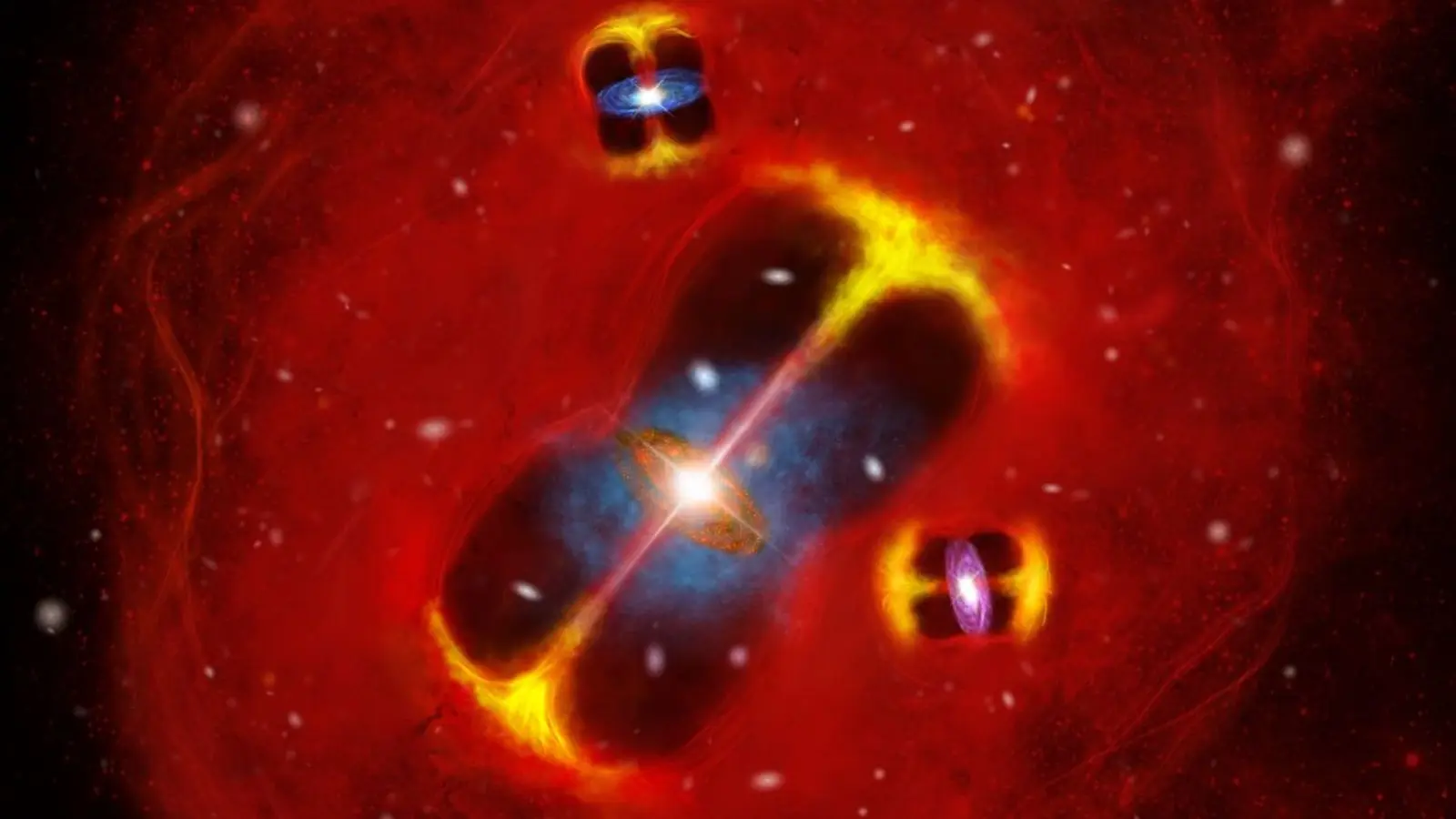
Scientists have uncovered a galaxy cluster in the early Universe whose hot gas defies current models. Observations of SPT2349-56, seen just 1.4 billion years after the Big Bang, reveal an intracluster medium dramatically hotter and more energetic than gravity alone can explain.
How a faint cosmological shadow revealed a giant anomaly
SPT2349-56 was first detected by the South Pole Telescope in 2010 and later identified as a compact, extreme cluster made of more than 30 galaxies. Follow-up observations showed furious star formation — roughly 1,000 times the Milky Way’s rate — and abundant molecular gas linking those galaxies. To probe the hot gas between the galaxies, an international team led by Dazhi Zhou used the Atacama Large Millimeter/submillimeter Array (ALMA) to measure distortions in the cosmic microwave background (CMB).
These distortions are known as the thermal Sunyaev–Zeldovich (tSZ) effect: energetic electrons in hot, diffuse gas scatter CMB photons and leave a measurable imprint, effectively casting a faint shadow on the otherwise uniform background glow. The ALMA observations returned an unmistakably strong tSZ signal from SPT2349-56, indicating temperatures in the intracluster medium above 10 million kelvin.
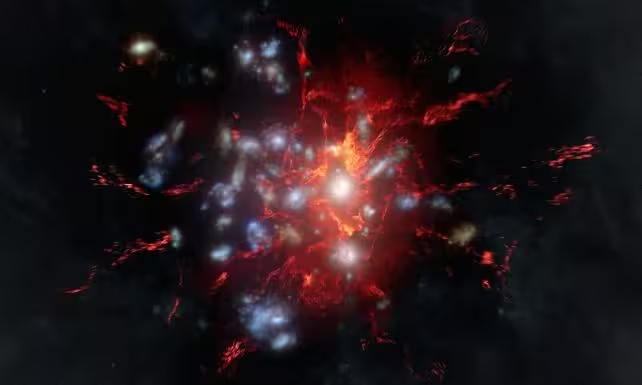
An artist's impression of molecular gas in the intracluster medium of SPT2349-56.
Why this temperature is a problem for cluster formation models
Galaxy clusters heat their gas primarily through gravitational processes: as member galaxies fall together, potential energy converts into kinetic energy and then into thermal energy. That heating is expected to be gradual, requiring several billion years to reach the regimes now detected in present-day clusters. Models tuned to the early Universe, however, cannot reproduce the extreme thermal signature observed in SPT2349-56 at just 1.4 billion years post-Big Bang.
Lead author Dazhi Zhou reported months of cross-checks after initially doubting the signal’s strength. The team’s analysis shows the intracluster gas is at least five times hotter than predicted by standard gravitational heating alone — and in some respects hotter than gas seen in many local clusters. That discrepancy points to additional, non-gravitational energy sources shaping the nascent cluster.
Possible power sources: supermassive black holes and energetic feedback
The most plausible explanation is energetic feedback from active galactic nuclei (AGN). Observations indicate SPT2349-56 likely hosts at least three supermassive black holes that are actively accreting and launching relativistic jets. Those jets can inject vast amounts of energy into the surrounding intracluster medium, heating and agitating the gas far more rapidly than gravity can.
“This tells us that something in the early Universe, likely three recently discovered supermassive black holes in the cluster, were already pumping huge amounts of energy into the surroundings and shaping the young cluster, much earlier and more strongly than we thought,” says Scott Chapman, an astrophysicist involved with the study. If confirmed, such early AGN feedback would require revisions to simulations of cluster formation and galaxy evolution.
Scientific context and broader implications
Understanding the interplay between star formation, black-hole activity, and the intracluster medium is central to mapping how the Universe’s largest structures assemble. Galaxy clusters host the most massive galaxies, and their growth histories are sensitive to heating and cooling processes in the cluster environment. If intense AGN-driven heating was common in the early Universe, it could suppress or redirect star formation in massive galaxies, alter gas accretion, and accelerate the transition of clusters from chaotic proto-clusters to the relaxed systems we see today.
Technically, these results hinge on precise measurements of the tSZ effect with ALMA, which provides the necessary sensitivity and angular resolution to isolate the signal from this dense, early system. Combined with molecular gas studies and optical/infrared spectroscopy that pinpoint redshifts and star-formation rates, researchers are assembling a clearer, if more puzzling, picture of early cluster dynamics.
Observations, instrumentation and next steps
ALMA’s detection of a strong tSZ signal in SPT2349-56 complements prior surveys like the South Pole Telescope’s wide-field mapping and follow-up imaging that revealed the cluster’s compact architecture. Future work will include deeper multiwavelength campaigns: X-ray observations could directly measure hot gas emission, radio mapping can trace jet structures from AGN, and high-resolution simulations can test whether multiple black-hole jets can produce the observed heating on short timescales.
Researchers will also search for other early clusters with comparably strong tSZ signatures. If SPT2349-56 proves unique, it may represent a rare evolutionary pathway. If similar overheated clusters are common, theoretical frameworks for structure formation will need significant revision to incorporate powerful early feedback mechanisms.
Expert Insight
“Finding gas this hot so early is like discovering a furnace in a nursery,” says Dr. Anjali Rao, a theoretical astrophysicist not on the study. “It forces us to ask whether we’ve underestimated early black-hole growth or mischaracterized how rapidly AGN can channel energy into the surrounding medium. Either answer has major consequences for models of galaxy and cluster evolution.”
Conclusion
SPT2349-56 stands as a provocative outlier: a compact, star-forming cluster whose intracluster medium is far hotter than gravity-driven models predict. ALMA’s tSZ detection points to substantial early AGN feedback as a plausible heating mechanism. Confirming and contextualizing this discovery will require coordinated observations across the electromagnetic spectrum and improved simulations that include aggressive, early non-gravitational heating processes.

“My work centers on sustainability, energy, and environmental science — examining how innovation can lead to a greener future.”

Discussion
Leave a Comment