
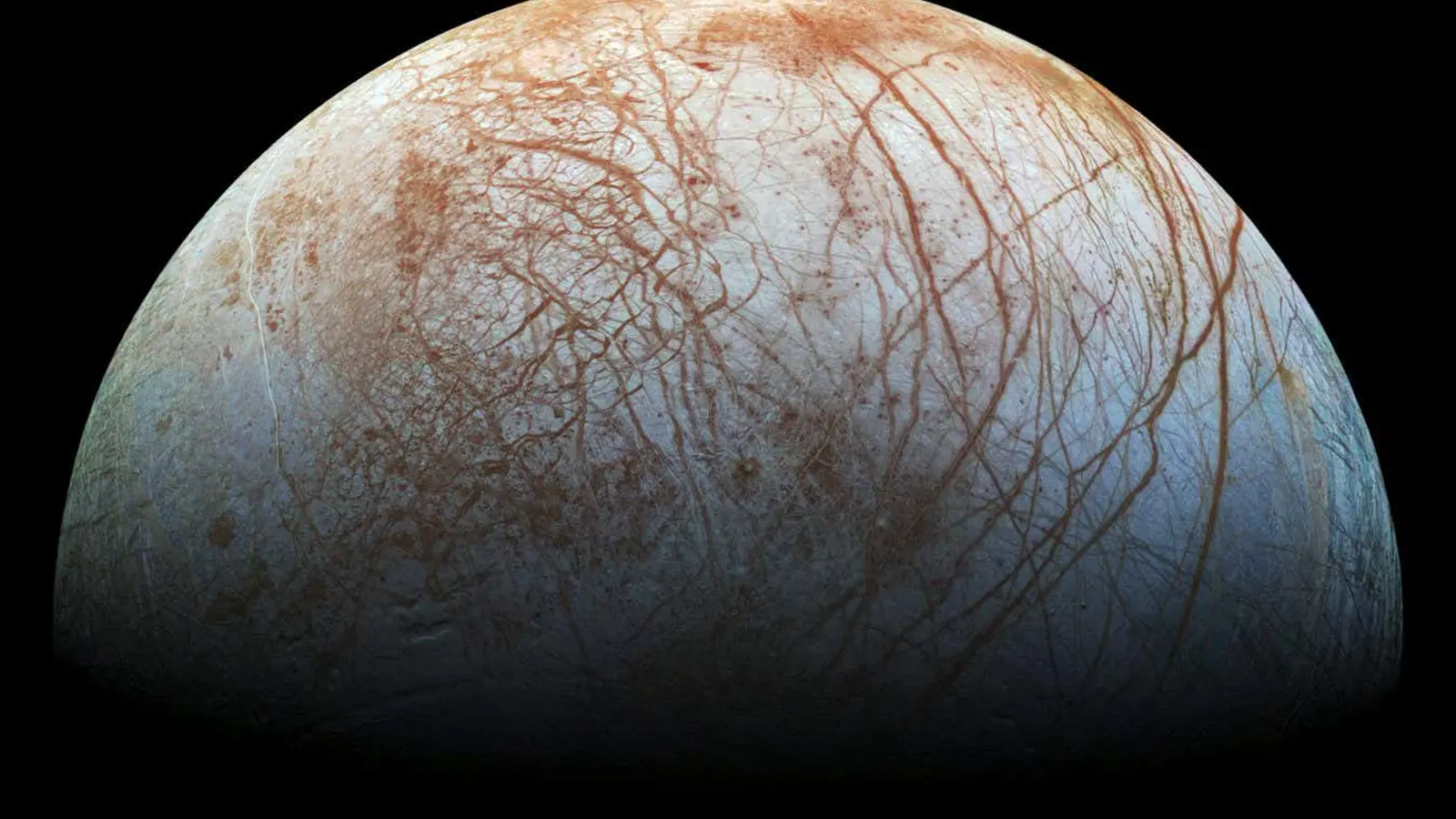
Europa, one of Jupiter's most intriguing moons, has long fueled hopes that a vast subsurface ocean could harbor life. But fresh research suggests the seafloor beneath Europa's icy shell may be remarkably inactive — and that stillness could limit the moon's capacity to sustain life as we know it.

Cutaway illustration of Europa’s icy crust, subsurface ocean, and possible vents that transport material to the surface.
A quieter seafloor than many expected
A team led by Paul Byrne, an associate professor of Earth, environmental, and planetary sciences, published a study in Nature Communications suggesting Europa's deep ocean floor may be geologically dead. Using models constrained by Europa's size, inferred rock composition, and the gravitational forces it experiences from Jupiter, the researchers conclude that the moon probably lacks ongoing tectonic churn, hydrothermal vents, and other seafloor activity commonly associated with energy sources for life.
On Earth, hydrothermal vents and active tectonics drive chemical gradients and heat flow that support rich biological communities independent of sunlight. The new study argues that Europa may not host analogous processes today. "If we could explore that ocean with a remote-control submarine, we predict we wouldn't see any new fractures, active volcanoes, or plumes of hot water on the seafloor," Byrne says. "Geologically, there's not a lot happening down there. Everything would be quiet."
How scientists reached this conclusion
The team combined several lines of evidence to assess Europa's internal activity. First, Europa's ice shell is estimated at roughly 15 to 25 kilometers thick, sitting above an ocean that could reach depths of up to 100 kilometers. Beneath that ocean lies a rocky core, likely cooled over billions of years.
Second, the researchers considered tidal heating, the process by which Jupiter's gravity flexes a moon and generates internal heat. Tidal heating is famously intense on Io, Jupiter's innermost major moon, producing extreme volcanism. Europa, however, orbits farther out with a more stable path. The result: far weaker tidal forces that may sustain a liquid ocean but are insufficient to drive vigorous seafloor volcanism or sustained hydrothermal activity.
Byrne and colleagues also compared Europa with other planetary bodies, including Earth and the Moon, and used established thermal models to estimate how quickly any primordial heat would have dissipated. Their calculations indicate that much of Europa's internal heat could have leaked away billions of years ago, leaving a relatively cold, inert core today.
Implications for the search for life
From an astrobiology perspective, energy availability is a critical factor. Life as we understand it requires not just liquid water and chemical building blocks but also a source of free energy to power metabolism. On icy worlds, seafloor hydrothermal systems are a prime candidate for that energy source. If Europa lacks modern hydrothermal vents or active tectonics, the window for life may be narrower than previously hoped.
That does not entirely rule out life. Chemical disequilibria could persist from ancient activity, and life might survive in low-energy niches or have been more abundant in the past. But Byrne emphasizes that, under present conditions, the energy budget at Europa's seafloor appears limited. "The energy just doesn't seem to be there to support life, at least today," he notes.
Missions and measurements that can test the idea
Definitive answers will have to wait for more data. NASA's Europa Clipper, slated for flybys beginning in the spring of 2031, will map Europa's surface in unprecedented detail and gather measurements of the ice shell and ocean that can test models of interior structure and tidal heating. High-resolution imaging could reveal signs of recent surface disruption or plume activity that hint at sub-ice exchanges between ocean and surface. Magnetometer and gravity field data will help constrain the thickness of the ice and the depth and conductivity of the ocean.
Even so, remote sensing can only go so far. Direct sampling of plume material or the seafloor itself — a technological and logistical leap — would be the most conclusive way to determine whether hydrothermal venting or active geology exists at Europa's base. Until then, model-based studies like Byrne's provide an essential framework for mission planning and for calibrating expectations about Europa's habitability.
Broader scientific context
Europa sits among several icy moons that interest astrobiologists, including Saturn's Enceladus and Titan. Enceladus, for instance, displays active plumes and signs of hydrothermal chemistry that make it a strong contender for hosting life-sustaining environments. The contrast highlights that not all watery worlds are identical: the interplay of composition, size, orbital dynamics, and thermal history creates a spectrum of possible interior states.
Understanding that diversity helps scientists prioritize targets and design instruments that can detect chemical disequilibria, organics, and potential biosignatures. Keywords in this research area include tidal heating, hydrothermal vents, Europa Clipper, astrobiology, and icy moons.
Expert Insight
Dr. Lina Ortega, an astrobiologist and mission planner not involved with the study, offers a measured perspective: 'This paper is an important corrective to optimism unmoored from physics. It reminds us that the presence of an ocean alone is not a guarantee of habitability. But quiet seafloors do not eliminate scientific value — they teach us about planetary evolution. Europa Clipper's data will be decisive for refining these models.'
Conclusion
Byrne and his collaborators have shifted the conversation about Europa from the simple presence of a global ocean to the finer question of whether that ocean has the energy flux needed to sustain life today. Their analysis does not close the book on Europa — instead, it clarifies what future missions must measure to settle the question. Whether Europa turns out to be a still, lifeless ocean or a hidden ecosystem, probing its depths will deepen our understanding of where and how life might emerge on icy worlds.

“My work centers on sustainability, energy, and environmental science — examining how innovation can lead to a greener future.”

Discussion
Leave a Comment