
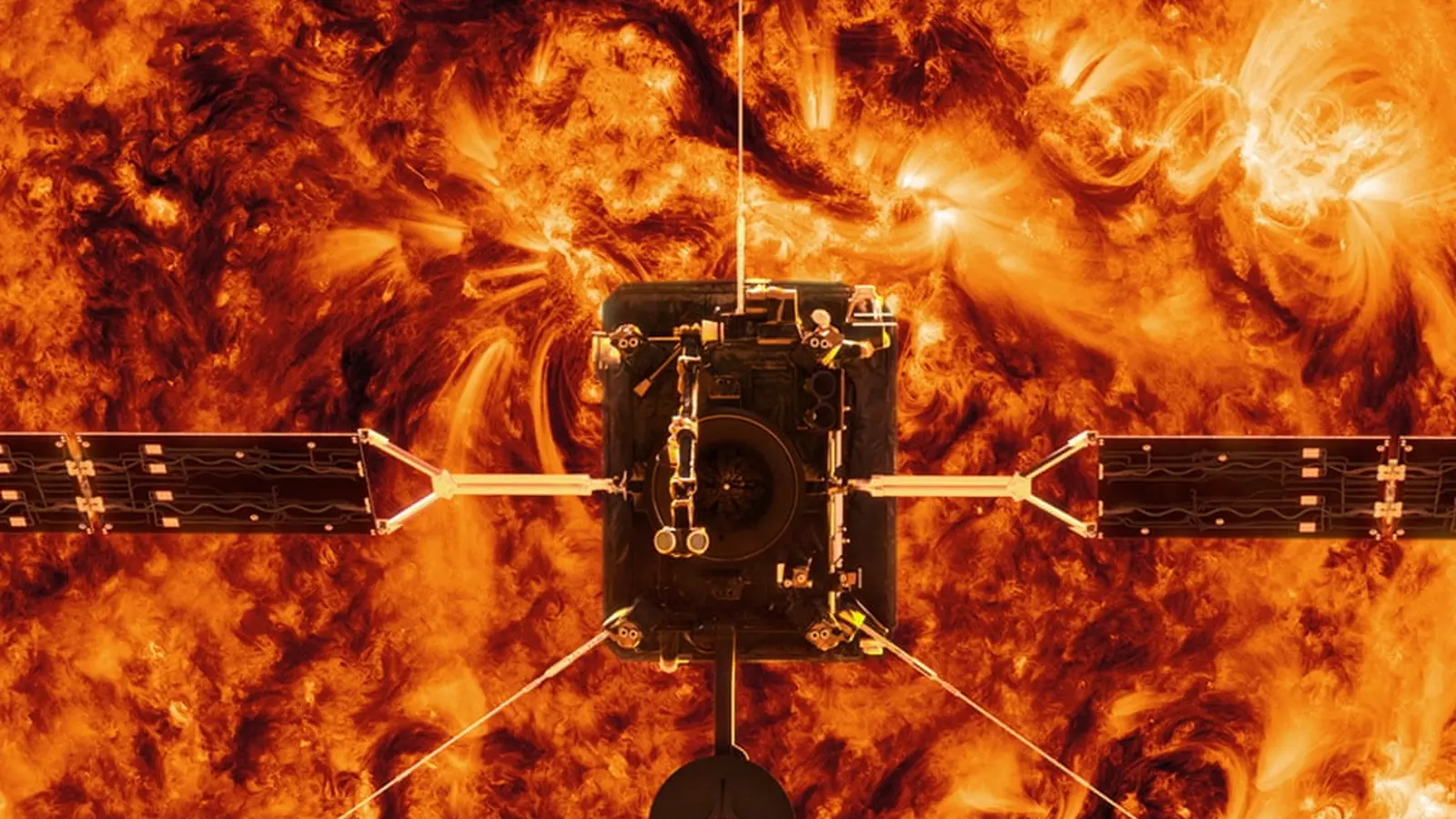
Scientists combined images from two space observatories to follow an unusually active region on the Sun for 94 days, revealing how its magnetic architecture evolved and ultimately spawned some of the most powerful space weather of recent decades.

The European space probe Solar Orbiter delivers images of the sun, including observations of what is, from our perspective, its far side.
Following NOAA 13664 across three solar rotations
Solar active regions typically stay visible from Earth for roughly two weeks before rotating to the Sun's far side for another two. That limited vantage point has long constrained our ability to observe the full life cycle of the most energetic regions. By pairing data from ESA's Solar Orbiter with continuous observations from NASA's Solar Dynamics Observatory (SDO), an international team led by researchers at ETH Zurich tracked active region NOAA 13664 for 94 days between April and July 2024 — a record-length continuous image series for a single solar region.
"Fortunately, the Solar Orbiter mission, launched by the European Space Agency (ESA) in 2020, has broadened our perspective," said Ioannis Kontogiannis, solar physicist at ETH Zurich and IRSOL in Locarno. Observing the region from multiple vantage points allowed the team to document its emergence on 16 April 2024, follow changes in magnetic complexity through successive rotations, and record its decay after 18 July 2024.
Tracing the same active region across three rotations is important because solar magnetic structures are three-dimensional and evolve over timescales longer than a single visible transit. Continuous monitoring revealed repeated episodes of flux emergence and reconfiguration that would have been missed from a single viewpoint. The dataset therefore provides an unprecedented chronology of how a superactive region grows, twists, and stores energy prior to major eruptions.
Magnetic complexity, flares and earthly impacts
Active regions form where magnetized plasma pushes through the solar surface, producing tightly tangled magnetic fields. Those fields can suddenly reconfigure and release energy as flares and coronal mass ejections (CMEs). NOAA 13664 became one of the most active regions observed in the last twenty years and produced the strongest geomagnetic storms on Earth since 2003.
"This region caused the spectacular aurora borealis that was visible as far south as Switzerland," said Louise Harra, professor at ETH Zurich and director of the Davos Physical Meteorological Observatory. Beyond bright skies, these eruptions can disrupt modern infrastructure: power grids, satellite operations, aviation radiation exposure, and precision navigation systems are all vulnerable. The team notes real-world impacts in May 2024 — from disrupted agricultural drones and sensors to communication outages — underscoring how solar activity affects delicate high-tech systems.
One stark example from another event: in February 2022, many recently launched satellites in low Earth orbit suffered damage or loss after a storm increased atmospheric drag. That incident, together with the disruptions caused by NOAA 13664, highlights why understanding magnetic complexity and eruption triggers matters for both industry and public safety.
What the observations revealed about eruption mechanics
By following NOAA 13664 over months, researchers observed successive injections of magnetic flux and a progressive build-up of twisted, interlaced field lines. These repeated episodes increased the region's magnetic complexity until it produced the largest flare observed on the Sun's far side on 20 May 2024. While the study shows that complex, braided magnetic structures are correlated with energetic eruptions, it also emphasizes the limits of current forecasting: the timing and magnitude of future eruptions remain hard to predict precisely.
"This is the longest continuous series of images ever created for a single active region: it’s a milestone in solar physics," Kontogiannis said. The record offers new constraints for models of magnetic energy storage and release, improving our physical understanding even when deterministic forecasting is not yet possible.
Advancing space weather forecasting and future missions
Long-duration, multi-vantage observations like these feed improved models of how active regions evolve and how their eruptions propagate through the heliosphere. Better models can refine space weather forecasts, giving utilities, satellite operators, airlines, and farmers more lead time to mitigate impacts.
Researchers are also developing dedicated missions to bridge remaining gaps. Harra noted ongoing work on ESA's planned Vigil mission, designed to provide continuous monitoring of the Sun-Earth line and improve early warning for Earth-directed eruptions. Vigil is scheduled for launch in the early 2030s and will complement instruments like Solar Orbiter and SDO by supplying targeted data for operational space weather services.
Expert Insight
"Being able to watch the same active region as it rotates away and returns changed how we link surface magnetic evolution to eruptive outcomes," said Dr. Maya Chen, a heliophysics researcher at the Center for Solar-Terrestrial Research (fictional affiliation). "These observations let us test, refine, and discard models much more quickly — and that accelerates progress toward practical space weather forecasts that protect infrastructure and human activity."
Conclusion
The 94-day tracking of NOAA 13664 demonstrates the scientific payoff of coordinated, multi-spacecraft observations. It offers a clearer picture of how complex magnetic systems mature and release energy, and it provides a data-rich foundation for better space weather prediction. As new missions like Vigil come online, observations of this quality should become more routine — and our ability to anticipate solar-driven disruptions will steadily improve.

“The cosmos has always fascinated me. I write about space missions, astronomy, and the technologies pushing humanity beyond Earth.”

Discussion
Leave a Comment