
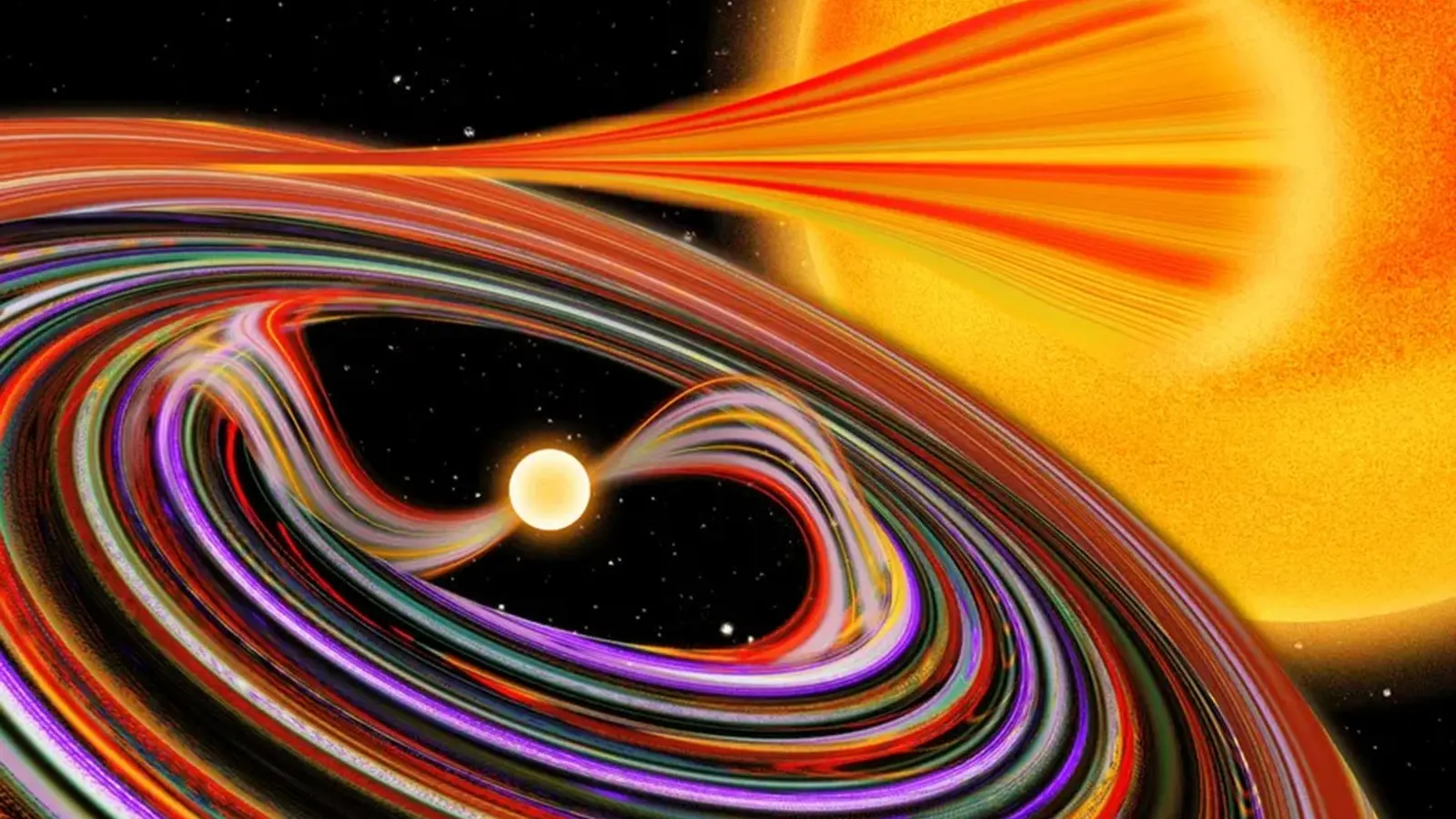
NASA’s Imaging X-ray Polarization Explorer (IXPE) has given astronomers a new way to map the violent environment around a white dwarf. By measuring X-ray polarization, IXPE probed the geometry and physics of the binary system EX Hydrae, revealing how stolen gas behaves under the twin forces of gravity and magnetism.
How X-ray polarimetry opened a new window on accretion
EX Hydrae sits about 200 light-years away in the constellation Hydra and belongs to a class of binary systems where a compact white dwarf siphons gas from a companion star. That gas settles into an accretion disk but is also nudged by the white dwarf’s magnetic field. In systems known as intermediate polars, the field is strong enough to channel portions of the inflow toward the star’s magnetic poles while still allowing a disk to form.
As gas spirals inward and slams onto the white dwarf, it heats to tens of millions of degrees Fahrenheit and produces intense X-rays. These X-rays carry polarization signatures that depend on the shape and orientation of the emitting and scattering regions. IXPE’s polarimetry — a technique that measures the orientation of X-ray light waves — lets scientists infer the geometry of the accretion flow at scales far smaller than any imaging instrument can resolve directly.
Key findings from a week-long IXPE observation
IXPE observed EX Hydrae for nearly a full week in 2024. The resulting polarization measurements, reported in the Astrophysical Journal by a team led at MIT with collaborators from multiple institutions, allowed researchers to constrain the size and structure of the accretion column above the white dwarf.
Using polarization, the team estimated the accreting, X-ray–emitting column to rise roughly 2,000 miles from the white dwarf’s surface — a scale that would be impossible to image directly at 200 light-years. The data also suggest that a fraction of the observed X-rays were scattered off the white dwarf’s surface itself, a detail that helps refine models of radiative transfer and plasma behavior in strong gravity and magnetic fields.
In practical terms, IXPE’s measurements reduce the number of assumptions required to infer column height, shock structure, and where energy is dissipated in the flow. That improves our understanding not only of EX Hydrae but of other high-energy binaries where magnetic accretion shapes emission.

An artist’s illustration of the IXPE spacecraft in orbit, studying high-energy phenomena light-years from Earth.
Scientific context and broader implications
White dwarfs are the dense cores left behind when stars like the Sun exhaust their nuclear fuel. They pack roughly a Sun’s mass into a volume about the size of Earth, producing extreme surface gravities. When a white dwarf accretes matter from a companion, the interplay of gravity, magnetic fields, and high-temperature plasma creates some of the most energetic — and physically complex — processes in stellar astrophysics.
Polarimetry adds an independent observational axis: while spectroscopy tells us about temperature and motion and timing reveals variability, polarization probes geometry and scattering physics. By combining these diagnostics, scientists can better constrain the magnetic field strength and configuration, accretion rate, and where the shock forms above the stellar surface. That in turn refines models used across many contexts, from accreting neutron stars to supermassive black hole disks where analogous physics operates at different scales.
The IXPE mission, a NASA and Italian Space Agency partnership with science teams across a dozen countries, continues to expand the reach of X-ray astronomy. Mission leadership at NASA’s Marshall Space Flight Center and operations partners including BAE Systems and the University of Colorado’s Laboratory for Atmospheric and Space Physics enable sustained observations of extreme objects like EX Hydrae.
Future prospects for X-ray polarimetry
With IXPE demonstrating that polarimetry can measure features such as column height, future observations can target a broader sample of intermediate polars and other magnetic accretors. Repeated monitoring could reveal how column geometry evolves with accretion rate or how magnetic topology changes over time. Coupling IXPE data with optical, ultraviolet, and higher-energy X-ray measurements will produce more complete maps of the most energetic corners of binary star systems.
Expert Insight
"Polarimetry gives us a geometric handle on processes we previously inferred only indirectly," says Dr. Lena Ortega, an astrophysicist not involved in the IXPE team. "Measuring a column height of about 2,000 miles around a stellar remnant hundreds of light-years away is a striking example of how new techniques let us test and refine accretion physics in detail."
As IXPE continues to survey the sky, its polarimetric measurements will inform models across astrophysics, improving our ability to interpret high-energy emissions from compact objects throughout the universe.

“The cosmos has always fascinated me. I write about space missions, astronomy, and the technologies pushing humanity beyond Earth.”

Discussion
Leave a Comment