
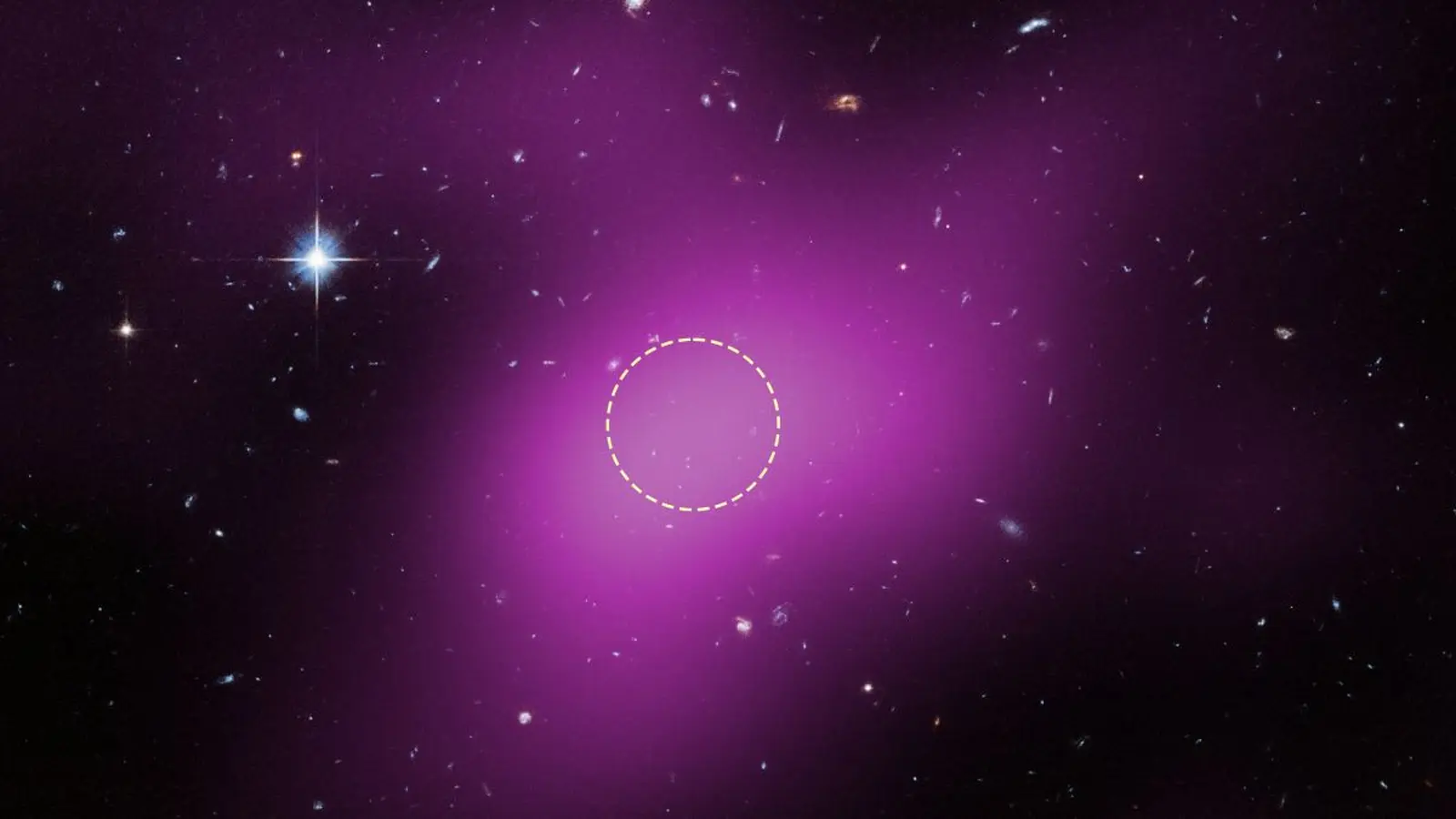
An unusual, starless object dubbed Cloud-9 has been identified roughly 14.3 million light-years away, close to the spiral galaxy M94. Observations suggest it is a dark-matter–dominated concentration of neutral hydrogen — a rare potential example of a galaxy that never ignited into a stellar system.
A ghostly cloud with no stars
Most galaxies we study are built from three basic components: stars, baryonic gas (mostly hydrogen), and an extended halo of dark matter that supplies the gravity needed to hold the system together. Cloud-9 appears to break that template — it contains a relatively compact pocket of neutral hydrogen but shows little to no starlight. That combination makes it a leading candidate for what cosmological simulations call a Reionization-Limited H I Cloud, or RELHIC.
RELHICs are predicted objects: dark-matter halos that gathered normal gas early in cosmic history but never reached the density or conditions required to start sustained star formation. The neutral hydrogen detected in Cloud-9 implies the gas is cool and self-shielded from the pervasive ultraviolet background; unlike ionized gas, neutral hydrogen emits a faint radio signal that radio telescopes can detect.
Cloud-9 is invisible in most wavelengths. Neutral hydrogen emits weak radio waves.
How Cloud-9 was discovered and measured
The object was first picked up in a neutral-hydrogen survey performed with FAST (the Five-hundred-meter Aperture Spherical Telescope) in China. The FAST detection flagged an H I source near M94 (the Cat's Eye Galaxy), prompting follow-up observations using the NSF's Green Bank Telescope (GBT) and the Karl G. Jansky Very Large Array (VLA).
These higher-resolution radio measurements revealed a roughly spherical concentration of neutral hydrogen about 4,900 light-years across, with an H I mass near one million solar masses. Crucially, the gas shows no significant rotation — a notable difference from many dwarf galaxies, which typically exhibit measurable angular momentum in their gas content.
To test for hidden starlight, the team used deep optical imaging from the Hubble Space Telescope. Hubble’s sensitivity was sufficient to detect even a faint dwarf like Leo T if it were present within Cloud-9. The result: essentially no detected starlight. The data limit any possible stellar population within Cloud-9 to, at most, a few thousand solar masses — orders of magnitude below a normal dwarf galaxy.
Mass balance and implications
For the neutral hydrogen to remain gravitationally bound without dispersing, Cloud-9 requires a dark-matter halo on the order of several billion solar masses — the team estimates roughly 5 × 10^9 solar masses. That mass-to-gas ratio places Cloud-9 firmly in the regime of dark-matter–dominated systems, consistent with the RELHIC scenario where baryons were retained but did not convert into stars.
Why Cloud-9 matters for galaxy formation and dark matter
Cloud-9 may be the clearest nearby example yet of a halo that stalled between being a pure dark-matter clump and a bona fide galaxy. Cosmological models of structure formation predict many small dark-matter halos; whether they become luminous galaxies depends on their mass, gas content, environment, and the effects of cosmic reionization. Reionization and subsequent heating of the intergalactic medium can strip or ionize gas in small halos, preventing star formation. Finding an intact, bound neutral-hydrogen cloud embedded in a massive dark halo validates aspects of those predictions.
Other candidate RELHICs have been reported, but many are ambiguous: some show faint stellar components, others are part of tidal debris or are foreground clouds. Cloud-9 is compelling because it (1) lacks detectable stars, (2) is not rotating, and (3) has a secure distance thanks to its association with M94. That combination reduces alternative explanations and strengthens the RELHIC interpretation.
Related observations and future prospects
Follow-up work will aim to refine Cloud-9’s dark-matter profile and search for any faint signatures of past star formation. Deeper imaging, ultraviolet searches for ionized gas, and higher-sensitivity radio mapping could reveal low-surface-brightness stars or subtle kinematic signatures. If Cloud-9 remains starless under even more sensitive scrutiny, it will be a rare laboratory for studying dark-matter halos unaffected by internal stellar feedback.
Telescopes such as the Square Kilometre Array (SKA) and next-generation optical surveys could discover more objects like Cloud-9, allowing statistical tests of how many halos fail to form stars and under what conditions. Those surveys would also refine constraints on dark-matter distribution on small scales — a region where different dark-matter models (cold, warm, self-interacting) predict divergent behaviors.
Expert Insight
“Cloud-9 gives us a nearby example of a halo that may have retained gas but never crossed the threshold for star formation,” says Dr. Mira Solano, an observational cosmologist at the Institute for Extragalactic Studies. “Studying such objects helps connect the dots between cosmological simulations and what we actually observe: they are the missing links between dark structure formation and luminous galaxies.”
Dr. Solano adds: “If more RELHICs are found, we can begin to map the boundary conditions where galaxy formation succeeds or fails — and that has consequences for both astrophysics and the particle physics of dark matter.”
Conclusion
Cloud-9 stands out as one of the best candidates for a failed galaxy: a dense pocket of neutral hydrogen wrapped in a massive dark-matter halo but devoid of stars. Whether it remains an eternal relic or eventually forms stars, Cloud-9 provides a rare, local example of early cosmic structure that can test theories of reionization, baryon retention, and dark-matter behavior on small scales. Ongoing and future observations will determine whether this object is unique or the first of many quietly dark halos waiting to be found.

“The cosmos has always fascinated me. I write about space missions, astronomy, and the technologies pushing humanity beyond Earth.”

Discussion
Leave a Comment