

Researchers have discovered that airborne microscopic plastics are far more abundant over major cities than previously understood, revealing an overlooked component of urban pollution with possible climate and health implications.
Scientists have uncovered shockingly high levels of microscopic plastic particles in the air over major cities, far exceeding previous estimates. The discovery suggests airborne plastics play a much bigger role in environmental and health impacts than once thought.
New measurement tools expose an invisible pollutant
Over the last two decades, microplastics (MPs) and nanoplastics (NPs) have moved from isolated curiosities to recognized global contaminants. They are now detected across the atmosphere, oceans, soils, and living organisms. Yet the atmosphere — where particles can travel long distances and enter lungs — has remained the least well‑quantified part of the global plastic cycle.
To tackle that gap, researchers at the Institute of Earth Environment, Chinese Academy of Sciences (IEECAS) developed a semi‑automated analytical workflow to detect and quantify plastic particles in air samples. The technique couples computer‑controlled scanning electron microscopy (SEM) with systematic image analysis to reduce manual bias and to reach into the nanoscale range. That means particles down to roughly 200 nanometers — near the lower limit of many traditional methods — can be identified in complex environmental matrices.

MP and NP abundances in aerosols and estimated fluxes across atmospheric compartments in semiarid (XA) and humid subtropical (GZ) urban environments.
Results from two Chinese megacities
The team tested the system in Guangzhou (humid subtropical) and Xi’an (semiarid), sampling total suspended particulates, dustfall, rain and snow, and resuspended road dust. Their semi‑automated workflow revealed concentrations of plastics in TSP and in dustfall that were two to six orders of magnitude greater than earlier counts based on visual or manual spectral identification (for example, μ‑FTIR, μ‑Raman, or hand‑scored SEM‑EDX).
Those are not small differences. Two to six orders of magnitude implies previous studies likely missed large fractions of airborne MPs and NPs — especially the smallest particles that are most mobile and biologically active. The new measurements also show huge variability in how plastics move: fluxes and concentrations differed by two to five orders of magnitude across atmospheric pathways, influenced by road dust resuspension and wet deposition patterns.
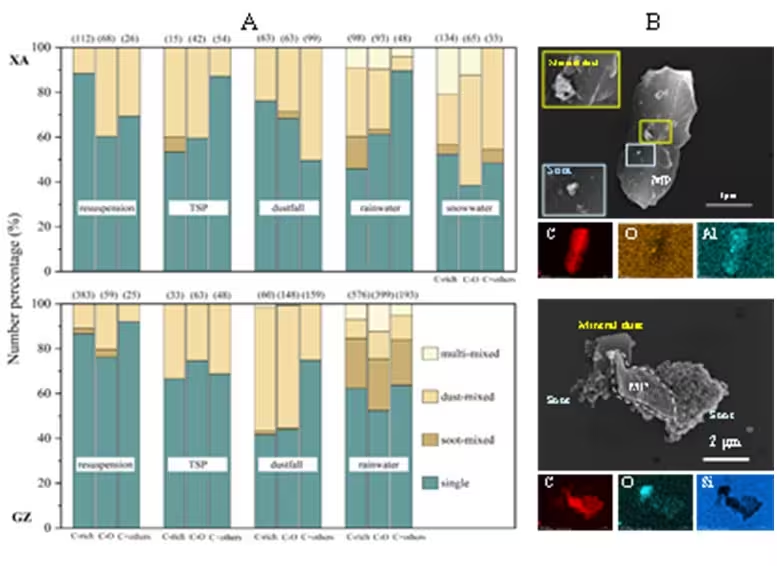
Plastic aggregate mixing states across atmospheric compartments in XA and GZ city.
Why airborne micro- and nanoplastics matter
Detecting NPs near 200 nm in real environmental samples is a milestone. Nanoplastics at these sizes can remain suspended longer, penetrate deeper into the respiratory tract, interact with clouds and aerosols, and potentially alter chemical and radiative properties of the atmosphere. Wet deposition (rain, snow) appears to clump and remove a broader mix of particle types, suggesting that precipitation helps transfer a diverse plastic load from air to land and water.
Understanding atmospheric plastics is essential for several reasons: they are a pathway for human inhalation exposure, they may affect particle formation and cloud processes, and they link urban sources to distant ecosystems. The IEECAS study, published in Science Advances on January 7, 2026, adds critical, higher‑resolution data to those debates.
Implications and next steps
More systematic measurements across seasons and regions are needed to map sources (traffic, industry, wear of materials), transport, and sinks. Standardized, automated detection approaches will help reconcile divergent estimates and feed into models of air quality, human exposure, and climate forcing. Policymakers and public health agencies will likely need to consider airborne plastics alongside particulate matter and chemical pollutants when assessing urban air risks.
As IEECAS researchers note, the discovery of a hidden plastic burden in city air does not answer every question — but it does change the scale and urgency of the problem. Better instruments, broader monitoring networks, and targeted emission controls are the logical next steps if we hope to reduce this newly visible layer of pollution.

“My work centers on sustainability, energy, and environmental science — examining how innovation can lead to a greener future.”

Discussion
Leave a Comment