
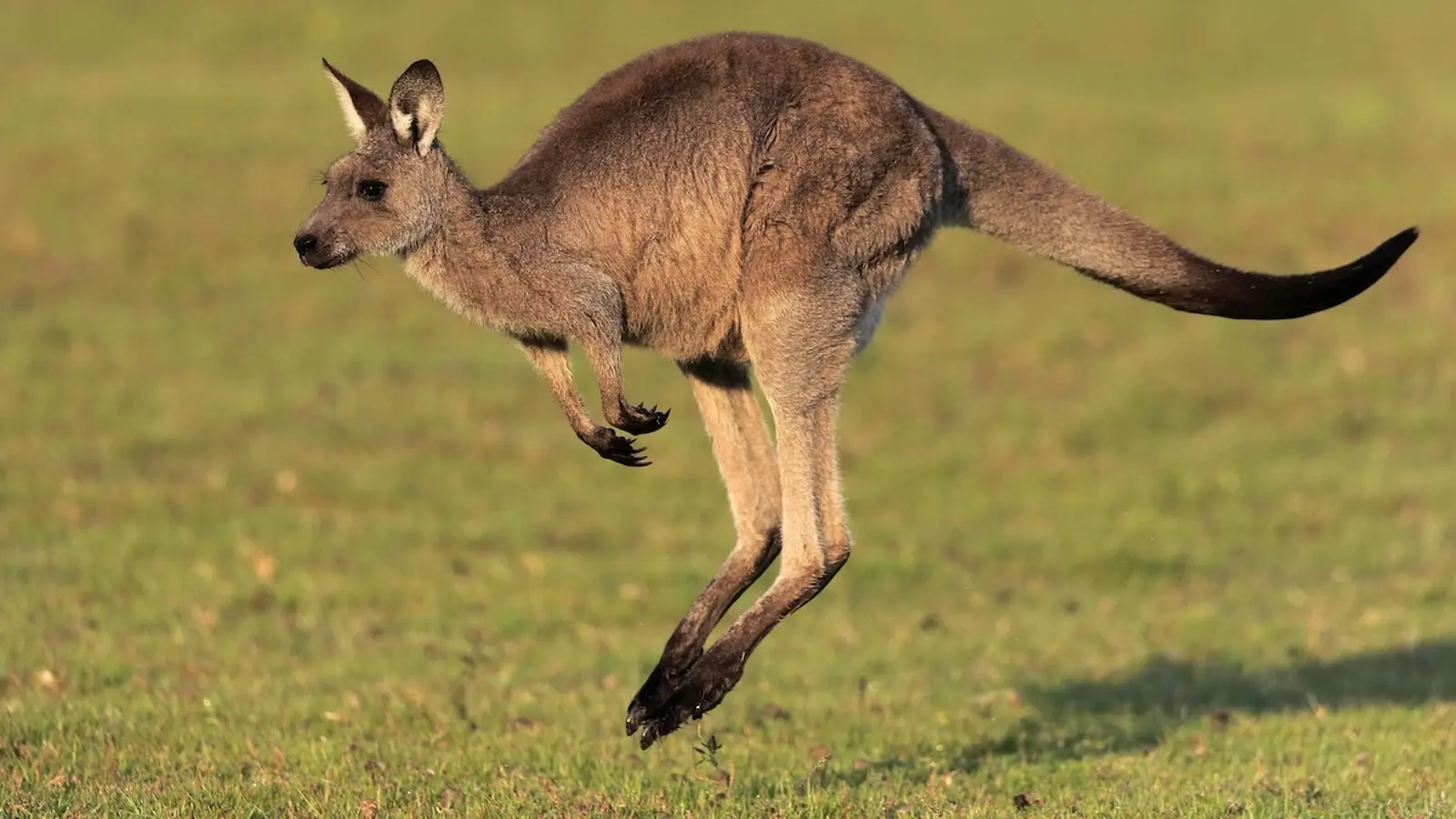
Kangaroos are almost synonymous with hopping across Australia’s open landscapes. But during the Pleistocene epoch, the continent was home to kangaroo relatives so large they could have made today’s red kangaroos look modest. For decades, many scientists suspected these heavyweight marsupials were simply too massive to hop safely. New fossil research suggests a more surprising reality: even giant kangaroos likely retained the ability to bounce—at least in brief, practical bursts.
A Pleistocene heavyweight with a modern mystery
Australia’s extinct megafauna included outsized versions of many familiar animals, and kangaroos were no exception. One of the largest known species, Procoptodon goliah, is often estimated to have reached around 2 meters in height and up to roughly 250 kilograms (about 550 pounds). Put next to a modern kangaroo that might weigh around 90 kilograms, that’s a dramatic leap in body mass.
That size created a long-standing puzzle in paleobiology: could an animal that heavy perform the high-impact mechanics of hopping without damaging its Achilles tendon or overloading its feet and ankles? Hopping in kangaroos is not just a “jump.” It is a specialized form of locomotion that stores and releases energy through elastic tendons—especially the Achilles—like biological springs. Scale that system up too far, and the forces can become punishing.
Because of this, many reconstructions proposed that giant kangaroos primarily moved with a more upright, walking gait—sometimes described as oddly human-like. The new study complicates that picture.
How scientists tested the “could it hop?” question
In a collaboration involving researchers from the University of Manchester and the University of Bristol in the UK, along with the University of Melbourne in Australia, scientists took a detailed anatomical approach rather than relying on assumptions about size alone. They compared limb bones from 63 kangaroo and wallaby species, spanning both living animals and extinct forms. The dataset included 94 modern specimens and 40 fossil specimens, giving the team a broad framework for how bone structure correlates with locomotion.
The key idea was straightforward: if giant kangaroos hopped, their skeletons should show the necessary “hardware” to handle hopping forces. Researchers used modern kangaroos as a reference to estimate how thick and wide the Achilles tendon (and related tendons) would need to be in extinct giants to tolerate the stresses of hopping. They then examined fossil heel bones to see whether the attachment points—the areas where tendons anchor—were large and robust enough to support tendons of the required size.
They also focused on the fourth metatarsal, a long foot bone that is especially vulnerable during hopping because it can bend under extreme loading. By measuring the length and diameter of these bones, the researchers evaluated whether the feet of extinct kangaroos were engineered to resist bending to the point of failure.

Strong tendons, reinforced feet—and a more flexible lifestyle
The anatomical results point in a clear direction: the extinct species examined appear to have been built to hop. Their heel bones show attachment sites compatible with large, powerful tendons. Their fourth metatarsals look sufficiently robust to withstand the bending stresses associated with hopping, implying the rest of the hindlimb was likely capable of managing high loads as well.
That does not mean these megafaunal kangaroos spent their days bounding across plains like modern kangaroos often do. Instead, the researchers suggest hopping was likely one tool in a broader “locomotor repertoire”—useful when needed rather than a constant default. In practical terms, that could mean walking most of the time, then switching to short bursts of hopping to cross rough terrain, navigate obstacles, or escape predators.
As the team notes in the study, “While hopping may not have been their primary mode of locomotion, our findings suggest that it may have formed part of a broader locomotor repertoire, for example, for short bursts of speed.”
Why this matters for fossils, biomechanics, and evolution
This kind of work sits at the intersection of fossil anatomy, biomechanics, and evolutionary biology. It shows why body mass alone cannot fully predict how an extinct animal moved. Tendon attachment sites, bone geometry, and stress resistance can preserve vital clues about behavior—especially when researchers connect fossil measurements to living species with known locomotion.
The study also strengthens a broader lesson in paleontology: evolution often favors versatility. Even as some kangaroos grew to extraordinary sizes during the Pleistocene, they may not have abandoned hopping entirely. Instead, they may have kept the ability as a high-performance option—an evolutionary “backup gear” for moments when walking wasn’t enough.
For anyone imagining Australia’s ancient ecosystems, the takeaway is vivid. The iconic hop was not only a feature of today’s kangaroos—it may have belonged, in flashes, to the giants too.

“My work centers on sustainability, energy, and environmental science — examining how innovation can lead to a greener future.”

Discussion
Leave a Comment