
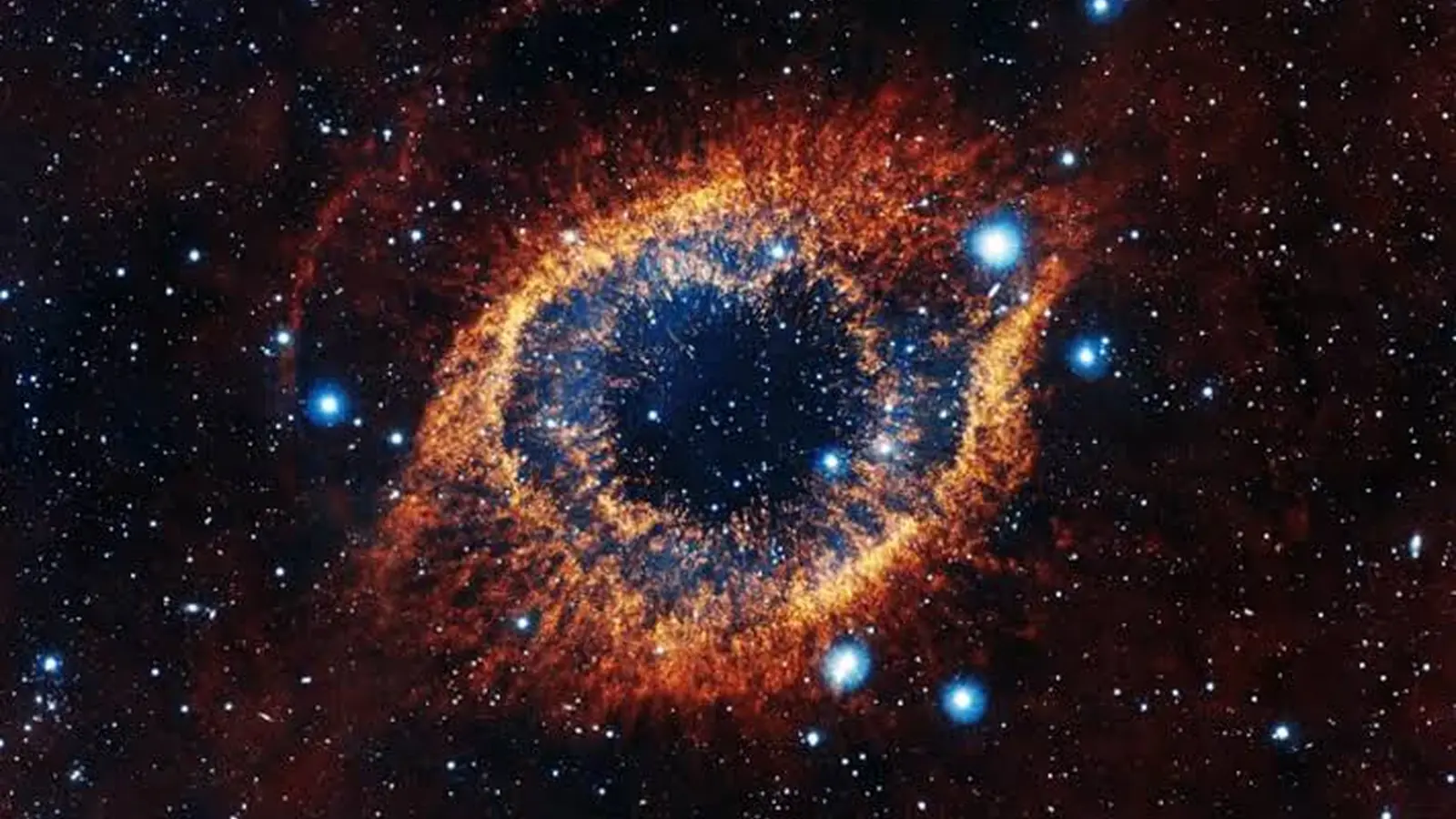
The James Webb Space Telescope has delivered a new, intimate view of the Helix Nebula — the so‑called "Eye of Sauron" — revealing intricate structures in the dying envelope of a Sun‑like star. These images deepen our understanding of how stars like the Sun shed material and seed the galaxy with the elements needed for future planets and life.

The image of the Helix Nebula on the left is from the ESO's VISTA telescope in Chile, a visual and infrared telescope with a 4.1 meter primary mirror. On the right is a JWST image of the nebula taken with its NIRCam instrument.
Why the Helix Nebula matters — and what JWST shows
Planetary nebulae are brief, luminous stages in the lives of Sun‑like stars. When a star exhausts its core hydrogen fuel, it swells into a red giant and eventually expels its outer layers. The hot stellar remnant — a white dwarf — bathes that ejected gas in intense ultraviolet radiation, causing the gas to glow and creating the layered, colorful shells astronomers call planetary nebulae.
The Helix Nebula, located roughly 650 light‑years away in the constellation Aquarius, is one of the closest and most observed examples. Its familiar, eye‑shaped appearance has long made it a favorite target for telescopes from Hubble to ground‑based observatories. Now JWST's near‑infrared sensitivity has revealed fine structure within the nebula that optical telescopes cannot easily see.

Hubble image of the Helix Nebula.
Among the most striking features are thousands of dense, comet‑like knots embedded in the glowing gas. JWST's NIRCam resolves these cometary knots with unprecedented clarity, allowing astronomers to study their shapes, sizes and how they survive the harsh radiation from the central star.
Cometary knots: cosmic survivors in a hostile wind
Cometary knots — sometimes simply called globules — are compact clumps of denser material embedded in the more diffuse nebular gas. In the Helix Nebula there are an estimated ~40,000 such knots. Each knot typically has a bright, ionized "head" facing the central star and a fainter tail stretching away, resembling comets moving through a stellar wind.
Although each knot spans distances comparable to or larger than the extent of our Solar System (out to Pluto), their total mass is tiny compared to a star. Their survival is a balance between outward accelerating stellar winds and the knots' own internal density or magnetic support. JWST's infrared view penetrates dust and highlights molecular and warm dust emission, giving astronomers clues about composition and temperature that are difficult to obtain in visible light.

Zoomed-in image highlights cometary knots in the Helix Nebula.
What the structures tell us about stellar death and recycling
The Helix Nebula is relatively mature for a planetary nebula, roughly 10,000–12,000 years old. Its progenitor began shedding layers perhaps 15,000–20,000 years ago. Over the next several 10,000s of years the nebula will expand, cool and fade as the central white dwarf dims. Eventually the expelled gas will disperse into the interstellar medium — effectively returning enriched material to the galaxy.
That process is central to cosmic chemical evolution. The gas carries heavier elements forged during the star's lifetime — carbon, nitrogen, oxygen and others — which later contribute to new star and planet formation. In other words, planetary nebulae are both an ending and a beginning: a star's final breath that may help make future worlds.
Link to the Sun's future
Our own Sun will undergo a similar transformation in several billion years. As it leaves the main sequence and becomes a red giant, it will lose outer layers that form a planetary nebula illuminated by the shrinking white dwarf core. That fading remnant will radiate leftover heat for billions of years while the nebular gas gradually mixes into the galaxy.
The colors and structure we observe in objects like the Helix Nebula are essentially snapshots of the Sun's eventual fate — useful context for understanding long‑term stellar evolution and the origin of elements on Earth.
Mission context and technical advantages of JWST
JWST observes primarily in the infrared, which provides two major advantages for planetary nebula studies. First, infrared wavelengths penetrate dust that obscures features in optical images. Second, many molecules and warm dust grains emit strongly in the near‑ and mid‑infrared, so instruments like NIRCam and MIRI can detect emission lines and continuum that reveal the temperature, density and chemistry of knots and filaments.
Compared with Hubble, JWST trades higher optical resolution for sensitivity at longer wavelengths and larger collecting area. That combination is ideal for studying faint, structured emission in nearby nebulae, and it complements the detailed optical morphology Hubble provided. Ground‑based telescopes such as ESO's VISTA also contribute useful wide‑field infrared context, helping astronomers connect small‑scale features to the broader nebular shell.
Expert Insight
"JWST gives us a new set of eyes on objects we've studied for decades," says Dr. Maya Chen, an observational astrophysicist specializing in evolved stars. "The telescope's infrared sensitivity lets us identify molecular gas and dust survival pathways inside the knots. That information is crucial for models of how planetary nebulae disperse and how stellar material is returned to the interstellar medium."
Dr. Chen adds: "Understanding these processes not only tells us about stellar death, it helps explain where the raw ingredients for future planets — and possibly life — originate."
Conclusion
JWST's close‑up of the Helix Nebula enriches a long tradition of observing planetary nebulae and highlights the dynamic, multi‑phase processes at play when Sun‑like stars die. By resolving cometary knots and probing their composition in the infrared, Webb adds critical detail to our picture of stellar recycling. For astronomers and the public alike, these images are both scientifically valuable and visually arresting — vivid reminders that our Sun's materials will one day join the cosmic tapestry that spawns new stars and planets.

“My work centers on sustainability, energy, and environmental science — examining how innovation can lead to a greener future.”

Discussion
Leave a Comment