
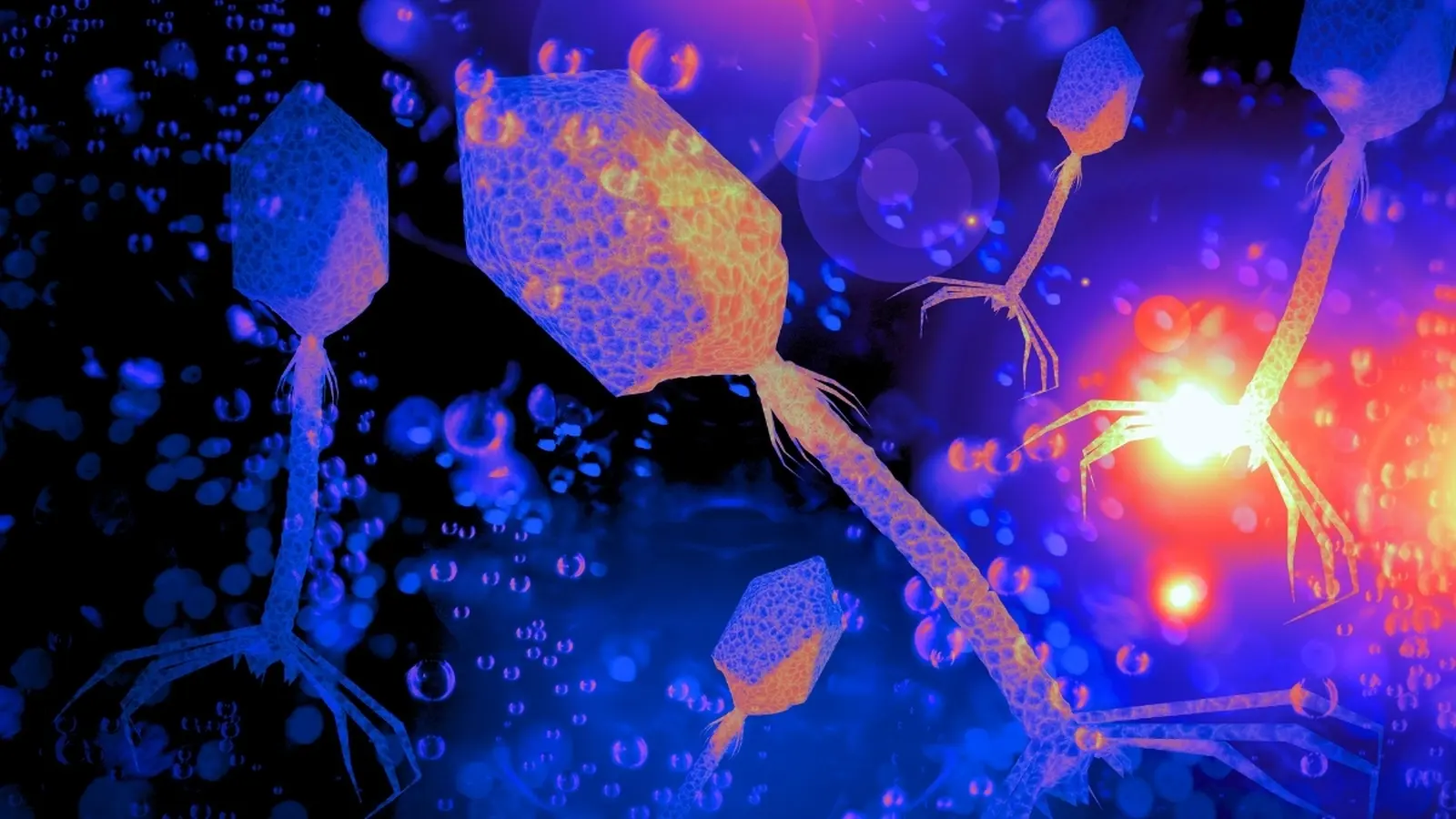
Viruses usually trigger headlines about disease, but in the open ocean many are vital engines of life. New fieldwork in the subtropical Atlantic reveals that virus-driven cell breakups can turbocharge nutrient recycling, stimulate photosynthesis, and sustain a ribbon of oxygen-rich water — turning microscopic predators into ecosystem architects.
From invisible particles to ecosystem players
Viruses are extremely small — often only tens of nanometers across, far smaller than bacteria or a single strand of hair — so they went unnoticed in seawater for decades. Improvements in electron microscopy in the late 20th century changed that picture. When scientists began viewing seawater at high magnification, they found not just a few viral particles but tens of millions per milliliter. That discovery reshaped our understanding of marine microbial ecology.

An electron microscope view shows examples of Prochlorococcus myoviruses. Images A and D show different viruses with their tails. In B and C, the tail is contracted. The black scale bar indicates a length of 100 nanometers.
Most marine viruses attack the microorganisms that form the base of the ocean food web: bacteria and single-celled algae. These microbes drive roughly half of global photosynthesis and are central to the carbon and nutrient cycles. Scientists developed the "viral shunt" concept to describe how viruses, by lysing microbial cells, redirect carbon and nutrients from particulate forms (like living cells) back into dissolved and particulate organic pools. Those released materials become available to other microorganisms, effectively shunting energy and nutrients through different ecological pathways.
Watching the viral shunt in the wild
Recent research led by Naomi Gilbert and Daniel Muratore — carried out across a wide, oxygen-rich band of the subtropical Atlantic near the Sargasso Sea — provides direct evidence of the viral shunt operating at ecosystem scale. The study focused on Prochlorococcus, a tiny cyanobacterium that dominates photosynthesis in these waters, reaching tens of thousands of cells per milliliter.

Scientists aboard a National Science Foundation research expedition in the open Atlantic in 2019 prepare equipment to collect water samples at different depths to analyze the activity of marine viruses.
By sequencing community RNA, the research team could infer what both viruses and their microbial hosts were doing simultaneously — which genes were active and which metabolic processes were running. The results showed infection rates in the oxygenated ribbon were roughly four times higher than in surrounding waters where microbial reproduction is slower. Viruses were infecting and lysing large numbers of Prochlorococcus cells, releasing organic carbon and nitrogen into the water.
Bacteria readily took up that released organic matter, respiring carbon and converting nitrogen into ammonium. That regenerated nitrogen then appeared to fuel renewed Prochlorococcus growth and photosynthesis. In short, viral infections were not merely destructive; they were recycling nutrients in a way that promoted more primary production and helped sustain the oxygen-rich band observed across hundreds of miles.
Implications for carbon, nutrients and climate
This field evidence ties virus activity directly to nutrient cycling, primary production, and even oxygen patterns in the open ocean. The viral shunt can influence whether carbon is exported to deeper waters or recycled in the surface layer, with consequences for carbon sequestration and climate feedbacks. By converting cell biomass into dissolved organic matter, viruses can both sustain local microbial food webs and alter how much carbon sinks into the deep sea.
Those processes matter for fisheries and global biogeochemical cycles. Phytoplankton growth supports krill, small fish, and ultimately major fisheries and aquaculture industries that produce hundreds of millions of tons of seafood annually. At the same time, changes in viral-host dynamics — driven by temperature shifts, nutrient inputs, or ocean circulation — could modify how nutrients are partitioned, potentially altering productivity in key regions.
Expert Insight
"We tend to think of viruses only as agents of disease," said Dr. Maya Benton, a fictional marine microbial ecologist for this commentary. "But in the ocean they are ecosystem engineers: by lysing cells, they redistribute nutrients and shape which microbes thrive. That has ripple effects on oxygen levels, food availability, and carbon flow. Monitoring viral dynamics gives us a new lever to understand and predict changes in marine productivity."
Understanding viral impacts requires targeted field campaigns, high-resolution sequencing, and cross-disciplinary analysis of ocean chemistry, microbial behavior, and physical circulation. Technologies such as automated sampling rosettes, in situ sensors for oxygen and nutrients, and RNA sequencing pipelines make these integrated studies possible, allowing researchers to link molecular activity to ecosystem-scale outcomes.
Broader context and future prospects
The Gilbert–Muratore-led study builds on a growing body of work demonstrating viruses’ central role in ecosystem functioning — from promoting microbial diversity to aiding carbon storage in deep waters. Future research will need to clarify how environmental change alters viral infection patterns: warming waters can speed up microbial metabolism and viral replication, but shifts in nutrient regimes may favor different host-virus relationships. Predictive models that include viral processes will improve forecasts of productivity, oxygen dynamics, and carbon export under climate scenarios.
Policymakers and ocean managers should take note: microbial and viral processes operate on microscopic scales but produce macroscopic effects. Investing in long-term microbial observations, global sequencing efforts, and open data sharing will help track how these invisible drivers respond to a changing planet.
Conclusion
Viruses in the ocean are neither simply harmful nor negligible; they are key players in nutrient regeneration, primary production, and carbon cycling. The new field evidence from the Sargasso Sea underscores that tiny viral interactions can scale up to shape regional oxygen levels and food webs — a reminder that the smallest actors often have outsized influence on Earth’s life-support systems.

“The cosmos has always fascinated me. I write about space missions, astronomy, and the technologies pushing humanity beyond Earth.”

Discussion
Leave a Comment