
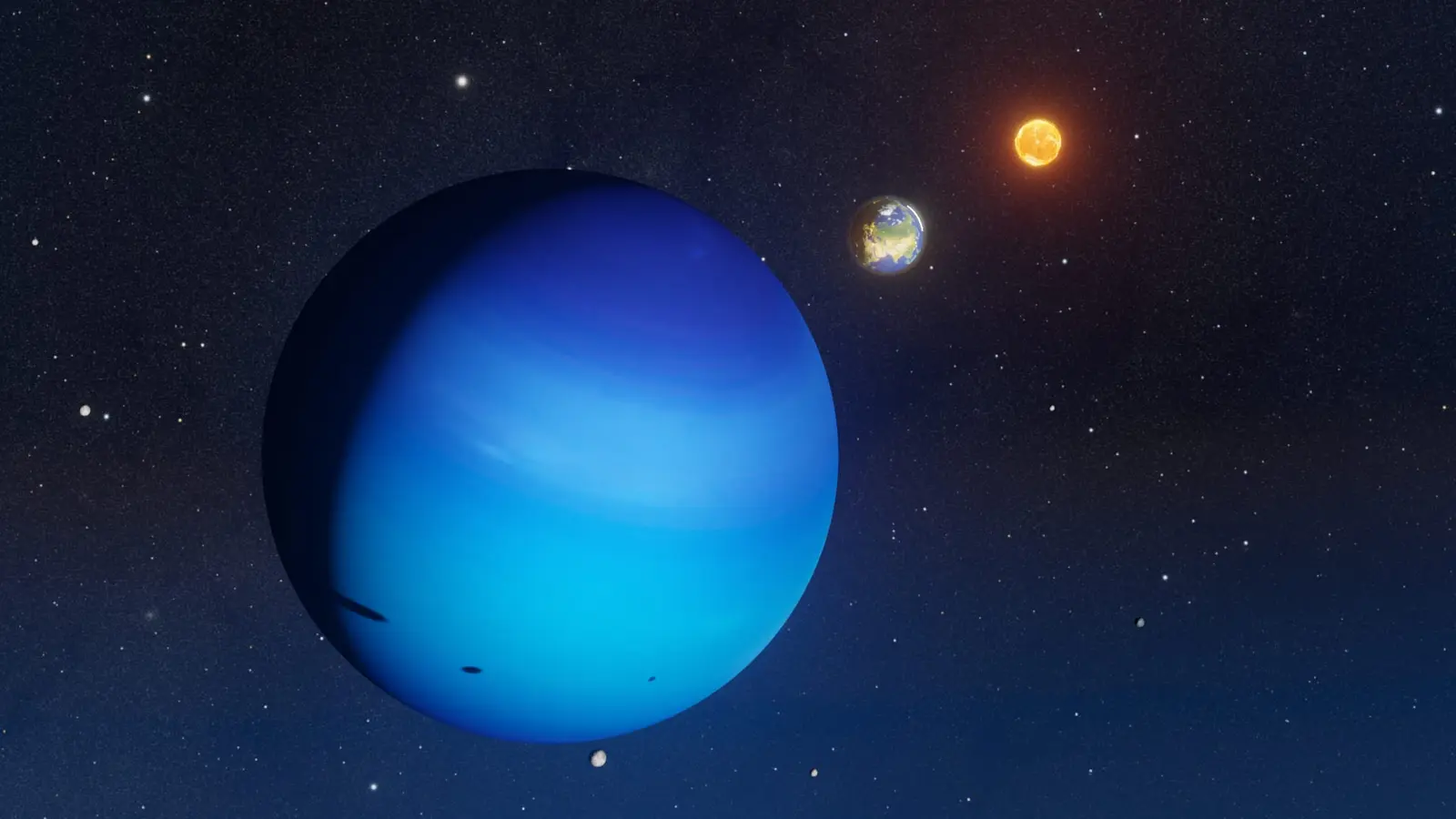
Deep inside Uranus and Neptune, water behaves unlike anything we experience on Earth. At extreme pressures and temperatures it becomes a hot, electrically conductive crystal—'superionic water'—and new lab results suggest its messy internal lattice could explain the odd magnetic fields those planets produce.
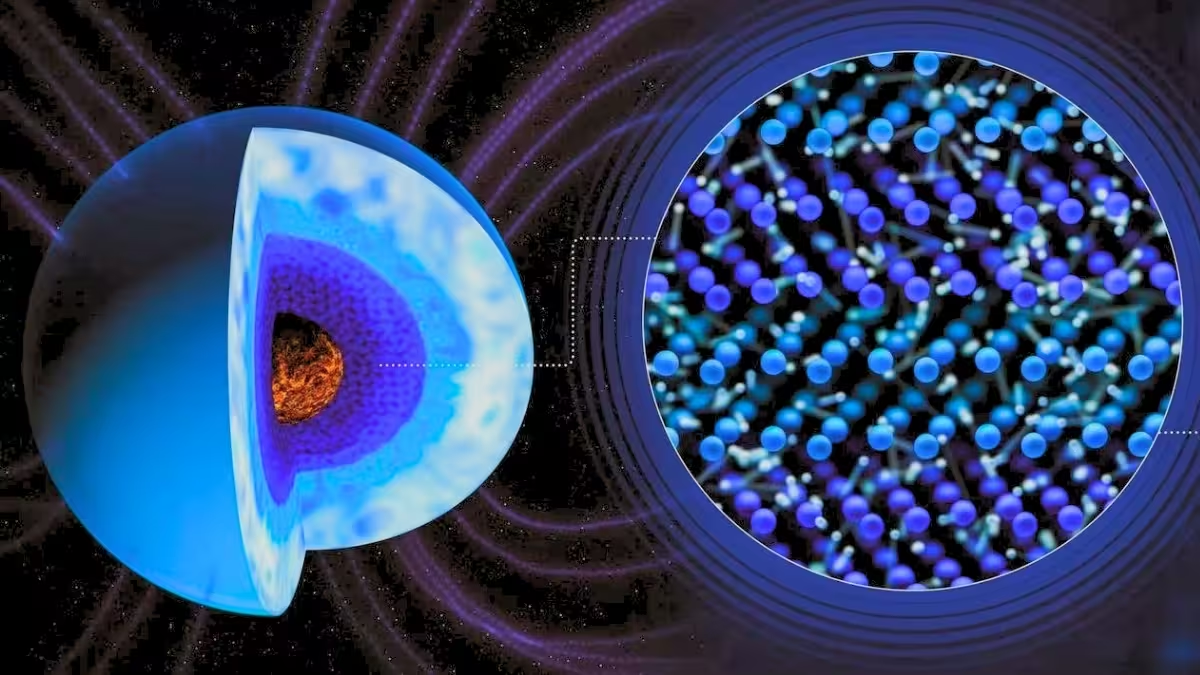
Visualization showing the crystal structure of superionic water and how it fits inside Ice Giant planets.
What is superionic water and why it matters
In ordinary conditions water cycles between liquid, solid (ice) and gas. But under millions of atmospheres of pressure and thousands of degrees Kelvin, water enters a different regime: the oxygen atoms lock into a solid crystal lattice while the much smaller hydrogen nuclei (protons) become mobile, streaming through the structure and carrying electric current. This state is called superionic water. It looks like a solid but behaves in many ways like an ionic conductor—part solid, part fluid.
Planetary scientists have long suspected superionic water plays a central role inside ice giants. Voyager 2 measured magnetic fields around Uranus and Neptune that are unusually tilted, asymmetric, and offset from the planets' centers. Those magnetic signatures don't match the neat, dipolar fields generated by Earth's liquid iron core. Instead, researchers have proposed that electrically conducting layers of superionic water could produce more chaotic magnetism. But the detailed microstructure of that superionic layer—how oxygen atoms arrange and how protons move—remained theoretical until recently.
How researchers recreated planet-core conditions
A team from SLAC National Accelerator Laboratory and the Sorbonne reported experimental evidence in Nature Communications showing that superionic water's internal structure is far less tidy than many models assumed. Producing this exotic phase in the lab is technically demanding: the experiments compress tiny water samples between diamond anvils to reach pressures near 1.8 million atmospheres, then heat them with pulsed lasers to approximately 2,500 K. Those conditions exist only for femtoseconds before the sample relaxes, so the team used intense X-ray pulses to capture diffraction images essentially instantaneously.
X-ray diffraction is the standard method to map atomic positions inside crystals: different lattice arrangements scatter X-rays into distinctive patterns. The expectation was a clean transition between well-ordered lattices such as body-centered cubic (BCC) or face-centered cubic (FCC), where oxygen atoms sit at predictable cube centers or face positions. Instead, the diffraction data showed overlapping, blurred patterns—regions of FCC-like stacking interleaved with hexagonal close-packed (HCP) arrangements and other irregularities. In short: the oxygen lattice looked messy, dynamic and multi-phased.
The messy lattice and planetary magnetism
Why does this laboratory messiness matter for ice giant magnetism? Magnetic fields are produced by moving charges in conductive fluids. In Earth's core, a relatively homogeneous liquid iron layer produces a largely dipolar (north-south) field. In Neptune and Uranus, if the conductive region is a thin, irregular shell of superionic water with variable conductivity and internal geometry, the resulting dynamo can be non-dipolar, strongly tilted and spatially shifted—precisely what Voyager 2 observed.
The SLAC–Sorbonne experiments revealed that, as pressure and temperature vary, the superionic lattice does not switch cleanly between crystal types but can host overlapping domains and mixed stacking sequences. Those internal inhomogeneities would create localized currents and unstable flow patterns at planetary scales, offering a plausible route to the strange multipolar fields measured in situ.
Experimental reliability and repeat tests
At first the messy diffraction patterns were dismissed as experimental noise. To rule out artifacts, the researchers repeated the experiment at a different linear accelerator facility in Germany; the results matched. Varying pressures and temperatures produced consistent evidence for overlapping lattices rather than a single, perfect crystalline phase. That consistency strengthens the argument that the chaotic lattice is an intrinsic property of superionic water under ice-giant conditions—not an experimental fluke.
Implications for exoplanets and planetary science
Superionic water may not be a rare curiosity confined to our solar system. Ice giant–type planets form a significant share of detected exoplanets, and while detection biases inflate their apparent frequency, many worlds likely host interiors with pressure–temperature regimes favoring superionic phases. If so, the galaxy may contain vastly more water in exotic forms than the liquid and solid phases familiar on Earth.
This has practical implications for interpreting magnetic field measurements of exoplanets (future missions and observatories could infer interior structure from magnetism), for modeling heat transport inside planets, and for understanding chemical evolution in planetary interiors where mobile protons might enable unusual high-pressure chemistry.
Experiment limits and open questions
Laboratory samples live for femtoseconds under extreme conditions—far shorter than planetary timescales. That raises two important caveats. First, some equilibration processes that occur inside a planet over millions of years might relax a messy lattice into something more ordered. Second, conversely, sustained turbulence and heat fluxes inside planets might continually disrupt crystalline order, preserving chaos on geological timescales. Both scenarios remain possible, and connecting femtosecond snapshots to steady-state planetary dynamos requires further modeling and longer-duration experiments.
Expert Insight
"These results give us a more textured picture of ice-giant interiors," said Dr. Elena Martinez, a planetary physicist at the University of Colorado (comment provided for context). "Superionic water isn't simply a neat, middle-layer crystal—it appears to be a dynamic, patchwork conductor. That kind of heterogeneity is exactly what can generate the non-dipolar and off-center magnetic fields we've struggled to explain for decades."
Dr. Martinez added that future work combining laboratory diffraction, high-fidelity dynamo simulations, and targeted observations of exoplanet magnetic signatures will help close the gap between tiny, short-lived experiments and the grand, persistent phenomena inside planets.
Future prospects and technologies
Upcoming advances in pulsed-power facilities, higher-repetition X-ray sources, and improved diamond-anvil techniques will allow researchers to probe a broader range of pressures and temperatures and to map transient behaviors with finer time resolution. Coupling these data with computational models of proton transport and magnetohydrodynamic dynamos can quantify whether the observed lattice disorder suffices to reproduce observed field geometries. Ultimately, combining laboratory physics with planetary missions and telescopic surveys will refine our understanding of how water—familiar on Earth—behaves in its most alien and abundant cosmic forms.

“My work centers on sustainability, energy, and environmental science — examining how innovation can lead to a greener future.”

Discussion
Leave a Comment