
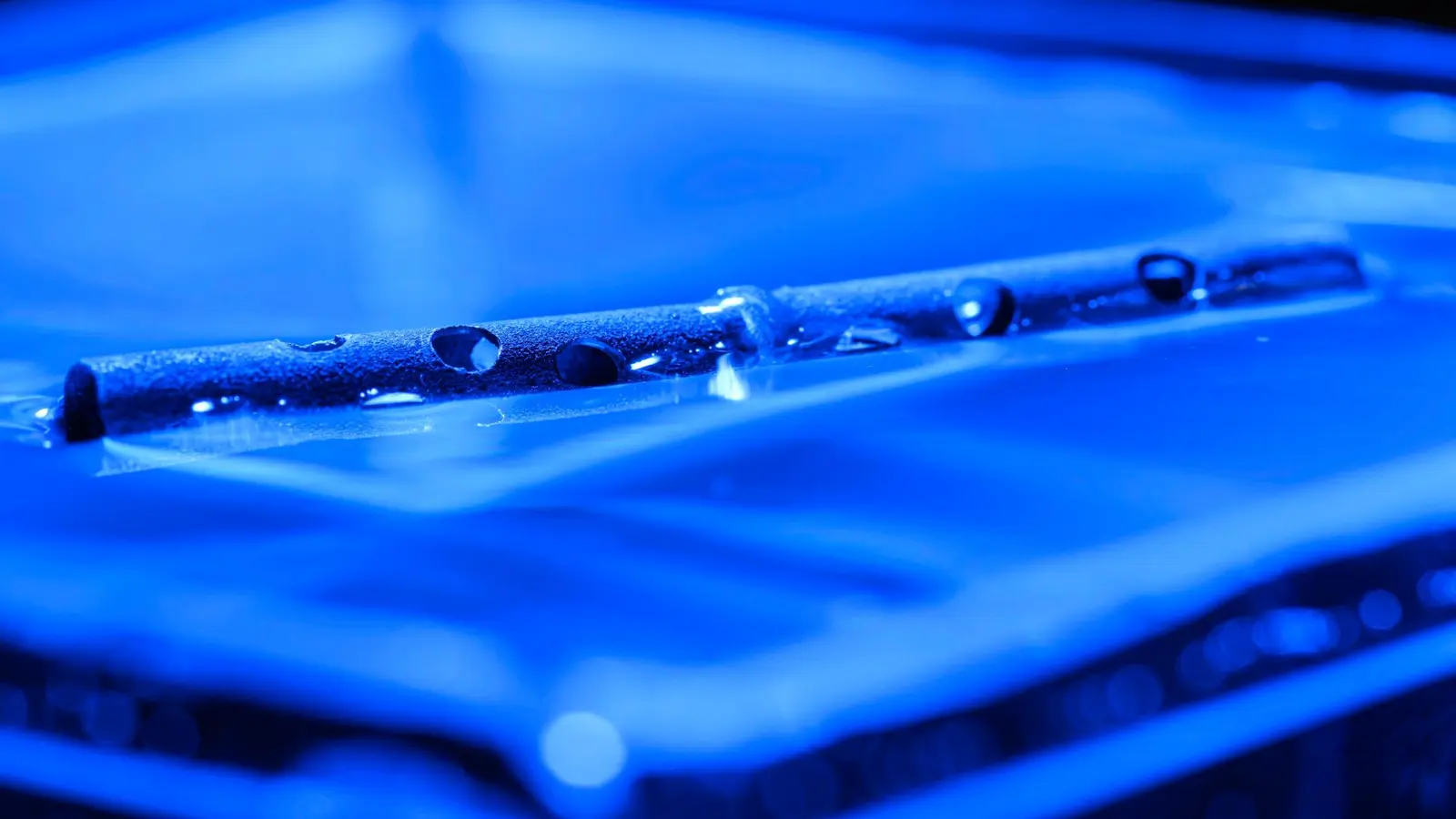
Engineers at the University of Rochester have developed aluminum tubes that stay afloat even after sustaining heavy damage—a step toward vessels and floating platforms that could be effectively unsinkable. The team’s approach combines laser and chemical surface treatment to trap air and maintain buoyancy, opening new possibilities for marine engineering and renewable energy systems.
“If you severely damage the tubes with as many holes as you can punch, they still float,” says Guo.
How a dry interior keeps metal afloat
The secret lies not in hollowing the metal more, but in changing its microscopic texture. Led by Chunlei Guo, a professor of optics and physics at the University of Rochester and senior scientist at the Laboratory for Laser Energetics, the research team used controlled etching to roughen the inner surface of ordinary aluminum tubes at micro- and nanoscales. That texture turns the interior superhydrophobic—intensely water-repellent—so when the tube is submerged it traps a stable pocket of air and resists wetting.
“Superhydrophobic” is a technical term for surfaces that repel water so effectively that liquid cannot penetrate surface valleys. Nature provides precedents: diving bell spiders and certain insects trap air against their bodies to remain dry underwater, and Guo’s lab borrowed that functional principle and reproduced it on metal.
“Unsinkable” metal tube made from chemically-etched aluminum floats in distilled water at the lab of University of Rochester professor Chunlei Guo.
Design choices that matter for real seas
Earlier demonstrations from Guo’s group used paired, sealed disks to create buoyancy, but those designs were sensitive to tilt and could fail at extreme angles. The tubular geometry addresses that vulnerability: the team added a central divider inside each tube so the trapped air remains stable even when the tube is pushed vertically or tumbled by waves. Tests in the laboratory included sustained exposure to rough water and repeated mechanical damage. According to Guo, tubes still floated after weeks of testing and after researchers intentionally perforated them in many locations.
Beyond simple buoyancy tests, the researchers connected multiple tubes into rafts to evaluate load-bearing behavior. Tubes of differing lengths—some approaching half a meter—were demonstrated in the lab, and the team argues the method can scale to larger diameters and longer lengths needed for buoys, floating platforms, or components of an unsinkable hull. The metal substrate offers advantages over polymer foams or sealed compartments because the superhydrophobic finish preserves trapped air indefinitely rather than relying on impermeable seals that can fail over time.

Multiple unsinkable metal tubes linked together in a raft formation could be the basis for the ships, buoys, and floating platforms of the future.
Implications for marine systems and renewable energy
A practical, resilient floating structure could transform maritime safety and offshore engineering. Unsinkable sections could act as fail-safe buoyancy compartments on ships, reduce the need for heavy internal ballast, or simplify damage-control systems. Beyond safety, the team has begun exploring wave-energy capture by coupling the tubes to power conversion devices. A durable floating array that resists wetting and mechanical wear could host oscillating systems or piezoelectric harvesters to convert wave motion into electricity with less maintenance than current floating platforms.
Expert Insight
"This work is a clever translation of biological wetting strategies into a metallic platform," says Dr. Rebecca Nolan, a coastal engineer with two decades of offshore experience. "If the surface treatment remains robust in saltwater and under UV exposure, it could reduce long-term maintenance costs for buoys and floating renewables. The scalability and material choice will determine whether this stays a lab curiosity or becomes a field-deployable solution."
Conclusion
The University of Rochester’s etched-aluminum tubes represent a promising route toward floating structures that maintain buoyancy even when damaged. By engineering superhydrophobic interiors that trap air pockets, researchers have created a system that preserves buoyancy without relying on sealed cavities. The approach addresses stability and durability concerns that limited earlier designs and suggests multiple applications—from safer ships and resilient buoys to novel platforms for harvesting wave energy. Next steps will focus on large-scale testing, long-term exposure to marine environments (including saltwater corrosion and biofouling), and integration with load-bearing ship structures or energy converters.

“The cosmos has always fascinated me. I write about space missions, astronomy, and the technologies pushing humanity beyond Earth.”

Discussion
Leave a Comment