
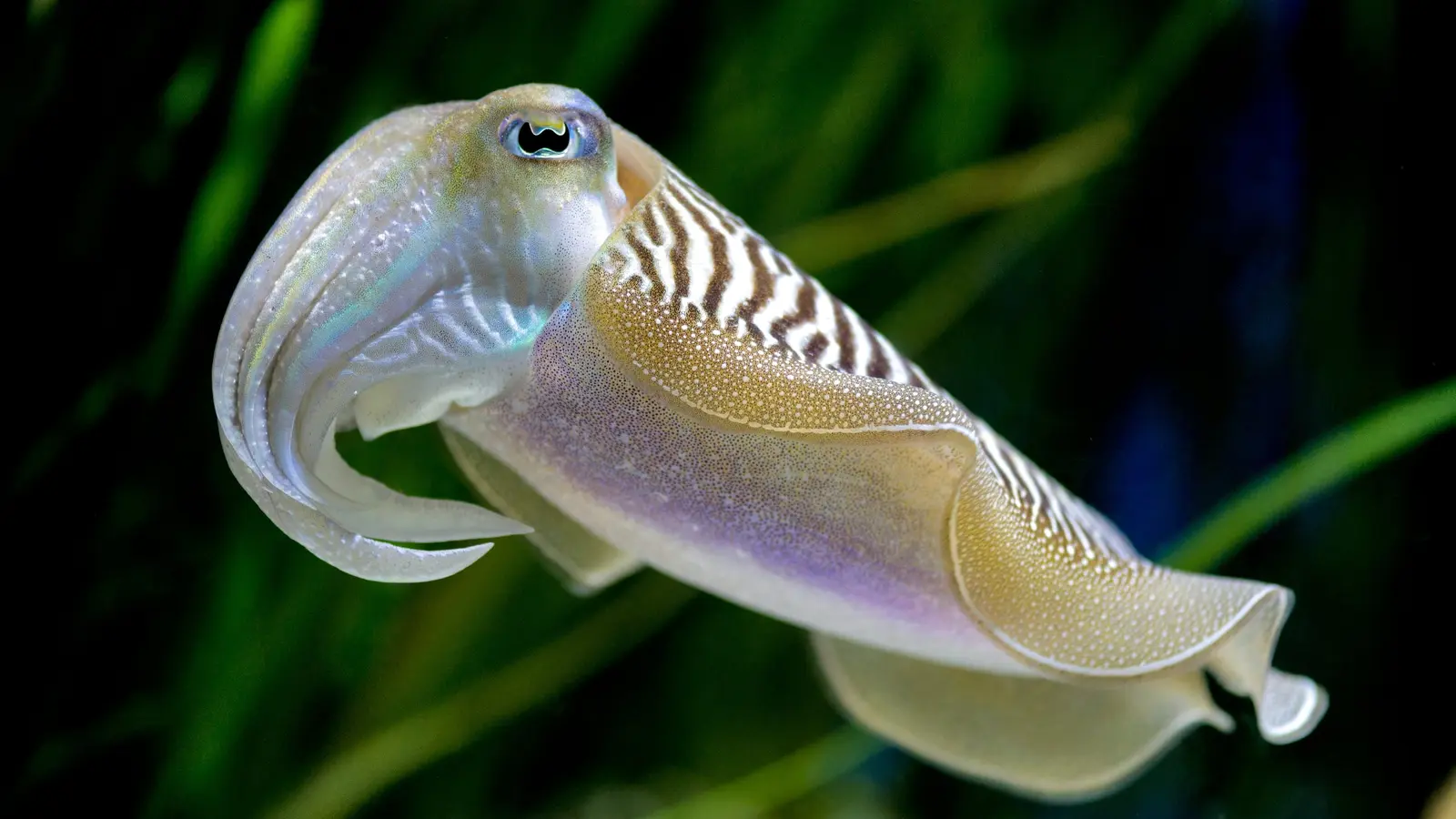
Male Andrea cuttlefish manipulate light itself during courtship, using specialized translucent arms that act like biological optics. New research shows these cephalopods convert horizontally polarized ocean light into alternating bands of polarization, producing a high-contrast visual signal tuned to cuttlefish vision and designed to grab attention during mating displays.

A male cuttlefish with a specialized arm coiled in the first stages of a courtship display. The colors are iridescence from its iridophores.
How they twist light: polarization, birefringence and the perfect arm
Cuttlefish eyes are unlike ours. Their W-shaped pupils are dramatic, and although many cephalopods appear colorblind to human observers, they can detect the orientation of light waves — a property called polarization. Polarization describes the direction in which light waves oscillate; polarized sunglasses exploit the same physics to reduce glare by filtering particular orientations of light.
Researchers led by Arata Nakayama (University of Tokyo) show that male Andrea cuttlefish (Doratosepion andreanum) use a more active trick than simply reflecting polarized patterns. The muscles and connective tissues in two extra-long mating arms are birefringent: they rotate the orientation of polarized light that passes through them. When the arm is coiled or twisted in a specific geometry, horizontally polarized sunlight from the ocean surface enters the cylindrical arm and emerges with its polarization rotated by nearly 90 degrees. The result is alternating bands of horizontally and vertically polarized light along the arm — maximum contrast for a polarization-sensitive visual system.
That cylindrical shape matters. The arm is close to an ideal biological waveplate, turning incoming horizontal polarization into vertical and back again across the display. For a cuttlefish watching with polarization-sensitive eyes, the pattern is striking, far more conspicuous than subtle chromatic changes would be to a human observer.

The courtship display of a male Andrea cuttlefish in normal (top) and polarized light (bottom).
Experiment design: recreating ocean light and filming hidden signals
To test whether this polarization pattern functions as a deliberate signal, Nakayama and colleagues collected wild cuttlefish and staged paired encounters in tanks where lighting could be controlled to mimic the horizontal polarization typical of open water. Using polarization-sensitive cameras, the team filmed courting interactions and compared these to baseline footage of the animals when they were not displaying.
In non-courting postures, the arms did not produce the alternating polarization bands. The signal emerged specifically during courtship gestures: males coiled and extended the specialized arms while also showing iridescent body bands. The birefringent tissues rotated the polarization by almost 90 degrees, creating the alternating pattern that stands out to another cuttlefish but remains nearly invisible to predators or rivals that lack polarization vision.
Scientific context and broader implications
This work builds on earlier findings that cephalopod tissues can polarize light and that many cephalopods perceive polarization cues. It pushes the idea further: polarization is not just a passive consequence of tissue optics, it can be an actively controlled signalling channel. In evolutionary terms, that suggests a parallel to colorful sexual ornaments in other animals, but achieved through fundamentally different optics.
Because humans cannot naturally perceive polarization patterns, a whole suite of communication behaviors may have gone unnoticed. The study authors propose that, just as plumage and pigmentation produce a wide diversity of color signals among animals with color vision, polarization-sensitive species may use a similarly rich vocabulary of hidden signals. Whether Andrea cuttlefish use polarization patterns outside the mating context — for territorial displays, camouflage modulation, or species recognition — remains an open question.
Expert Insight
Dr. Emily Vargas, a marine visual ecologist at the Oceanic Institute, comments: 'This is one of those discoveries that makes you rethink what animals can actually 'see'. The cuttlefish has evolved a physical structure that transforms the physics of light into a social cue. It highlights how sensory ecology and biomechanics can interact to produce signals invisible to humans but vividly obvious to their intended receivers.'
Beyond basic biology, the finding has potential technological echoes. Birefringent materials and compact waveplates are used in optical engineering; understanding how a soft-bodied animal sculpts polarized light with muscle and tissue might inspire new designs for dynamic optical devices that are flexible, low-energy, and adaptive.
Conclusion
Nakayama and colleagues have revealed that Andrea cuttlefish can literally twist light to make a conspicuous polarization signal during courtship, using birefringent arm tissues to convert horizontal ocean light into alternating polarization bands. The discovery expands our view of animal communication, showing once again that sensory worlds can be far richer than what human eyes alone reveal. Future studies that map polarization signals across species and contexts will help us see that hidden diversity more clearly — but for now, researchers have exposed a striking example of evolution engineering optics for romance.

“My work centers on sustainability, energy, and environmental science — examining how innovation can lead to a greener future.”

Discussion
Leave a Comment