

Small changes in daily movement—literally a few extra minutes—may deliver measurable benefits to lifespan, according to a large analysis of wearable-device data. Researchers modeled how tiny increases in moderate-to-vigorous physical activity, or modest reductions in sitting time, could lower estimated mortality risk across diverse populations.
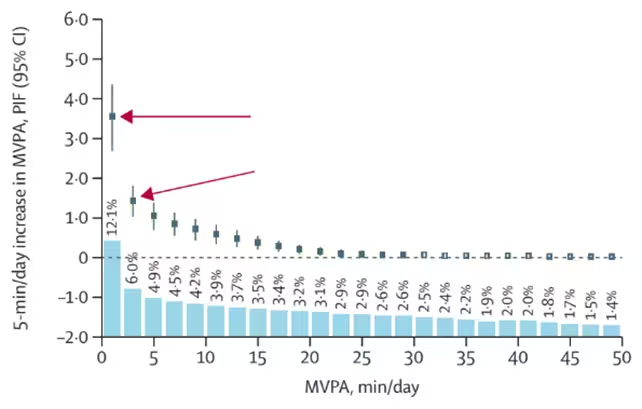
An extra 5 minutes of exercise a day made the most difference for those exercising the least.
What the study looked at and why it matters
A team from the Norwegian School of Sport Sciences analysed accelerometer and wearable data from more than 130,000 people across several countries. Instead of tracking behaviour changes over time, the researchers estimated each participant’s mortality risk and used statistical models to simulate how small behavior shifts would alter those risks.
The headline finding: adding roughly five minutes of moderate-to-vigorous physical activity per day—or cutting sedentary time by about 30 minutes—was associated with noticeable drops in predicted deaths. The impact was largest for the least active participants: in a high‑risk model (the bottom 20% of activity), a five-minute daily increase could prevent up to 6% of deaths; in a population-based model (everyone except the top 20%), the same change was associated with up to a 10% reduction in deaths, the authors report in The Lancet.
Interpreting the results: models, not proof
It’s important to note the study’s observational and modeling approach. The researchers used established risk relationships and device-measured activity to project possible effects—rather than running an intervention where people actually changed their routines and were followed forward in time. That means the work shows strong associations and plausible public-health benefits, but it stops short of demonstrating definitive cause and effect.
Still, the large sample size and consistent pattern across analyses point to a robust signal: the biggest gains come from getting the least active people moving. For public-health planning, that’s a useful insight—small, realistic steps may deliver disproportionate returns in population health.
Practical takeaways for everyday life
For individuals who struggle to meet exercise targets, the message is encouraging: you don’t have to overhaul your life overnight. Five minutes of brisk walking, a short bike ride, or even a brief bout of higher-effort activity embedded in your day can help. Likewise, breaking up long periods of sitting—standing, a short walk, or active chores for 30 minutes total across the day—can be meaningful.
The study’s authors and public-health commentators still point to existing guidelines: the World Health Organization recommends 150 minutes of moderate-to-vigorous physical activity per week. But the new analysis reinforces that incremental increases matter—and that getting inactive people to start is where the largest health benefits occur.
Research gaps and next steps
The authors note several areas for further study. Their analysis focused on all-cause mortality, so future work should look at specific outcomes such as cardiovascular disease, diabetes, mental health, and cognitive decline. They also call for more device-measured studies in low- and middle-income countries, where age structure, baseline activity, and disease patterns differ from higher-income populations included in the current datasets.
“Small and realistic increases in moderate-to-vigorous physical activity of 5 min/day might prevent up to 6 percent of all deaths in a high-risk approach and 10 percent of all deaths in a population-based approach,” the researchers write, while adding that reducing sedentary time by 30 minutes could prevent a smaller but still meaningful share of deaths.
Expert Insight
“We tend to think about exercise as an all-or-nothing goal,” says Dr. Maya Thompson, an epidemiologist specializing in physical activity and public health. “This study reframes the problem: for many people, the first hurdle is simply starting. Five minutes—done consistently—creates a bridge to gradually increasing activity, and that progression is what drives long-term health gains.”
Small steps, encouraged by clinicians, workplaces, and community programs, could be a practical route to closing the gap between guideline targets and real-world behaviour.
Implications for policy and practice
For GPs, employers, and public-health campaigners, the findings suggest actionable strategies: promote short, achievable activity goals; design environments that reduce sedentary time (standing meetings, active break policies, safe walking routes); and prioritize interventions for the least active groups. These changes are low-cost, scalable, and likely to yield the largest population-level improvements in longevity.
More exercise remains better—there’s no substitute for reaching recommended weekly activity levels—but this work helps reframe how to start: even a handful of extra minutes each day can matter.

“My work centers on sustainability, energy, and environmental science — examining how innovation can lead to a greener future.”

Discussion
Leave a Comment