
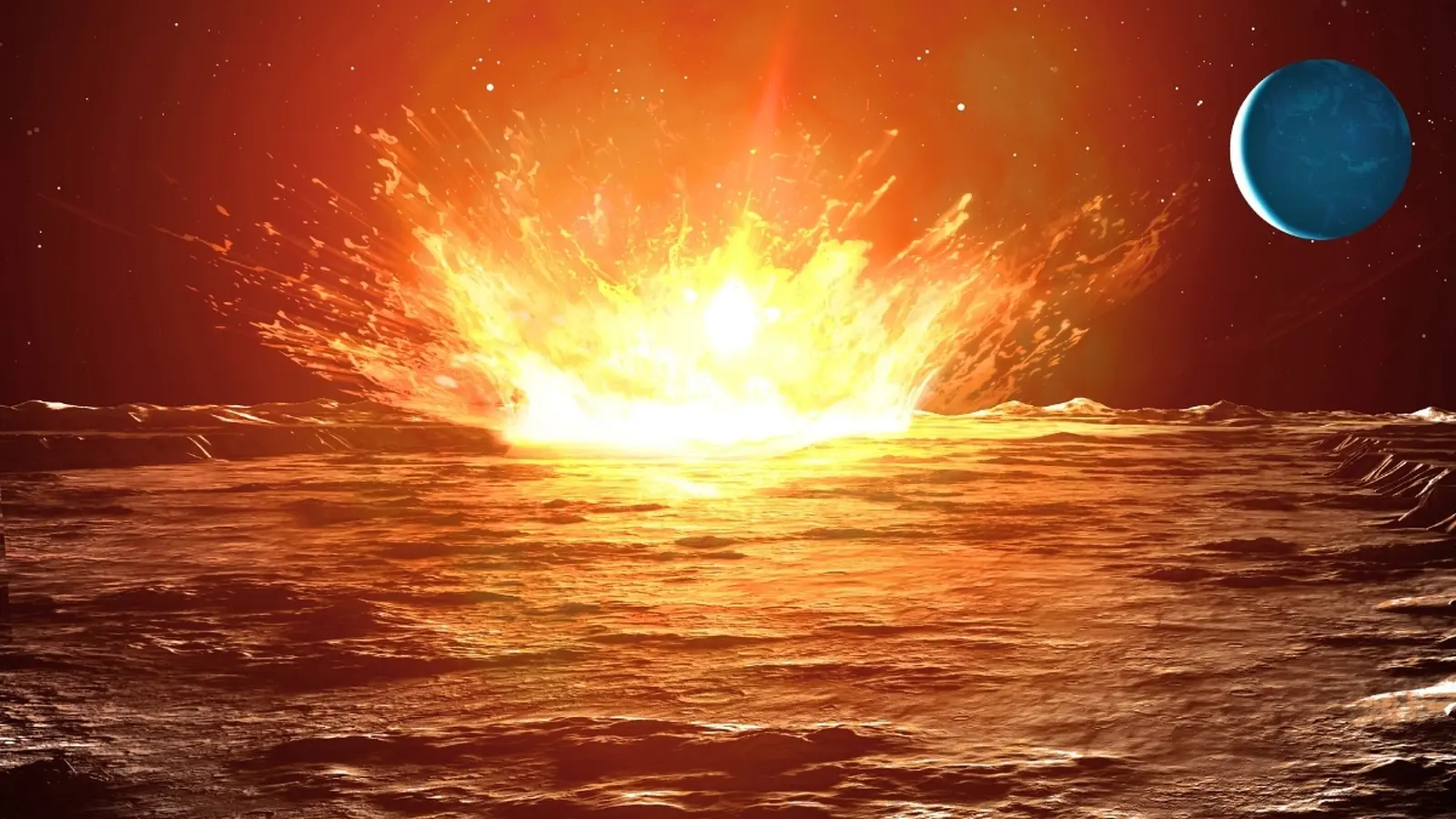
On December 22, 2032, a 60-meter asteroid known as 2024 YR4 has a small but meaningful chance of striking the Moon. That collision would be both a rare scientific opportunity and a potential hazard for satellites and people on Earth.
A close call and what it would unleash
A team led by Yifan He of Tsinghua University published a preprint on arXiv outlining what would happen if 2024 YR4 impacts the lunar surface. Current orbital solutions place the probability at roughly 4 percent — not a certainty, but also not vanishingly small. If the asteroid does hit, the energy release would be enormous: comparable to a medium-sized thermonuclear device and about six orders of magnitude greater than the 2013 lunar flash caused by a much smaller meteoroid.
Observers in the Pacific night hemisphere should be able to see the initial flash; the impact will vaporize rock, produce a hot plasma plume and excavate a new crater roughly 1 kilometer across and 150–260 meters deep. At the crater’s center models predict a roughly 100-meter-wide pool of molten rock. The immediate effects will be dramatic, but so will the days and weeks of cooling and material redistribution that follow.
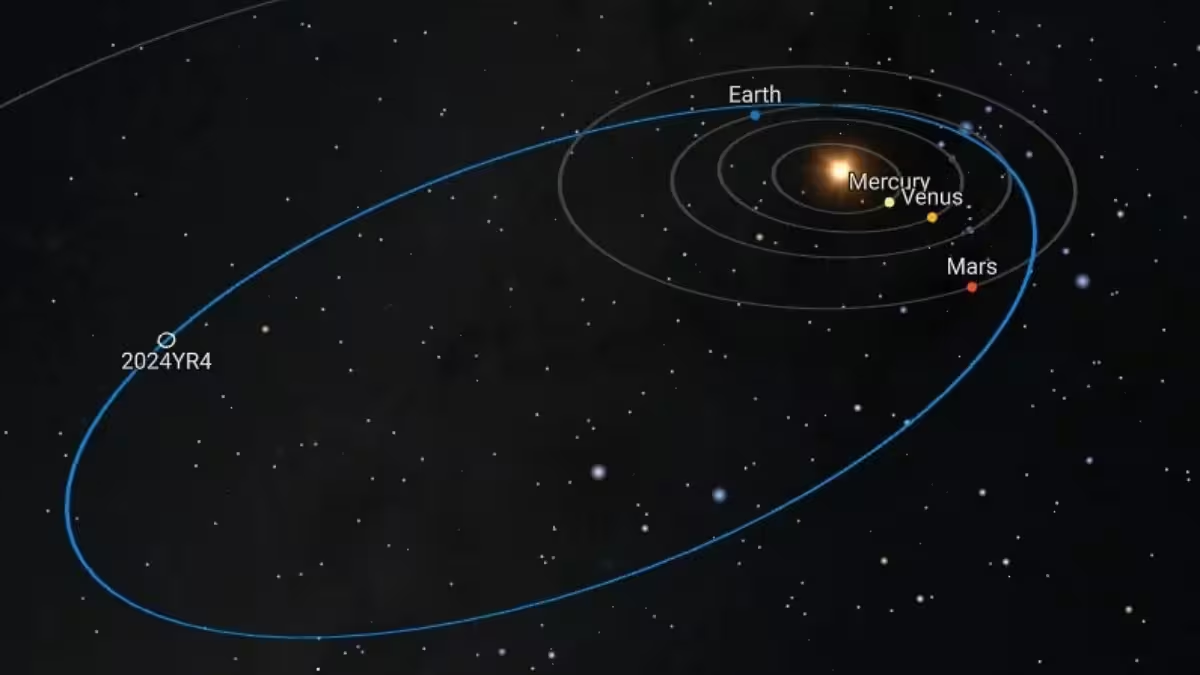
Orbital path of Asteroid 2024 YR4.
How the event would advance lunar science
For planetary scientists, a natural, well-timed lunar impact is a rare experiment in high-energy physics. Simulations can approximate shock propagation, vaporization and melt dynamics, but a real, observed impact would deliver direct data across multiple fields: impact mechanics, crater formation, high-temperature chemistry and lunar seismology.
Infrared observatories like the James Webb Space Telescope could monitor the cooling melt pool for days, revealing heat-loss behavior, melt viscosity and the timeline of solidification. Optical and spectroscopic instruments would analyze vaporized material and track ejecta composition, offering clues to subsurface stratigraphy and variations across the impact site.
Seismology will get a boost, too. Models predict the collision would trigger a global moonquake of about magnitude 5.0 — likely the strongest quake recorded by seismometers on the Moon to date. If space agencies have placed modern seismometers on the near and far sides by then (a stated priority in several lunar return programs), the quake’s propagation pattern could reveal interior layering, core size and attenuation properties without needing artificial explosions or costly drilling campaigns.
Debris: a free sample return — with strings attached
One of the most intriguing outcomes is the debris field. Simulations estimate up to 400 kilograms of lunar material could survive atmospheric reentry and reach Earth, effectively delivering naturally returned lunar samples. These fragments would be thermally altered, often charred, but would nonetheless provide ground-truth chemical and isotopic data from a known location.
However, delivering those samples would come at a visual and logistical cost. Models suggest an intense meteoroid storm at peak: as many as 20 million meter-scale particles per hour in the planet’s leading hemisphere around Christmas 2032, with 100–400 larger fireballs visible per hour. That spectacle would be awe-inspiring — but it also raises practical concerns.
Risks on Earth and in orbit
The predicted reentry trajectories concentrate landing probabilities over parts of South America, North Africa and the Arabian Peninsula. Many of those areas are not heavily populated, which reduces immediate human risk, but even small concentrated fragments can cause local damage if they hit infrastructure. Beyond surface impacts, the greatest systemic threat is to satellites.
A sudden influx of high-velocity lunar ejecta and dust could dramatically increase collision rates in low Earth orbit. If the debris intersects satellite altitudes, it could accelerate cascade effects known as Kessler Syndrome — a scenario in which collisions create more debris, which in turn causes more collisions, potentially incapacitating large satellite constellations used for navigation, communications and Earth observation.
That prospect has pushed some agencies to consider a preemptive deflection mission to nudge 2024 YR4 out of a lunar-impacting path. Deflection, however, is a judgment call: remove the hazard and protect orbital infrastructure and some lives, but forego a unique, large-scale natural experiment that could teach us about impact physics and the Moon’s interior.
Scientific and operational implications
If the impact probability rises in the coming years, space agencies will face a tough trade-off: attempt a costly, fast-turnaround deflection mission, or accept the modest impact risk and prepare observational and mitigation plans for both terrestrial and orbital effects. Either choice requires international coordination — for planetary defense, tracking debris reentry corridors, and protecting or reconfiguring satellite fleets.
From a technology perspective, this event underscores the value of flexible observation platforms (space- and ground-based), rapid-response mission planning, and distributed sensor networks. New or refurbished lunar seismometers, high-cadence infrared telescopes, and resilient satellite architectures would all pay dividends whether the impact happens or not.
Expert Insight
Dr. Elena Morales, an astrophysicist specializing in impact physics, comments: “A natural impact of this size is a once-in-several-decades opportunity to test our models against reality. If we can coordinate telescopes, seismometers and orbiters ahead of time, we’ll learn about shock physics, melt production and the Moon’s internal structure in ways simulations alone can’t deliver. At the same time, we must weigh those gains against the clear risks to satellites and people — it’s a decision that should be made with scientific, technical and societal input.”
Conclusion
Asteroid 2024 YR4 sits in a gray area between spectacle and hazard. With a 4 percent chance of impact, the scenario encourages both preparation and humility: preparation to protect critical infrastructure and, should the collision occur, to extract maximum scientific value. How humanity responds — by observing, defending, or both — will test our planetary-scale planning and our ability to turn a potential disaster into major advances in lunar and impact science.

“The cosmos has always fascinated me. I write about space missions, astronomy, and the technologies pushing humanity beyond Earth.”

Discussion
Leave a Comment