
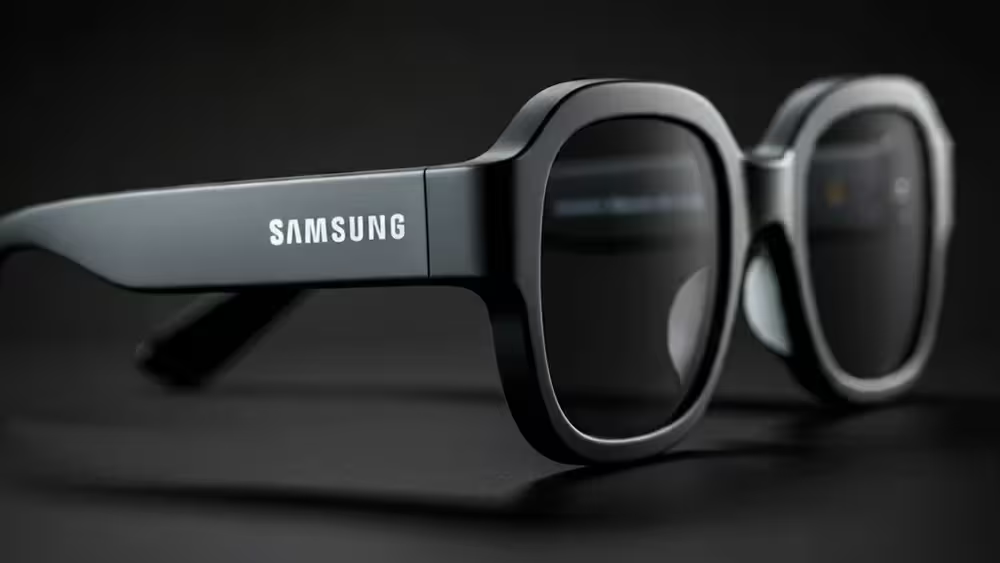
Samsung just changed a rumor into a calendar entry: smart glasses are real, and they're coming in 2026. Short sentence. Big implication.
The company has already dipped a toe into extended reality with the Galaxy XR headset; now it plans to turn that toe into a stride. Seong Cho, EVP of Mobile Experiences, made the announcement during Samsung's Q4 2025 earnings call, describing "next-generation AR glasses" designed to deliver multimodal AI experiences. Translation: these won't be simple notification frames — they're intended to blend vision, voice, and on-device intelligence.
Insiders and earlier reports suggest Samsung is preparing at least two distinct models. One will aim for the lightweight, Ray-Ban Meta–style market. The other appears to target a richer AR experience and will arrive later, once the first pair has cleared the runway.
Rumored hardware details are modest but telling. Expect a Qualcomm AR1 chipset at the heart of one model, a 12-megapixel camera for on-device capture, and a compact 155mAh battery. Those numbers alone don't answer every question. They do hint at a design that favors always-on AI features over marathon battery life.
- Processor: Qualcomm AR1 (rumored)
- Camera: 12 MP (rumored)
- Battery: ~155 mAh (rumored)
- AI: Google Gemini likely integrated for on-device features
Gemini is expected to be a central piece of the software puzzle, supplying conversational and multimodal AI capabilities that make the glasses feel less like a gadget and more like an assistant. That alignment — strong silicon, camera, and an advanced LLM — is exactly what's needed to move smart glasses from novelty to useful everyday tool.
When will you actually be able to buy them? Samsung hasn't locked down a specific month. The company's 2026 roadmap is crowded: the Galaxy S26 series and refreshed mid-range phones occupy Q1, and foldables typically dominate the latter half of the year. Where the glasses slot into that cadence will shape when they appear in stores.
Tech giants have tried this before. So why might Samsung succeed? Because it can stitch devices, services, and chips into an ecosystem people already use. Or it might stumble on battery, weight, or software polish. Either way, 2026 looks set to be the year we start judging wearable AI not on prototypes, but on everyday reality — and that judgment could be swift.
Are you ready to wear intelligence?

“I cover emerging technologies, digital innovation, and the intersection of tech and everyday life. My goal is to make complex trends accessible and inspiring.”

Discussion
Leave a Comment