
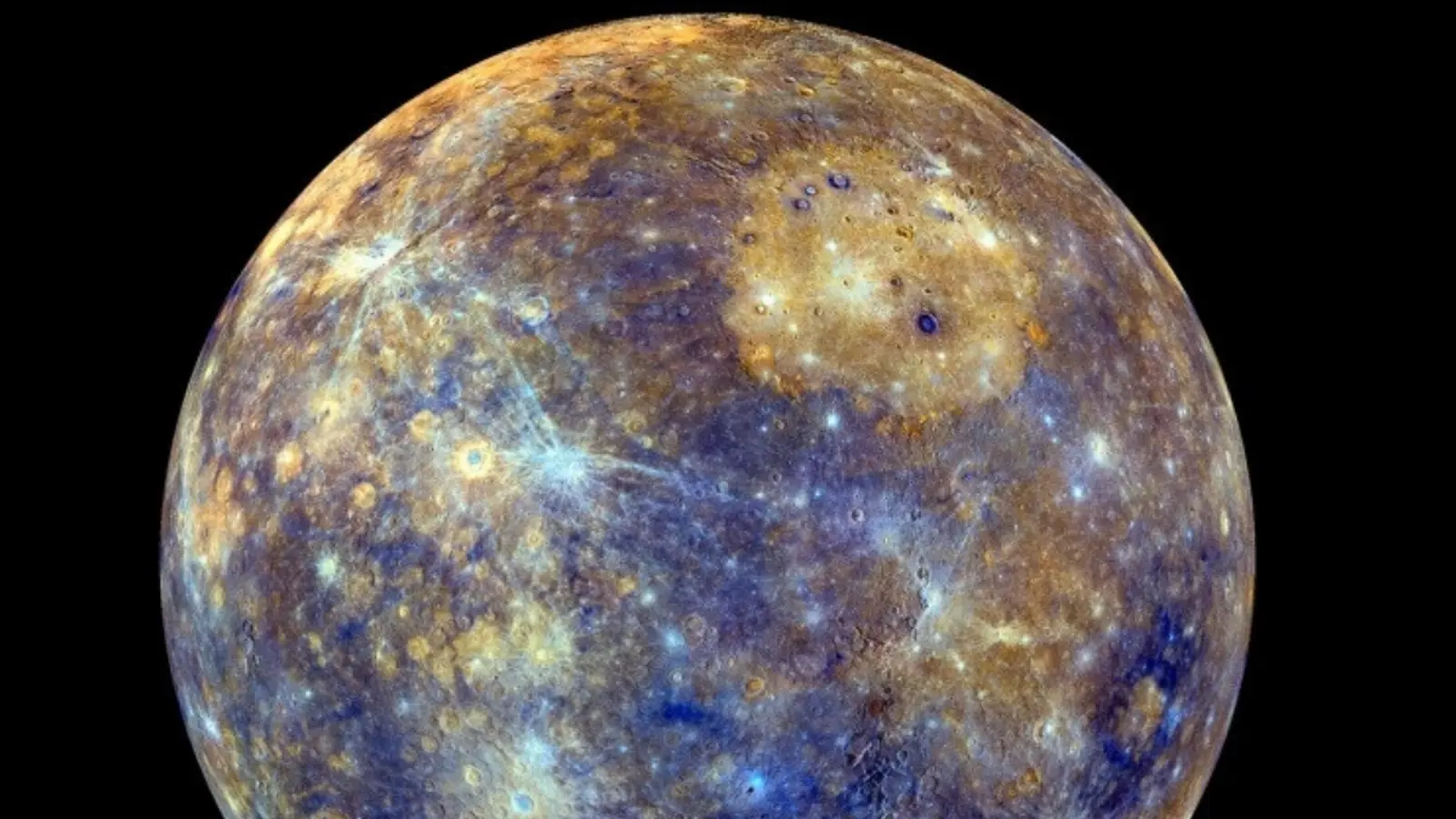
The smallest planet in our Solar System keeps returning the biggest surprises. Thin, luminous streaks traced along crater walls and slopes — long dismissed as static scars — now look more like signatures of ongoing change. Far from a geologic corpse, Mercury may still be breathing, in a planetary sense.
.avif)
The streaks on the slopes of a crater wall on Mercury in an image taken on 10 April 2014.
For decades, Mercury’s landscape was thought to be a museum: ancient impacts frozen under a thin, airless sky. But a new survey by Valentin Bickel (University of Bern) and colleagues at the Astronomical Observatory of Padova argues otherwise. By cataloguing 402 bright linear features, formally called lineae, and re-examining where they appear, the team has drawn a picture of a planet that still moves material from depth to surface.

Bright streaks are clearly visible around a crater on Mercury, in an image taken on 1 August 2012.
How did they get there? The researchers fed 100,000 high-resolution images taken between 2011 and 2015 into a machine-learning pipeline to locate and map lineae across Mercury’s sunlit hemisphere. Patterns emerged. The lines tend to cluster on sun-facing, steeper slopes of craters — places where daytime heating is strongest — and they often begin near hollows, the shallow, bright depressions known from earlier missions.
How these bright lines may form
One simple idea fits the geometry and the observations: volatile-rich material trapped beneath the crust moves toward the surface along networks of cracks created by impacts. When sunlight warms a sun-facing slope, volatiles — sulfur and other low-boiling-point compounds are candidates — can migrate and sublimate or chemically alter the upper regolith, leaving fresh, reflective streaks in their wake. 'Volatile material could reach the surface from deeper layers through networks of cracks in the rock caused by the preceding impact,' Bickel explains. Hollows themselves are likely related to the same process, often marking where subsurface volatiles have already been lost.
The team also notes that lineae on other planetary bodies fade relatively quickly under space weathering, so the presence and sharpness of many of Mercury’s streaks suggest they are still forming or evolving now, not merely relics of the distant past. That has implications for how heat, impact fracturing, and chemical composition interact on a tiny world with almost no atmosphere.
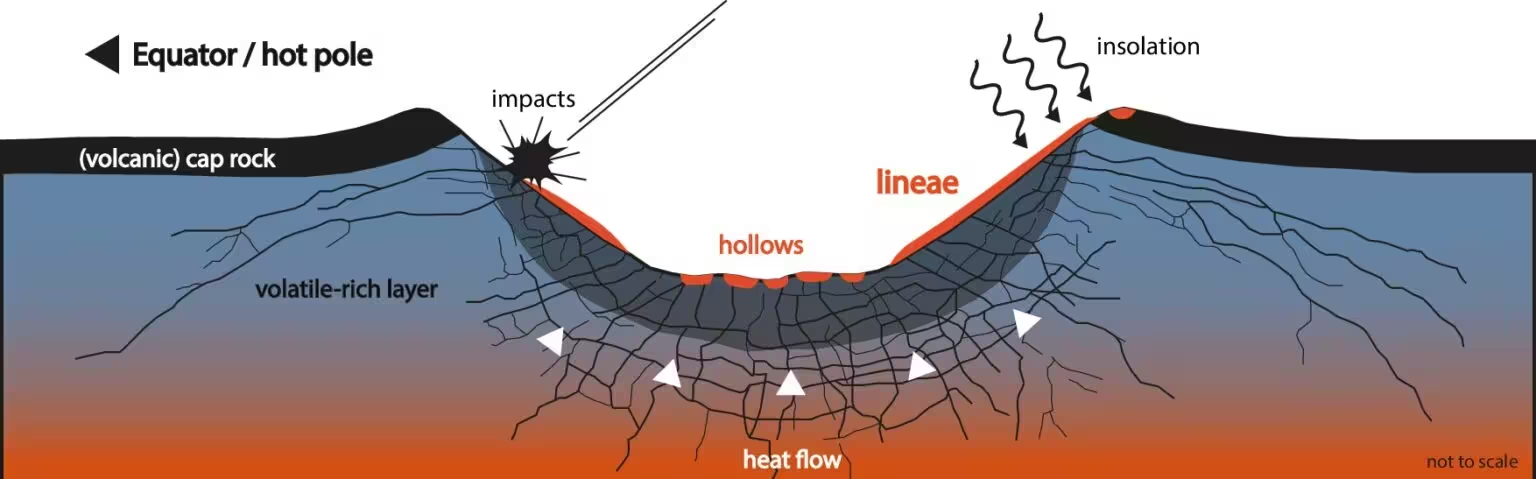
Conceptual hypothesis of slope lineae formation on Mercury.

Examples of slope lineae that do not originate from hollows.
Why this matters beyond academic curiosity: if Mercury is actively mobilizing volatiles, even episodically, it changes our understanding of volatile retention and redistribution on small, airless bodies. It also sharpens the questions planetary scientists bring to new datasets: which compounds are involved, what temperatures trigger the flows, and how deep the volatile reservoirs lie?
New orbital data from missions coordinated by ESA and JAXA — notably the BepiColombo mission — will supply higher-resolution stereo imaging and spectral measurements capable of testing the volatile hypothesis. If those observations show changes over time or identify telltale spectral signatures of sulfur-bearing or other volatile phases near lineae and hollows, the case for present-day activity will strengthen.
The study reporting these findings appeared in Nature Communications Earth & Environment and nudges Mercury off the shelf of inert worlds and back into a place where processes still unfold under Mercury’s harsh, sun-drenched skies.

“The cosmos has always fascinated me. I write about space missions, astronomy, and the technologies pushing humanity beyond Earth.”

Discussion
Leave a Comment