
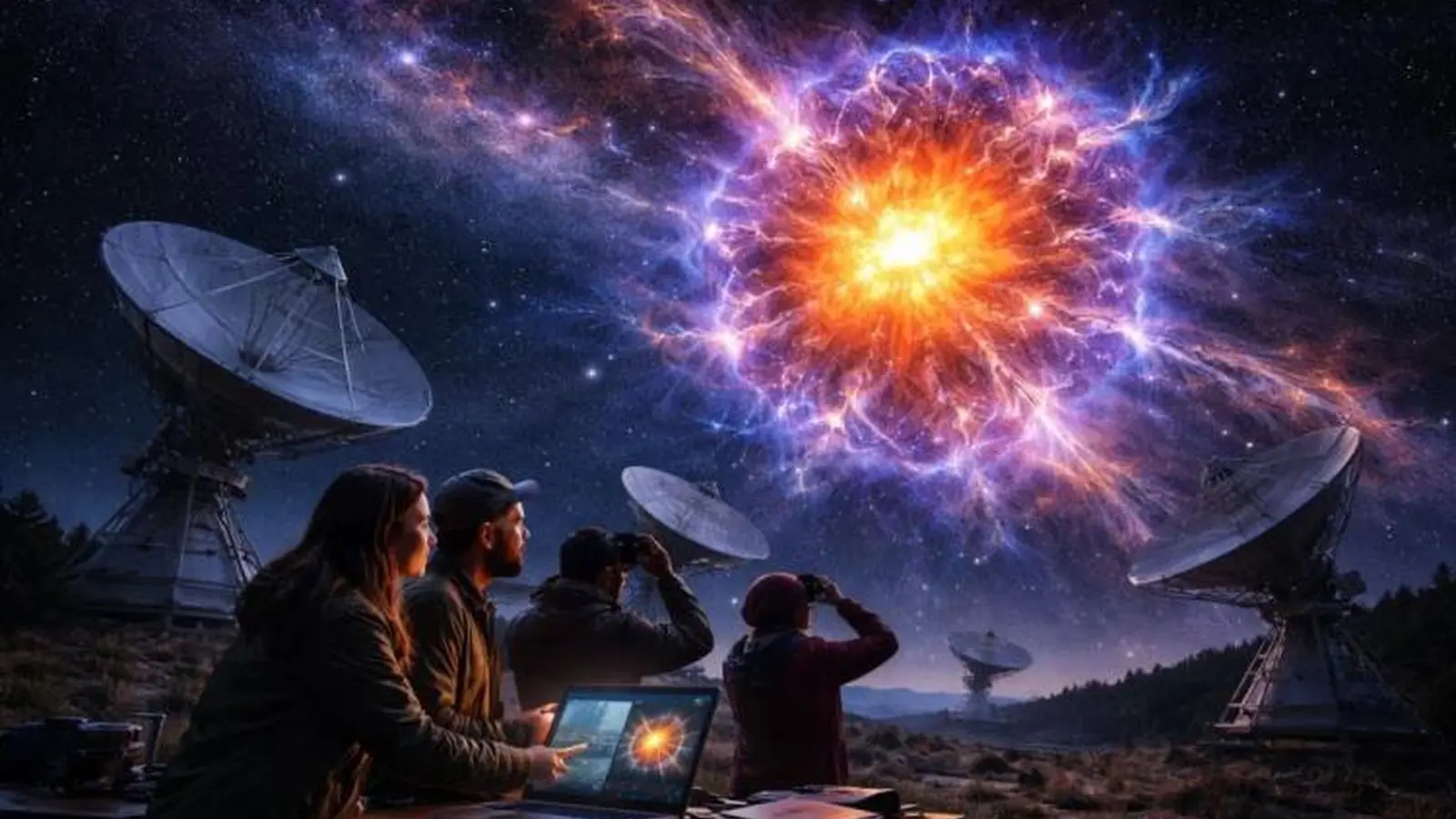
A faint radio whisper from a distant galaxy has rewritten a small but crucial chapter in how massive stars die. For the first time, astronomers have detected persistent radio emission from a Type Ibn supernova — a rare explosion born out of a star that shed large amounts of helium-rich gas just before it blew apart. That radio signature acts like a time capsule, exposing violent mass loss in the years immediately preceding the blast.
Listening where light cannot
Optical telescopes show us the blaze of a supernova, its changing colors and brightness. But they do not always reveal the dense shells of material a star can dump into its surroundings in the decades or years before collapse. Radio telescopes fill that gap. When the supernova’s shockwave slams into circumstellar gas, it accelerates electrons and generates synchrotron emission — radio waves that travel across space and arrive at our antennas. Those waves carry a record of the density, speed and timing of that escaped material.
Using the National Science Foundation’s Very Large Array in New Mexico, researchers tracked faint radio emission from a Type Ibn event for roughly 18 months. The observations pointed to gas that had been flung off the progenitor only a few years earlier — an intense, brief shedding episode that optical studies alone would have missed. In plain terms: the star didn’t ease into death. It violently threw off mass in its final years, and the radio aftershock told the story.
“Radio lets us read the last decade of a star’s life,” said the paper’s lead investigator, a graduate student who led the monitoring campaign. “We could see the final five years as a distinct phase of extreme mass loss.” The statement underlines a shift in how astronomers can reconstruct progenitor behavior: not by hunting archival images of the star itself, which is usually too faint, but by examining the environment it created just before exploding.

Binary trouble and the mechanics of shedding
One of the strongest implications from the radio data is that the violent mass loss was likely driven by a companion. Single massive stars can lose mass through winds or eruptions, but the magnitude and rapidity inferred here strongly suggest gravitational interaction between two stars. When a close companion strips material or triggers eruptive episodes, the primary can be left surrounded by a compact, helium-rich shell — the exact kind of environment that produces a Type Ibn event.
Why does that matter? Because the structure and timing of circumstellar material influence the appearance of the supernova and the diagnostic signals it emits at all wavelengths. A dense, nearby shell changes the shock dynamics, boosts radio and X-ray output, and can even alter optical light curves. In short, the pre-explosion behavior of the progenitor is not a footnote: it directly shapes the explosion’s observables and the way we classify and understand it.
Beyond a single case study, the result opens a new observational strategy. Point radio arrays earlier and more systematically after discovery. Monitor Type Ibn and other unusual supernovae for months to years. Combine radio with optical and X-ray follow-up to build a multiwavelength timeline of mass loss and explosion physics.
Expert Insight
“This kind of radio detection changes the timetables we use,” said Dr. Elena Suarez, an observational astrophysicist not involved with the study. “We used to think most critical mass-loss signatures would be visible in optical precursors or archival imagery. Now we see that radio can reveal very recent, compact shells of material — things that vanish quickly and are otherwise invisible. That has consequences for supernova demographics and for models of binary interaction.”
Technically, the discovery relied on the VLA’s ability to probe centimeter-wavelength emission with high sensitivity and cadence. By watching how the radio brightness evolved, the team could infer the density profile of the shocked gas and estimate when the material was expelled. Future facilities and coordinated observing campaigns will make such detections more routine, letting astronomers measure how common last-minute mass-loss episodes are across different progenitor types.
Beyond the immediate astrophysical implications, this work is a reminder: stars don’t always die quietly. Some spend their final years in frenetic motion, shedding identity and mass in dramatic acts that rewrite their final fate. Detecting those acts requires listening — with radio ears tuned to signals that optical telescopes alone cannot hear — and doing so early, before the echoes fade into the cosmic background.

“My work centers on sustainability, energy, and environmental science — examining how innovation can lead to a greener future.”

Discussion
Leave a Comment