
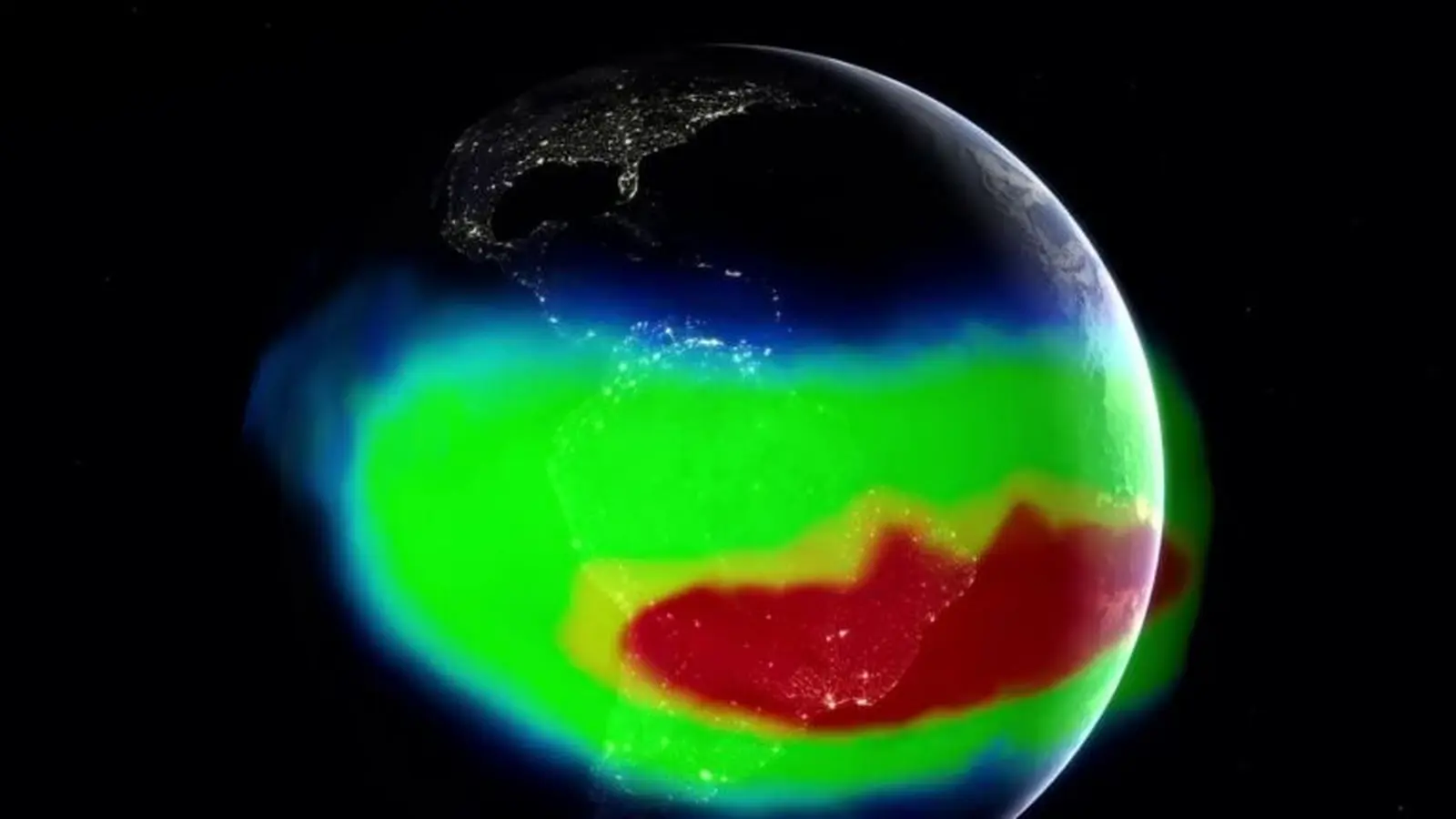
Satellites tracking Earth's magnetism report a widening "dent" in the planet's magnetic shield over the South Atlantic. New long-term data show the South Atlantic Anomaly (SAA) has expanded and weakened in ways that reveal restless motion deep inside Earth — motion that matters for satellites, navigation and radiation exposure.
What the South Atlantic Anomaly is — and how we monitor it
The SAA is a region above the South Atlantic and parts of South America and southern Africa where Earth's magnetic field is unusually weak. That weakened field allows charged particles from space to approach closer to the atmosphere and to interact more strongly with satellites and spacecraft passing through the area.
We first noticed anomalies in this region in the 1960s, but continuous, high-resolution study only became possible after the European Space Agency launched the Swarm constellation in 2013. Swarm's three satellites work in concert to map the geomagnetic field, producing the longest uninterrupted record of the field's behavior available today. From those time series, scientists can track changes in intensity, shape and movement of magnetic features such as the SAA.
New findings: growth, drift and a patchy structure
Recent Swarm analyses indicate the SAA has grown substantially since 2014 — by an area approximately half the size of continental Europe — while its magnetic intensity has continued to decline. The anomaly isn't a single, static hole; it behaves more like several connected patches that evolve differently across the region.
"The South Atlantic Anomaly is not just a single block," says geophysicist Chris Finlay of the Technical University of Denmark. "It's changing differently towards Africa than it is near South America. There's something special happening in this region that is causing the field to weaken in a more intense way."
The Swarm data show one of the unusual magnetic flux features moving westward over Africa, which contributes to the changing strength of the SAA in that sector. Another comparison image series highlights the difference between the anomaly's size and strength in 2014 and 2025.
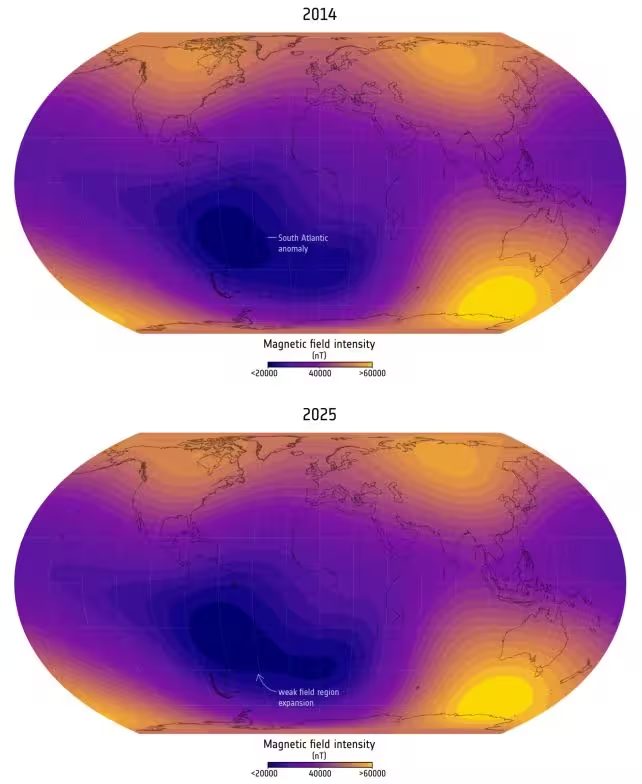
The size and strength of the anomaly in 2014 (top) and 2025 (bottom). (ESA)
What’s happening deep inside Earth?
Earth's magnetic field originates in the outer core, where molten iron conducts electricity while convecting and rotating. That geodynamo normally produces a roughly dipolar field — think of a bar magnet with a north and south magnetic pole — but the real field includes complex regional variations. Below the SAA, some magnetic flux behaves unexpectedly: instead of emerging from the core in the southern hemisphere, local patches show flux sinking back into the core.
One candidate for producing these anomalies is the African Large Low-Shear-Velocity Province (LLSVP), a vast, hot, dense region near the core-mantle boundary beneath Africa. That structure may disrupt convective patterns in the outer core and produce localized changes in the magnetic field above. In short, what Swarm detects in space is a fingerprint of dynamic processes many thousands of kilometers below our feet.
Why this matters: satellites, navigation and radiation
- Satellites and electronics: A weaker magnetic field reduces shielding against charged particles. Satellites passing through the SAA can experience increased single-event upsets, sensor noise or charge buildup that affects instruments and electronics.
- Navigation systems: Some navigation techniques still depend on geomagnetic references. Rapid or irregular changes can complicate calibrations and require updates to models used by aircraft and vessels.
- Aviation and human exposure: Astronauts and high-altitude flight crews receive more ionizing radiation when passing through regions of weaker magnetism. Although the increased doses are usually small, they are important to quantify for long-term missions and frequent flyers.
Understanding the SAA is therefore not only a matter of academic interest but a practical concern for satellite operators, airlines, space agencies and navigation services.
Mission details and future prospects
Swarm's three-satellite mission was designed specifically to resolve temporal and spatial changes in the geomagnetic field. The satellites carry magnetometers and auxiliary sensors that measure magnetic intensity, orientation and related parameters. Because Swarm provides coordinated point measurements over time, scientists can separate short-term fluctuations from longer-term secular change and better model the geodynamo's behavior.
Anja Strømme, Swarm mission manager at ESA, remarks: “It's really wonderful to see the big picture of our dynamic Earth thanks to Swarm's extended timeseries. The satellites are all healthy and providing excellent data, so we can hopefully extend that record beyond 2030, when the solar minimum will allow more unprecedented insights into our planet.”
Beyond Swarm, advances in ground networks, computer modeling and laboratory experiments on fluid dynamics and magnetism will help researchers test hypotheses about the links between deep mantle structures like the LLSVP and surface magnetic anomalies.
Expert Insight
Dr. Laura Mendes, a space physicist not involved in the Swarm analysis, offers context: “Imagine the core as a turbulent ocean of liquid metal. Localized 'eddies' and large-scale temperature anomalies in the mantle can steer that flow in ways that change the magnetic field over years or decades. What Swarm is showing us is the geodynamo's weather — and like weather, it can be fast, regional and surprising.”
Her practical note: “For satellite engineers and mission planners, the message is clear — assume regional magnetic variability and design systems and operations that can tolerate occasional increases in charged particle activity.”
As Swarm continues to expand the time record, scientists expect to refine predictive models that could provide earlier warnings of changes affecting space-borne infrastructure. For now, the South Atlantic Anomaly stands as a vivid reminder that Earth's interior and near-space environment remain highly dynamic and interconnected.

“The cosmos has always fascinated me. I write about space missions, astronomy, and the technologies pushing humanity beyond Earth.”

Discussion
Leave a Comment