
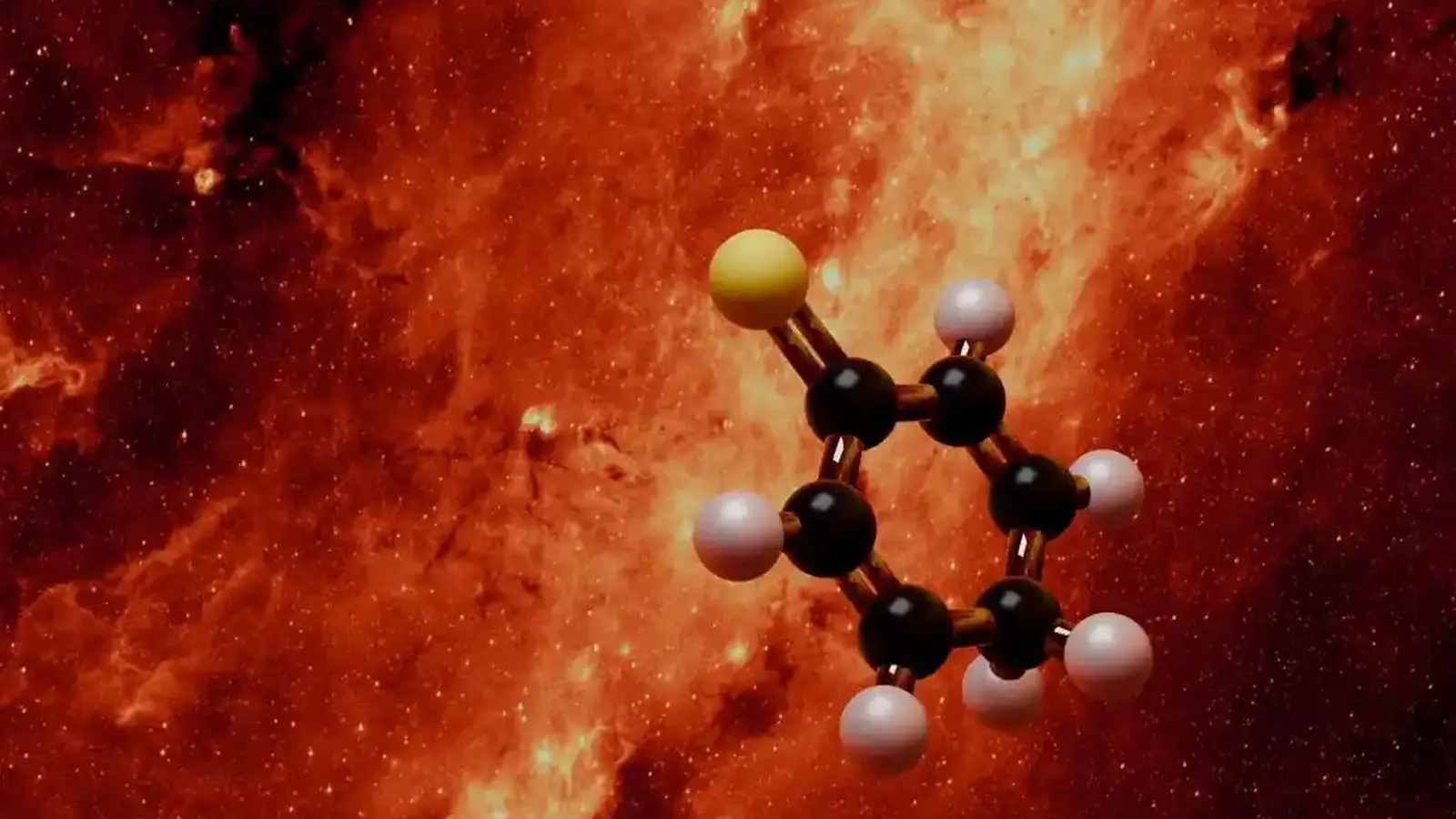
Imagine a sugar‑cube sized ring of atoms, forged in the cold and dark, drifting through a cloud that will one day birth stars. That image is suddenly less fanciful: astronomers have detected thiepine, a six‑membered sulfur ring (2,5‑cyclohexadiene‑1‑thione, C6H6S), floating in an interstellar cloud near the Milky Way’s center.
Scientists from the Max Planck Institute for Extraterrestrial Physics (MPE) and the CSIC‑INTA Centro de Astrobiología (CAB) looked into a dense molecular cloud known as G+0.693–0.027, roughly 27,000 light‑years away. What they found changes the chemistry checklist for regions that eventually form planetary systems: a 13‑atom, ring‑shaped sulfur compound previously unseen in space.

Scientists discovered the first sulfur-bearing six-membered ring molecule hiding in an interstellar cloud.
Discovery and detection
How do you prove something that small exists across thousands of light‑years? You make it on Earth first. In the lab, researchers subjected liquid thiophenol (C6H5SH) to a 1,000‑volt electrical discharge, producing a suite of reaction products. A custom spectrometer then measured the unique radio‑frequency fingerprint of thiepine among those products. Short sentence. Clear result.
Armed with that fingerprint, astronomers searched radio data from Spain’s IRAM 30‑meter and Yebes 40‑meter telescopes. The match was there: emission lines in the molecular cloud that aligned with the laboratory spectrum. That alignment is the smoking gun — a molecule identified not by visible light, but by the way it wiggles radio waves.
Until now, interstellar sulfur chemistry had been limited to quite small species — molecules with six atoms or fewer — even though meteorites and comet samples show much richer sulfur-bearing organics. Thiepine bridges that gap. Structurally, it resembles compounds found in primitive solar system material, hinting that complex organics can form long before planets and stars take shape.

Water in the planet-forming disc around the star V883 Orionis (artist's impression)
Why this matters
Why care about one molecule? Because chemistry is a conversation. Each new species discovered in space alters the grammar of that conversation and nudges theories about how life’s building blocks assemble. If a ring‑shaped sulfur molecule can exist in a cold, starless cloud, then the precursors for biologically relevant chemistry are present earlier and more widely than many models assumed.
Lead author Mitsunori Araki and colleagues describe the detection as the first unambiguous identification of a complex sulfur‑bearing ring in the interstellar medium. Co‑author Valerio Lattanzi notes that a molecule similar to those found in comets already exists in a young, starless cloud — chemical groundwork that predates star formation.
There is a broader pattern emerging. Recent laboratory and observational studies — including experiments showing spontaneous peptide formation under space‑like conditions — suggest that prebiotic chemistry is not a rare special case. It might be woven into the very fabric of molecular clouds, delivered later to forming worlds via comets and meteorites.
The immediate next steps are straightforward in concept and fiendish in execution: search other rich molecular clouds for further sulfur rings and expand laboratory spectroscopy to cover likely cousins of thiepine. If those searches succeed, our inventory of interstellar organics will grow, and with it, our understanding of how the ingredients for life travel from space to planets.
Discovery like this doesn’t answer every question. It raises new ones. Where else are complex sulfur molecules hiding? And how many more steps separate simple interstellar gases from the chemistry that ignites biology? The hunt has only just begun.

“My work centers on sustainability, energy, and environmental science — examining how innovation can lead to a greener future.”

Discussion
Leave a Comment