
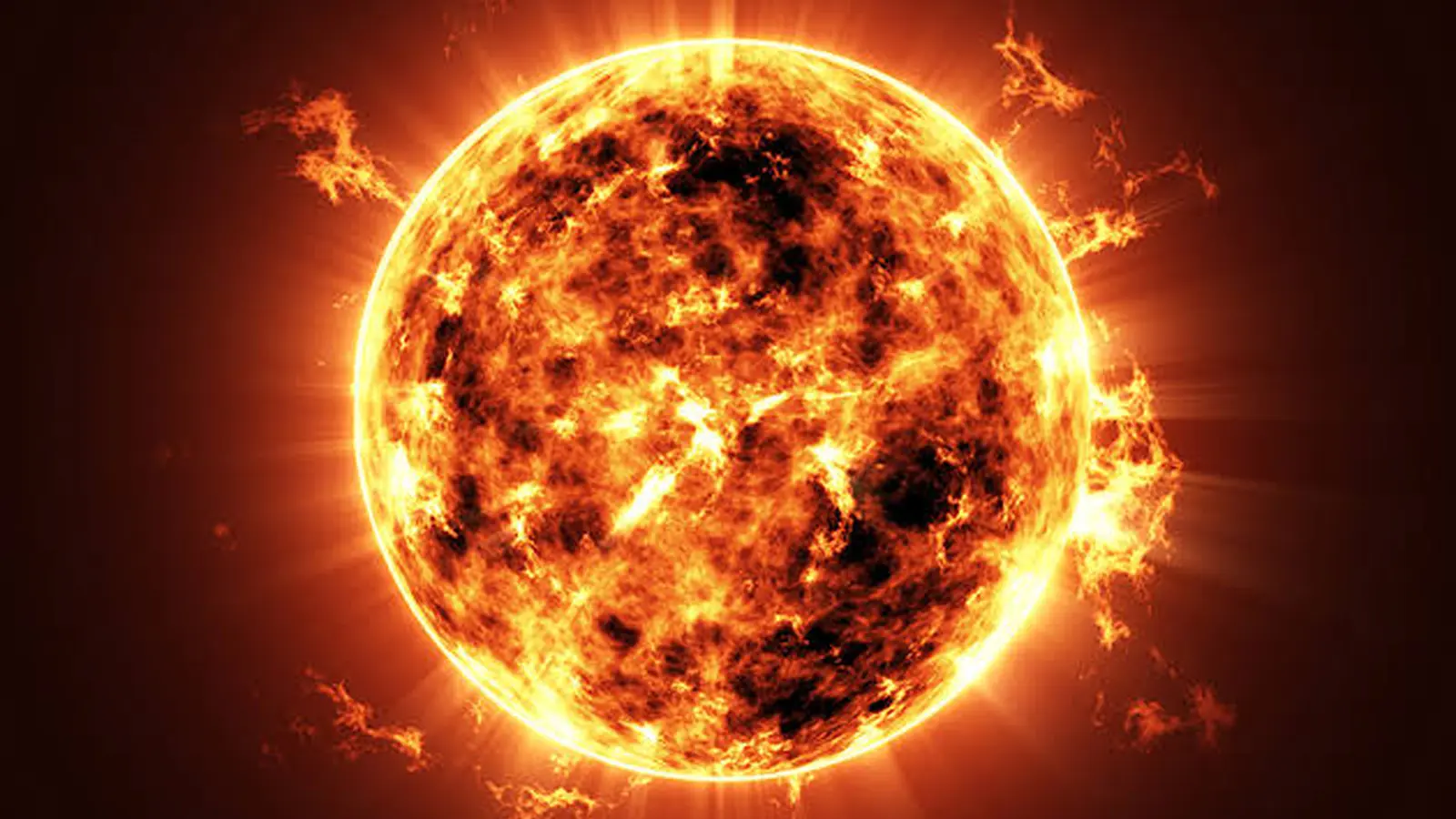
The Sun erupted with four powerful X-class flares over a short span, signaling that space weather could turn lively once again. It began on February 1 at 12:33 UTC with an X1.0 flare, then escalated dramatically that night when an X8.1 blast tore out of the solar surface at 23:37 UTC. Two more strong events followed in the early hours of February 2: an X2.8 at 00:36 UTC and an X1.6 at 08:14 UTC.

An image of the X8.1 flare captured by NASA's Solar Dynamics Observatory.
X-class flares represent the most intense category of solar flares. The X8.1 event stands out: it was the most powerful measured since October 2024 and ranks among the top twenty recorded flares in modern observations. These releases of electromagnetic energy travel across the solar system and can affect Earth even when the source remains several days away from the central disk.
All four flares originated from a sunspot cluster labeled RGN 4366. That group has only just begun to turn toward Earth, according to the National Oceanic and Atmospheric Administration Space Weather Prediction Center. NOAA warned that if the active region keeps evolving and maintains magnetic complexity, further strong flares and energetic particle events could follow, and coronal mass ejections, or CMEs, may be possible.
The February flares, captured by NASA's Solar Dynamics Observatory.
Why this matters for satellites, grids, and auroras
Not every flare produces a coronal mass ejection, and not every CME hits Earth. But when a CME does arrive, it can buffet Earths magnetosphere, triggering dazzling auroras and, in stronger cases, damaging satellite electronics, degrading high-frequency radio communications, and inducing currents in long conductors that can affect power transmission networks. Space weather forecasters watch both the flare intensity and the geometry of any accompanying CME to judge potential impacts.
What should we take from this sequence of events? First, the Sun is still capable of producing intense activity even as the overall solar cycle declines after a recent peak. Solar observers point out that the Sun passed through its most active phase of the roughly 11-year cycle in 2024, delivering remarkable auroral displays and a heightened rate of X-class flares. Decline is expected over the coming years toward the next minimum and the subsequent cycle around 2030, but intermittent surges of activity remain possible.
No immediate widespread disruptions were reported following these specific flares, but the episode is a reminder that space weather forecasting remains a critical part of modern infrastructure planning. Agencies such as NOAA and NASA continue to monitor active regions in real time, combining solar imagery, magnetograms, and particle data to update forecasts and advisories as conditions evolve.
For now, aurora watchers and satellite operators alike should pay attention. The Sun is quiet only until it is not, and RGN 4366 has not yet finished its show.

“My work centers on sustainability, energy, and environmental science — examining how innovation can lead to a greener future.”

Discussion
Leave a Comment