
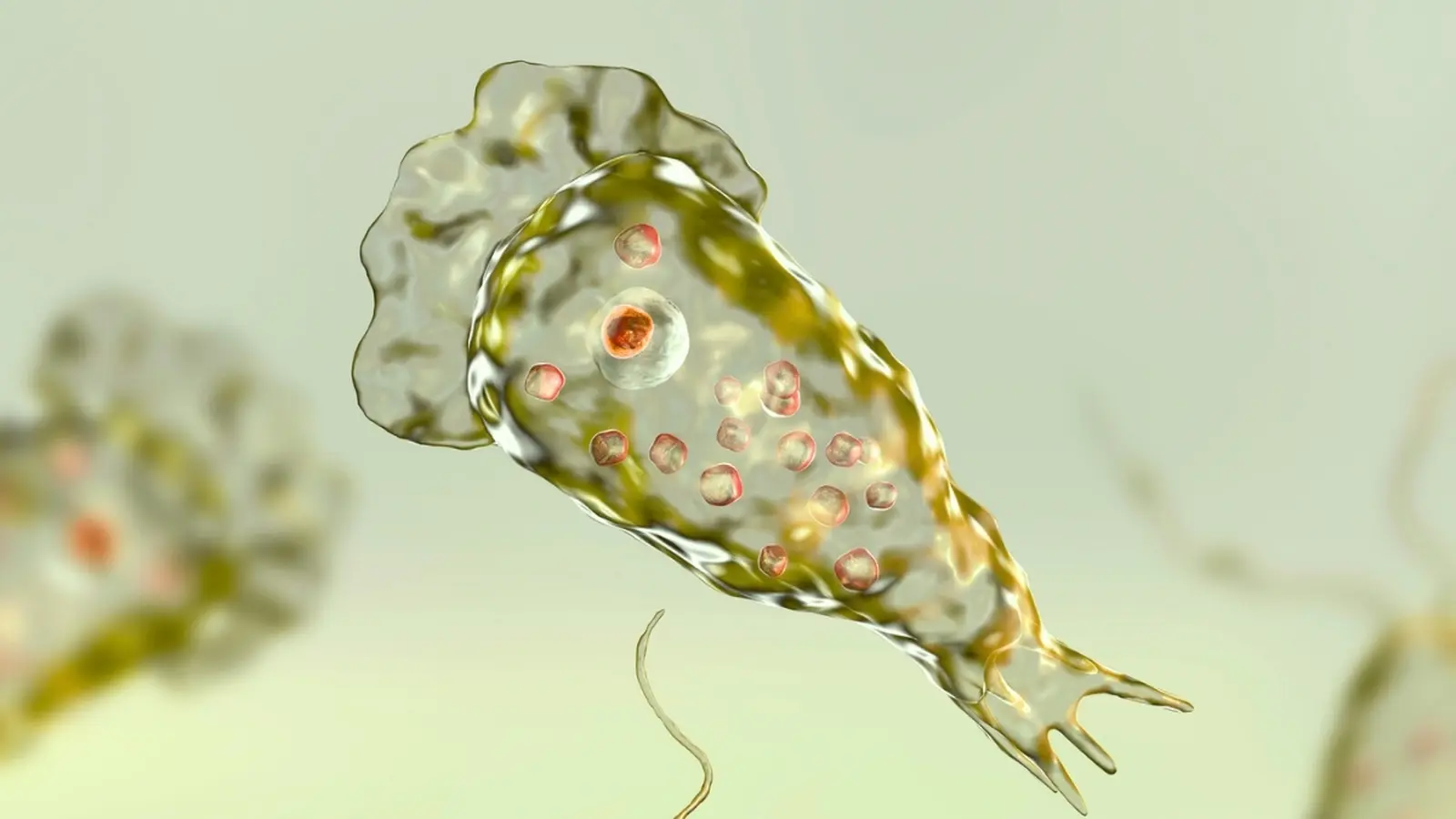
Imagine a single-celled organism that doesn't need a host to live, that oozes and reshapes itself to hunt, and that can turn a summer swim into a medical emergency. Small. Unseen. Dangerous under the right conditions.
Who these amoebas are and why they matter
Free-living amoebas are a diverse ensemble of single-celled eukaryotes found in soils and freshwater worldwide. They move on temporary arm-like projections called pseudopodia—literally "false feet"—and feed by engulfing bacteria, fungi and other microscopic prey. Most are harmless background actors in ecosystems. A few, however, have earned grim reputations.
Naegleria fowleri is the headline grabber. Known colloquially as the "brain-eating amoeba," it thrives in warm freshwater—lakes, rivers, hot springs and poorly treated municipal sources—usually between 30°C and 40°C. Infection occurs not by drinking contaminated water but when water carrying the organism is inhaled through the nose. Once the amoeba reaches the nasal mucosa it can migrate along olfactory nerves to the brain, where it triggers fulminant, often fatal inflammation. Mortality rates are terrifyingly high: reports put them between 95 and 99 percent for symptomatic infections.
Cases remain rare. Yet rarity is not the same as irrelevance. As climate patterns shift and human contact with warm, untreated water increases, the likely zones of exposure are widening.

Cases of Naegleria fowleri infection have occurred following sinus rinsing with contaminated water.
Survival tricks: cysts, biofilms and the Trojan horse
The reason these organisms are hard to eradicate is biological ingenuity. In hostile conditions some amoebas form cysts—dense, resistant shells that withstand temperature fluctuations and disinfectants. In plumbing and natural sediments they hide inside biofilms: slimy matrices of microorganisms and organic matter that coat pipe walls and reservoir surfaces. Chlorine struggles to penetrate biofilms, and organic load can neutralize chemicals meant to disinfect water.
There’s another layer of complexity: free-living amoebas can act as mobile sanctuaries for other pathogens. Inside an amoeba’s cell they find shelter from environmental stressors and disinfectants. Bacteria such as Legionella pneumophila and some mycobacteria can survive and multiply within amoebae; fungi like Cryptococcus may receive protection; and certain viruses can persist inside these hosts. This "Trojan-horse" relationship not only prolongs pathogen survival in water systems and soils but may shape virulence and antibiotic resistance in ways we are only beginning to understand.

Illustration of an amoeba eating bacteria.
Climate change and shifting risk
Warmer temperatures and longer, hotter summers expand habitats suitable for thermophilic microbes. Naegleria fowleri prefers heat. As lakes warm and hot weather persists, previously inhospitable regions become vulnerable. What was once a concern for subtropical areas is now being reported farther north and at higher elevations.
Human behavior amplifies exposure. More people swim, dive and use water-based recreation for longer periods of the year. In some communities, water scarcity drives reuse or creates stagnation in distribution systems—conditions that favor biofilm growth and pathogen persistence. When municipal water is warm and disinfectant residuals fall, the risk triangle—susceptible microbe, favourable environment, human contact—starts to align.
How safe is our water?
Routine testing for free-living amoebas is uncommon. Detection requires specialized laboratories, targeted assays and often sampling strategies that are more expensive than routine bacterial monitoring. Instead, public health systems rely on control measures: maintaining appropriate disinfectant residuals, flushing rarely used outlets, and following engineering practices that limit stagnation and biofilm formation.
That approach works most of the time. When it fails—when pipes warm, chlorination lapses, or private systems are poorly maintained—these organisms can slip through. There have also been instances where Naegleria was detected in tap water used for nasal rinsing and religious ablutions, leading to tragic infections when users instilled non-sterile water into their sinuses.
Clinical risks beyond the brain
Naegleria fowleri causes primary amoebic meningoencephalitis (PAM), an acute brain infection with rapid onset. But free-living amoebas include other species—Acanthamoeba and Balamuthia—that cause different disease spectra. Acanthamoeba can cause painful keratitis in contact lens wearers when lenses are rinsed with contaminated water; it can also produce chronic granulomatous encephalitis and skin lesions in immunocompromised patients. Balamuthia mandrillaris, though rare, can cause severe systemic and brain infections as well.
Prompt recognition is crucial. Symptoms—severe headache, fever, nausea, stiff neck, altered mental status—can be mistaken for other infections. Early diagnosis and aggressive treatment improve outcomes, but diagnostic windows are narrow and therapeutic options limited.
Prevention: practical steps
Prevention is straightforward in principle, less so in practice. For individuals, simple behavioral changes reduce risk dramatically: avoid submerging your head in warm, stagnant water; use nose clips when swimming in lakes; choose well-maintained, chlorinated pools; and for nasal irrigation, use only distilled, sterile, or boiled (and cooled) water. Contact lens users should never rinse lenses with tap water and must follow strict disinfection routines.
At the systems level, engineers and utilities must maintain disinfectant residuals, manage water temperatures in distribution networks, and routinely flush low-use branches. Public health guidance should highlight high-risk practices—sinus rinsing with untreated tap water is a preventable exposure—and clinicians should be trained to suspect amoebic infections after relevant freshwater exposures.
Expert Insight
"The biology here is straightforward but unforgiving: a tiny organism, the right temperature, and a direct route to vulnerable tissue," says Dr. Elena Ruiz, an environmental microbiologist with two decades examining urban water systems. "Our toolbox—chlorination, system design, outreach—is effective. The ongoing challenge is keeping that toolbox deployed in the face of aging infrastructure, climate shifts and human behavior. Early detection improves outcomes, but prevention remains the most reliable defence."
Dr. Ruiz’s point underscores a larger truth: technical fixes exist, yet they must be applied consistently and communicated clearly to the public.
What researchers are doing and what comes next
Scientists are improving detection methods, developing assays that find amoebae faster and more reliably in complex water matrices. Public health researchers are mapping environmental suitability to forecast where risks will emerge as the planet warms. Microbiologists are probing amoeba–pathogen relationships to understand how internalized microbes change in virulence or resistance. Each advance tightens the surveillance net and informs interventions.
Policy matters too: prioritizing upgrades in aging water infrastructure, ensuring routine maintenance in public and private systems, and integrating environmental surveillance with clinical reporting would bring a more proactive posture. Education campaigns about safe nasal irrigation, contact lens hygiene and recreational water choices can reduce individual risk immediately.
Rare? Yes. Tragic when it happens? Absolutely. Preventable? Largely, if the right measures are taken. If you spend time near warm freshwater this summer, remember: a few simple precautions can make all the difference.

“The cosmos has always fascinated me. I write about space missions, astronomy, and the technologies pushing humanity beyond Earth.”

Discussion
Leave a Comment