

The next time a yawn sneaks up on you, remember: that stretch of your jaw may be nudging the very fluid that cushions your brain. Researchers in Australia have used MRI to reveal an unexpected movement of cerebrospinal fluid (CSF) during yawning — a shift that diverges from what happens in a deep breath and could hint at why yawning evolved.
Study details and what the scans revealed
Scientists at the University of New South Wales scanned the heads and necks of 22 healthy adults while asking them to yawn, take deep breaths, stifle yawns and breathe normally. The team tracked both blood and CSF flow through the skull and neck to see how these behaviours affect the brain’s internal plumbing.
Deep breaths and yawns both increased blood leaving the brain, a change that makes room for fresh arterial inflow. But the surprise was in the CSF: yawns tended to push cerebrospinal fluid away from the brain, whereas deep breaths did not produce the same directional movement. The authors describe this as a movement opposite to what happens during deep inhalation.
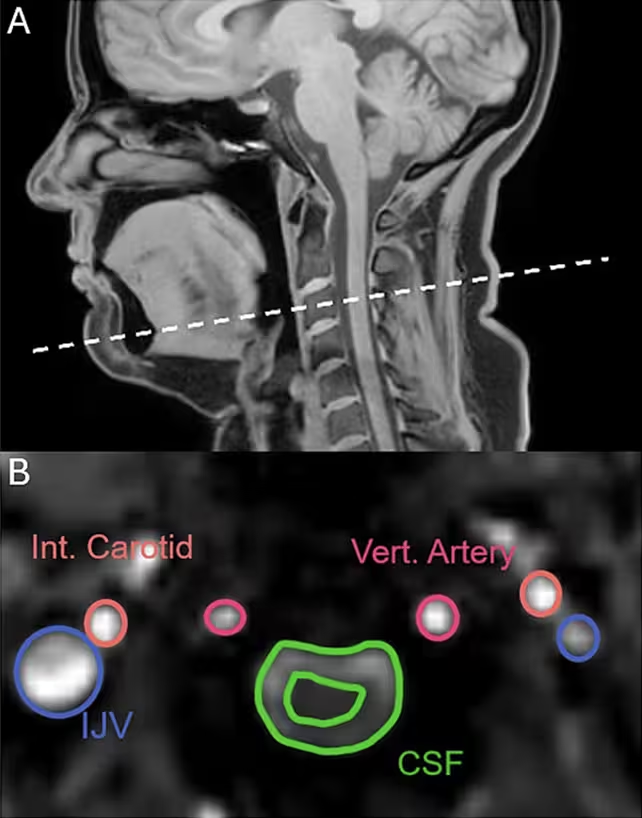
The scans showed yawns can displace CSF away from the brain, a pattern not seen with ordinary deep breaths.
That CSF shift did not occur in every participant, and it appeared less frequently in men — though the researchers caution that the scanner environment itself may have interfered with measurements. Another striking observation: during the initial phase of a yawn the carotid artery’s blood flow into the brain surged by roughly a third in many participants, which could point to multiple physiological roles for the behaviour.
Beyond group averages, the team found each volunteer had a unique yawning signature. Every person’s yawns tended to repeat the same internal timing and sequence when they yawned multiple times. The researchers interpret this as evidence for a central pattern generator — an innate neurological program that produces the characteristic motor sequence of a yawn rather than a behaviour learned from experience.
The study remains a preprint on bioRxiv and has not yet passed peer review, but it adds fresh data to a long-standing mystery. Is a yawn simply a mechanical reflex tied to respiration? Or is it doing something more: flushing waste, redistributing fluids, or even cooling neural tissue?
Expert Insight
"The idea that a single, stereotyped movement could help move CSF is exciting," says Dr. Claire Hammond, a neurologist who studies brain clearance mechanisms. "We already know that sleep and vascular pulsations help the glymphatic system clear metabolites. If yawning supplements that process, it opens up testable hypotheses about everyday behaviours and brain health."
Possible explanations offered by the authors include a role for yawning in brain clearance — mechanically promoting exchange between CSF and interstitial fluid — and a thermoregulatory function, with the pattern of jaw and respiratory movement helping to cool deep brain structures. The increased outbound venous flow seen with both yawns and deep breaths supports the idea that these actions change intracranial pressures briefly, creating windows for fluid exchange.
Practically, the findings are preliminary. The sample size is modest, the phenomenon was not universal across subjects, and instrument-related noise may have biased some measurements. Still, the results generate clear next steps: larger cohorts, simultaneous intracranial pressure or temperature monitoring, and experiments that link yawning behaviour to markers of metabolic clearance would help turn these motion pictures into mechanistic understanding.
The study also provides a neat piece of trivia: bigger brains tend to be associated with longer yawns, which could explain why yawning spans so many species and why its structure might scale with neural mass. Until follow-up studies arrive, the humble yawn remains a small, contagious puzzle with surprisingly large implications for how the brain moves and manages its fluids.

“The cosmos has always fascinated me. I write about space missions, astronomy, and the technologies pushing humanity beyond Earth.”

Discussion
Leave a Comment