
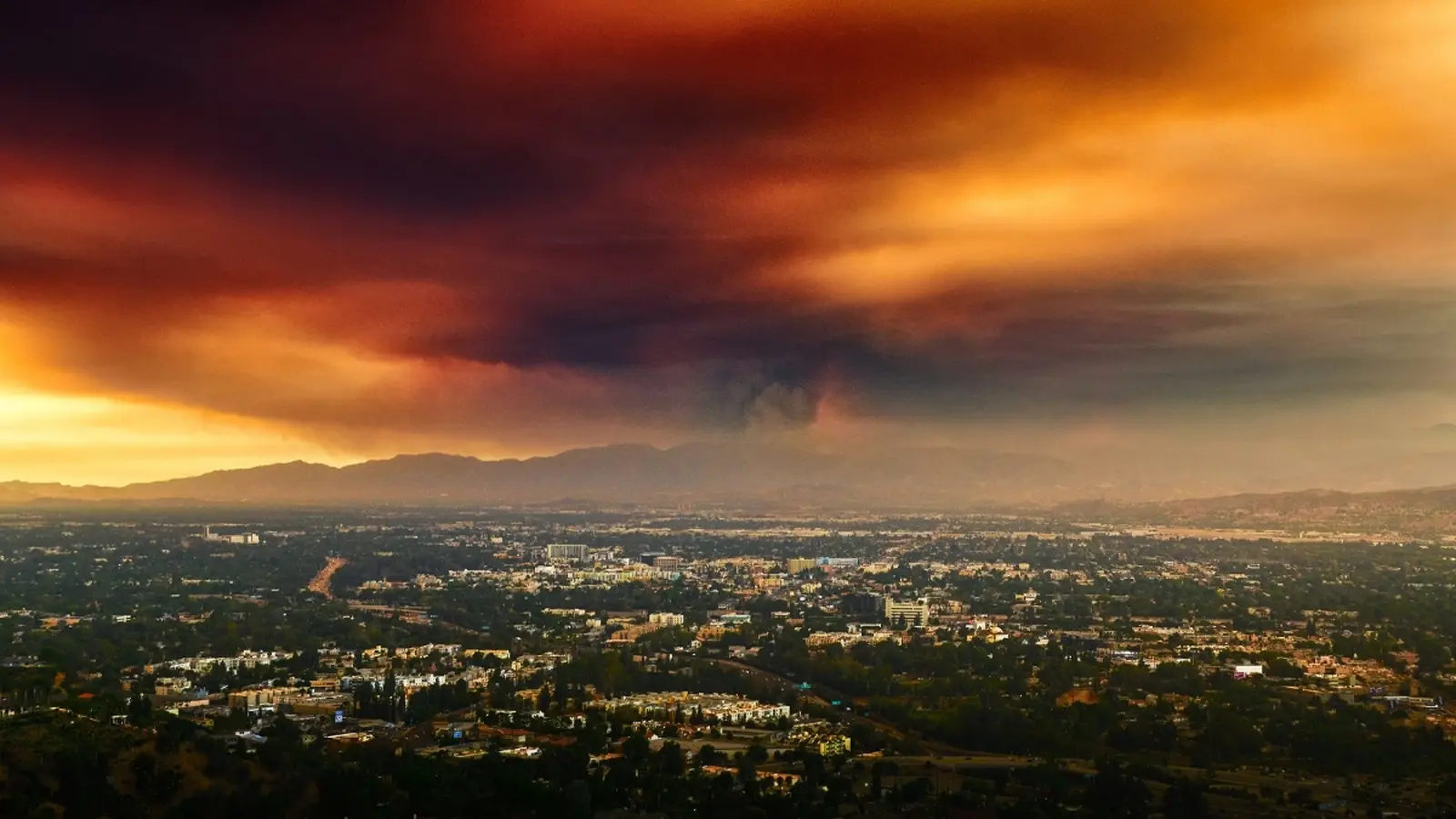
Smoke from distant blazes is doing something you might not expect: quietly shortening lives. A new analysis estimates that chronic exposure to fine wildfire particulates — the invisible dust known as PM2.5 — is linked to about 24,100 deaths per year across the contiguous United States between 2006 and 2020.
Invisible particles, visible consequences
Short breaths. Long damage. PM2.5 describes particles smaller than 2.5 micrometers. They slip past the nose and throat, settle deep in the lungs and can cross into the bloodstream. A day of heavy smoke triggers coughing and irritated eyes. Year after year of low-to-moderate exposure chips away at cardiovascular and respiratory health, raises risks for neurological problems, and can sharpen metabolic and endocrine disorders.
"Wildfire smoke is very dangerous," says Yaguang Wei, one of the lead authors and an assistant professor in environmental medicine at the Icahn School of Medicine at Mount Sinai. The study, published in Science Advances, quantifies a stark reality: these are not abstract statistics but real people whose health is compromised by airborne particles released when forests and grasslands burn.

2024 Line Fire smoke seeding cloud formation above its smoke plume.
Researchers emphasize that PM2.5 from wildfires is not the same as vehicle exhaust or industrial soot. Chemical composition and the mix of combustion products mean wildfire PM2.5 often has stronger health effects per unit mass. That difference matters for public-health planning, air-quality alerts, and how regulators view wildfire pollution.
How the study links smoke to mortality
The team examined county-level mortality records for the lower 48 states, covering all causes of death and specific categories such as circulatory, respiratory, and neurological diseases. They paired these records with estimates of annual average exposure to wildfire-specific PM2.5 from 2006–2020.
Across 3,068 counties, the analysis found statistically significant associations between rising wildfire PM2.5 and deaths from multiple disease classes — neurological conditions showed the largest relative increase. To test the robustness of their approach, the authors also looked at deaths unlikely to be caused by air pollution, like traffic accidents and falls, and found no association. That negative control strengthens the inference that the particulate exposure is linked to the other mortality signals.
Season and setting mattered. The relationship between particulate exposure and excess deaths was stronger during cooler months and in rural counties. Younger communities also showed unexpected vulnerability in some analyses, underscoring that smoke does not only threaten traditional high-risk groups.
Quantitatively, the paper reports that every 0.1 microgram-per-cubic-meter increase in wildfire PM2.5 corresponded to roughly 5,594 additional deaths annually across the study area — a sobering sensitivity given how smoke plumes can sweep across wide regions and cross state lines.
Michael Jerrett, a professor of environmental health science at UCLA who was not involved in the work, called the estimates reasonable and urged more studies with varied designs to build scientific confidence. He cautioned that county-level data can smooth over local hotspots — smoke drapes unevenly across landscapes, so large-county averages may under- or overestimate exposure for particular communities. Individual behaviors and risk factors, such as tobacco use or preexisting disease, were also not directly accounted for in the county-level model.
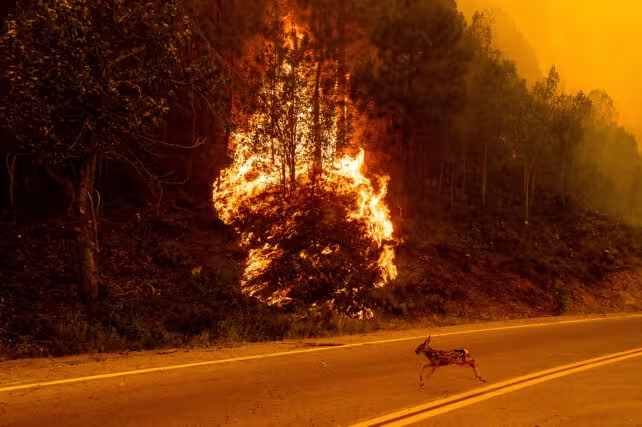
A fawn sprints across a road as the Sugar Fire, part of the Beckwourth Complex Fire, burns in Plumas National Forest
Policy, climate, and public health implications
The analysis lands at a crossroads of climate change, land management, and public health policy. Warmer conditions and prolonged droughts have lengthened fire seasons and amplified extreme-fire behavior, which in turn raises the frequency and extent of smoke episodes. Decades of forest mismanagement and expanding development into the wildland-urban interface have engineered more people into harm's way.
Kai Chen, an associate professor at Yale School of Public Health, praised the study for separating smoke-sourced PM2.5 from other particulate sources, and echoed a wider concern in the research community: wildfire-sourced PM2.5 tends to be more damaging per unit than many urban pollutants. Yet current air-pollution regulation treats wildfire emissions differently, often as an exempted "natural" source. That regulatory gap means many health harms hang outside routine EPA controls.
Federal policy rollbacks on climate and emissions controls amplify the risk, the authors warn. If the underlying drivers of extreme wildfire — rising temperatures, altered precipitation patterns, and human-caused ignitions — continue unchecked, the public-health burden from smoke will likely grow. Effective mitigation requires a mix of strategies: improved forest management, stricter controls on preventable ignition sources, urban planning that reduces exposure in the wildland-urban interface, and robust air-quality monitoring tied to protective public-health actions.
Expert Insight
"The message is plain: smoke is not only an episodic nuisance but a chronic environmental hazard," says Dr. Lena Morales, an environmental epidemiologist and public-health advisor who studies air pollution impacts on vulnerable populations. "We need better local monitoring, public-warning systems that reach people in rural and underserved areas, and building-level interventions—HEPA filtration, cleaner heating options—that reduce indoor infiltration during smoke events. Small steps add up when the exposure is widespread and repeated."
Min Zhang, a co-author, noted that increased wildfire frequency and intensity are central to the finding. Reducing the mortality toll will require both near-term protective measures for people when smoke is present and long-term strategies that address climate drivers and land-use choices.
The study is not the last word. It is a call to expand surveillance, refine exposure estimates at finer spatial and temporal scales, and test interventions that can blunt the toxic effects of wildfire smoke on communities. Because while the visible flames may be contained, the particles they send into the sky continue to move and to matter.

“My work centers on sustainability, energy, and environmental science — examining how innovation can lead to a greener future.”

Discussion
Leave a Comment