
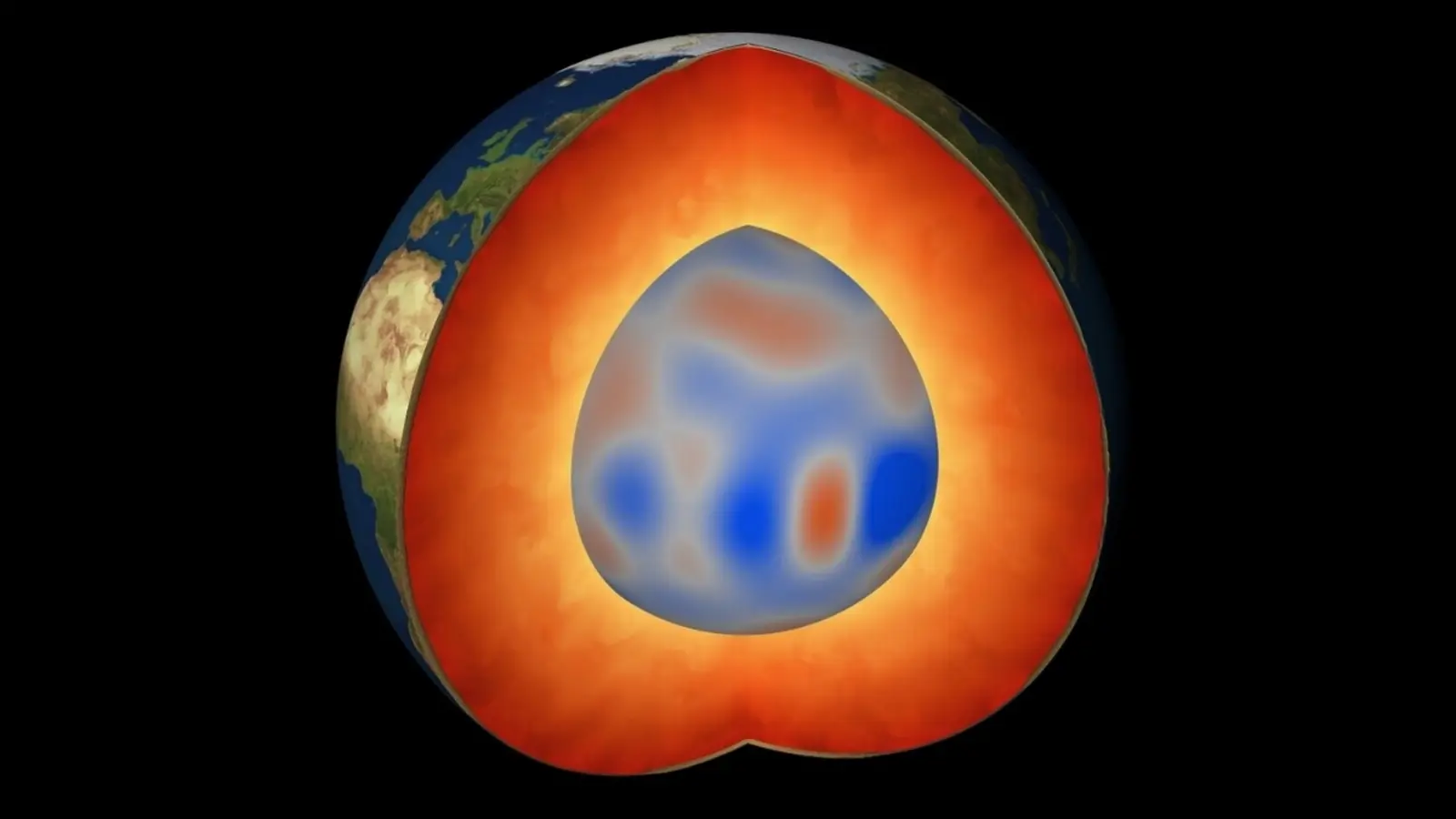
Imagine a pair of slow-burning furnaces sitting quietly at the bottom of the mantle, barely moving yet shaping the magnetic personality of our planet. Strange, right? Deep beneath Africa and the Pacific, seismologists have mapped gargantuan regions—nicknamed "Blobs"—that behave differently from the surrounding rock. They are solid, but anomalously slow for seismic waves. They are mysterious. And new research suggests they do more than sit there: they help stabilize Earth's magnetic field.
What these Blobs are and why they matter
We cannot drill to the core. We cannot ride a probe into the 3,000-kilometre-deep ocean of molten iron that churns in the outer core. Instead, our knowledge of the deep interior comes from indirect signals—seismic waves, laboratory mineral physics, and the magnetic recordings written into ancient rocks. Those recordings are a sort of time capsule: igneous rocks cool in Earth’s magnetic field and lock in a directional signature that tells us how the field looked when the rock formed.
The mantle itself is mostly solid rock that flows at geological speeds—millimetres per year—yet its lowermost section exhibits pronounced heterogeneity. Two enormous low-velocity zones, one roughly under Africa and the other beneath the central Pacific, stand out. Seismic waves slow down there, implying higher temperature, compositional differences, or both. These are the Blobs, or large low-shear-velocity provinces (LLSVPs) in technical parlance. If they are hotter than surrounding mantle, their thermal contrast can alter how heat escapes from the underlying liquid core—heat that drives the geodynamo and, by extension, the magnetic field that shields life from cosmic radiation.
From rocks to models: how scientists linked Blobs to the magnetic field
Researchers compared ancient magnetic directions preserved in rocks—some stitched to a timeline reaching back 250 million years—with magnetic fields generated in supercomputer simulations of the geodynamo. The observation was subtle but persistent: at low latitudes the recorded magnetic direction varied with longitude. In plain terms, the magnetic field at a given latitude seemed to care about where around the globe the rock formed. That longitude dependence hinted at a deep-seated, long-lived structure influencing the field.

Simulations that assume uniform heat flux across the core-mantle boundary failed to reproduce this pattern. The magnetic fields produced either lacked longitudinal structure or descended into an unruly, chaotic state inconsistent with geological evidence. When modelers imposed a pattern of heterogeneous heat flow—mimicking large, hot Blobs that inhibit heat loss—the geodynamo behaved differently. Magnetic fields developed longitudinal fingerprints that resembled the ancient rock record, and the overall field was more resistant to catastrophic collapse into weak, multipolar states.
Why does reduced heat loss beneath Blobs matter? The answer lies in fluid dynamics. Heat loss at the top of the outer core causes cooler, denser parcels of liquid metal to sink; their motion replenishes and sustains turbulent flows that generate magnetic field. Where Blobs sit, their elevated temperature and insulating effect suppress this thermal contraction and downwelling. The liquid metal beneath becomes a relatively stagnant pond, making little contribution to the dynamo. Those stagnant regions act like a conductive screen—muting or reshaping the magnetic field reaching the surface, in the same way a metal enclosure can deaden a radio signal.
Implications for Earth's magnetic history and habitability
The magnetic field we navigate with compasses is, most of the time, similar to that of a bar magnet aligned with Earth's rotation axis. But the field has experienced excursions and occasional multipolar episodes—times when compass directions were unreliable and the global shield weakened. The simulations show that introducing stable thermal heterogeneity at the core-mantle boundary reduces the frequency and severity of such collapses. In effect, Blobs may act as stabilizers, broadening the dynamo’s parameter space where a strong, dipolar field persists.
That matters for habitability. A persistent magnetosphere deflects charged particles from the solar wind and cosmic rays, protecting the atmosphere from gradual erosion and shielding surface life from increased radiation. Without a vigorous, long-lived geodynamo, Earth might have followed Mars or Venus toward magnetic silence—an outcome with profound consequences for atmosphere and life.
Methods, models and limitations
The study married paleomagnetism—measurements of ancient rock magnetization—with numerical magnetohydrodynamic models run on supercomputers. Paleomagnetic datasets provide observational constraints: directional records, intensities and their geographic distribution through time. Models solve the coupled equations of fluid motion, heat transfer and electromagnetic induction in a spherical shell representing the outer core. By varying the imposed heat flux pattern at the top of the core, researchers tested which setups produced fields consistent with the geological archive.
All models are imperfect. The mantle's rheology, precise Blob composition, and the long-term thermal evolution of the Earth introduce uncertainties. Simulations must compromise between physical realism and computational feasibility; they cannot yet capture all scales of turbulence present in the real core. Still, the convergence between independent paleomagnetic observations and model output strengthens the interpretation that heterogeneous mantle structure influences the geodynamo.
Expert Insight
"Linking deep mantle structure to long-term magnetic stability gives us a new way to read Earth's internal health," says Dr. Leila Moreno, a geophysicist at the University of Oxford. "It’s an elegant bridge between seismic imaging and magnetic paleodata: two very different signatures that converge on the same story. The Blobs are not just curiosities; they appear to be integral components of Earth’s magnetic machine."
Dr. Moreno adds, "Future progress will come from better mapping of the CMB heat flux and improved paleomagnetic records from under-sampled regions. As models grow more realistic, we'll test whether the Blobs are passive thermal anomalies or active players in mantle-core chemical exchange."
Looking forward: observations and technology that could refine the picture
Advances in seismic tomography, mineral physics experiments under extreme pressures, and denser paleomagnetic sampling will tighten constraints. Planned deep-Earth observation networks and high-performance computing projects will permit simulations that push closer to realistic parameter regimes. There is also room for interdisciplinary work: geochemists, seismologists, and dynamo modelers combined can explore whether the Blobs are purely thermal, have compositional signatures, or both—each option has different implications for how they evolve and interact with the core.
If Blobs indeed help maintain a stable magnetic shield, they are part of a planetary architecture that made Earth's surface hospitable. We cannot yet say whether similar structures exist on other terrestrial worlds or how different mantle-core architectures alter magnetic outcomes, but the connection between slow, deep mantle processes and the rapid dynamics of the geodynamo is a reminder: Earth's shield is a product of the whole planet, from molten iron to rigid crust.
We will need more data. More models. And patience—geological processes operate on timescales that demand long views. Meanwhile, the idea that sleepy blobs at the base of the mantle play a role in protecting life on the surface feels like one of the planet's quiet, consequential secrets.

“My work centers on sustainability, energy, and environmental science — examining how innovation can lead to a greener future.”

Discussion
Leave a Comment