
Imagine pouring an invisible pitcher of juice into two cups and watching someone choose the cup that still contains the pretend drink. Strange? Riveting. It’s the kind of test you’d use with toddlers to peek into their developing minds. Researchers recently adapted that child psychology trick for a bonobo named Kanzi — and the result reopened questions about where imagination begins in the tree of life.

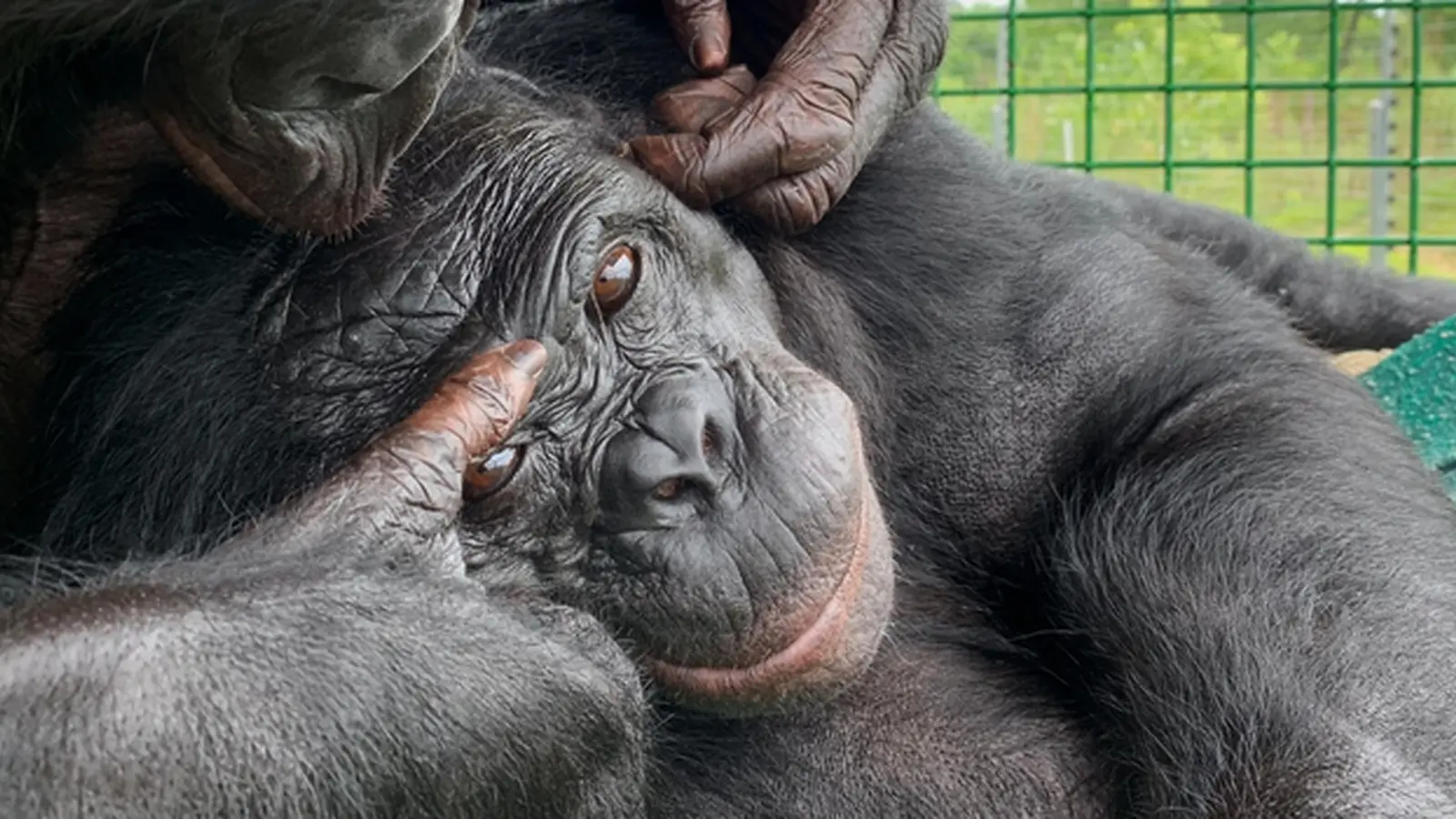
Kanzi, a bonobo who learned to communicate with humans, in Des Moines, Iowa.
Kanzi was no ordinary ape. Raised in close contact with humans, he learned to use graphic symbols to communicate, combined those symbols creatively, and even made simple stone tools. That background made him an ideal subject for a delicate experiment: could an ape act as if something were real while understanding that it was not — in other words, play pretend?
Scientists staged a mock juice party. An experimenter poured imaginary juice from a pitcher into two cups, then pretended to empty only one cup. When asked which cup he wanted, Kanzi pointed to the cup that still contained pretend juice 68% of the time. A control test offered real juice versus pretend; Kanzi chose the real liquid almost 80% of the time, suggesting he could tell the difference between an actual beverage and the same beverage enacted in play. A similar test using fake grapes in jars produced comparable results.
Why this matters for animal cognition
Play-pretend is more than whimsy. In humans it signals symbolic thinking, the capacity to represent absent objects and to manipulate mental scenarios — elements woven into creativity, planning, and elements of social cognition commonly linked to theory of mind. If nonhuman apes can reliably distinguish and act on imagined versus real states, the roots of those cognitive abilities may stretch deeper into our evolutionary past than many assumed.
“What’s really exciting about this work is that it suggests that the roots of this capacity for imagination are not unique to our species,” said Christopher Krupenye of Johns Hopkins University, a co-author on the study. Amalia Bastos of the University of St. Andrews, another co-author, noted that Kanzi’s performance on the control trials — choosing real juice when offered both options — strengthens the case that he was not simply confused by the illusion.
Still, caution is warranted. Not everyone in the field reads the findings as definitive. Michael Tomasello, a comparative psychologist at Duke University not involved in the study, has argued that seeing an animal respond to someone else’s pretense is different from observing an animal initiate or sustain pretense itself. To be fully convinced, he wrote, he would want to see Kanzi pour pretend water into a container or otherwise generate the pretense on his own.
Context matters. Kanzi’s extraordinary upbringing among humans may have shaped his behaviors. He grew up in close contact with caregivers who modeled symbolic communication and routine play; whether wild bonobos or other apes would behave the same way remains an open question. Kanzi died last year at 44, leaving behind data and a trail of possibilities for future research.
Experimental approach and implications
Methodologically, the researchers borrowed from developmental psychology: the same simple, repeatable manipulations used to gauge children’s understanding of pretend. That portability matters. When results cross species using comparable tests, they illuminate cognitive continuities rather than forcing artificial comparisons. Yet sample size, rearing history, and alternative explanations — imitation, cue reading, or learned response to experimental routines — must be ruled out through replication and diversification of methods.
Conservation urgency threads through this science. Many great apes are critically endangered; the ethical and logistical constraints on invasive or large-scale testing are real. Still, careful studies that respect welfare can reveal cognitive richness that reshapes how we think about animal minds and informs conservation priorities.
Expert Insight
Dr. Leila Moreno, a cognitive ethologist who studies social learning, reflects: “Kanzi’s case is a rare window. It doesn’t close the book, but it opens a new chapter asking whether pretense is a rare cultural artifact or a latent capacity in apes. The next step is controlled experiments with different groups and settings to separate individual history from species-level traits.”
The experiment does not settle whether apes experience imagination the same way humans do. It does, however, nudge the scientific conversation toward treating imagination as a measurable behavioral capacity rather than an exclusively human mystery. That shift invites new questions about how symbolic play, communication, and culture co-evolved across primates — and challenges us to listen carefully to what a simple tea party might tell us about minds that are not our own.

“The cosmos has always fascinated me. I write about space missions, astronomy, and the technologies pushing humanity beyond Earth.”

Discussion
Leave a Comment