
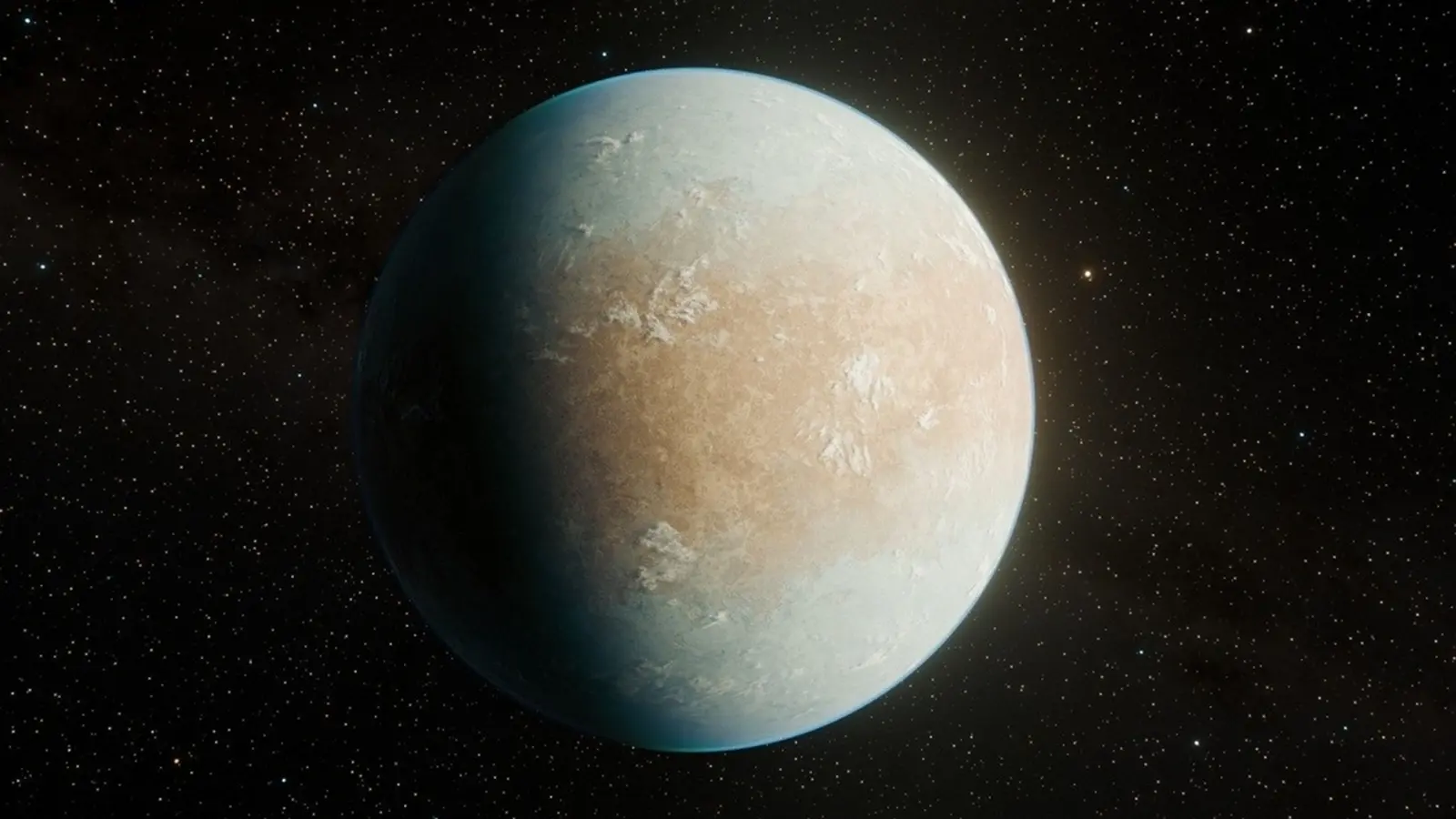
Think of a planet the size of Earth, circling a mellow orange star at roughly the same pace as our world, and then imagine it blanketed in ice. Strange, but true: astronomers have flagged HD 137010 b as a temperate—but potentially frozen—rocky world less than 150 light-years from us.
HD 137010 b emerged from reanalyzed data collected by NASA’s retired Kepler space telescope. The signal is subtle: a single, shallow dimming consistent with a planet crossing in front of its host star. From that lone silhouette, researchers infer a radius close to Earth’s and a mass near 1.2 times our planet’s. Its orbital period appears to be about 355 days—almost an Earth year—placing it tantalizingly near the star’s habitable zone, the region where liquid water could exist on a rocky surface.
Why this discovery matters
Not all habitable-zone worlds are created equal. HD 137010 is a K-type dwarf, roughly 70 percent the size and mass of the Sun. K dwarfs burn their hydrogen slowly; they sparkle less brightly than G-type stars like the Sun but live far longer. In fact, HD 137010’s main-sequence lifetime is longer than the current age of the Universe, which means any planets there enjoy a long, stable energy supply—useful for climate stability and, conceivably, biological evolution.
What makes HD 137010 b special is the combination of Earth-like radius, a near-year orbital period, and a host star bright enough for follow-up observations. The discovery team stresses that this is the first candidate with these properties transiting a Sun-like star that is bright enough to allow substantial further study. That opens a path to refine its mass, atmosphere, and climate picture—if follow-up observations can confirm the planet at all.
But confirmation is the rub. Kepler recorded only one transit. For long-period, Earth-like orbits, multiple transits are required to secure a detection and pin down orbital elements. In practice that often means years of patient monitoring. The detection here is nonetheless significant because it shows single-transit events can flag temperate, Earth-sized planets around Sun-like stars—places that sit right at the observational frontier.

Climate possibilities: bitter cold or marginally habitable?
Orbit and size only tell part of the story. Stellar energy—how much starlight reaches the planet—largely controls surface temperature. HD 137010 b receives less than one-third of the flux Earth gets from the Sun, a level that would put a bare-rock planet between roughly -68 and -85 degrees Celsius (-90 to -121 degrees Fahrenheit). Colder than Mars, colder than most places we imagine as habitable.
And yet the planet is not automatically lifeless. A moderately CO2-rich atmosphere could trap enough heat to permit liquid water at the surface, at least seasonally or in localized pockets. The same greenhouse gases that warm can also tip a planet into a runaway glaciation. If HD 137010 b carries a CO2 inventory similar to Earth’s, models suggest it could be trapped in a global “snowball” state—an ocean and surface locked beneath thick ice, highly reflective, which bounces starlight away and deepens the chill to around -100 degrees Celsius.
Life on a snowball planet? It’s not impossible. Earth itself has experienced global glaciations multiple times in deep geological history. Microbial life survived beneath ice sheets and in hydrothermal refugia. So while a frozen surface reduces the immediate prospects for surface ecosystems, subsurface or cryo-tolerant habitats cannot be ruled out from first principles.
Observational challenges and next steps
Confirming HD 137010 b will require patience and better data. Future facilities will help. ESA’s PLATO mission, designed to find terrestrial planets around bright stars, could catch additional transits and refine the planet’s period and radius. Ground-based radial velocity campaigns may constrain the mass if the star is quiet enough for precision spectroscopy. Space telescopes with sensitive infrared spectrographs could, in principle, probe atmospheric composition—but only once the planet’s orbit and transit schedule are known well enough to plan time-consuming observations.
There’s also a wider implication: the discovery hints that solar system–like architectures—multiple rocky planets occupying a system’s habitable region, possibly with a farther gas giant—might be more common than our sample currently suggests. If other planets lurk inside or outside HD 137010 b’s orbit, they could affect habitability through gravitational nudges, delivery of volatiles, or shielding from cometary bombardment.
Expert Insight
“The real excitement isn’t only the prospect of a chilly Earth analogue,” said Dr. Elena Morales, a planetary scientist involved in temperate-planet modeling. “It’s that HD 137010 b sits at an observational threshold. Confirming and characterizing such a world would teach us how atmospheres and climates behave under low stellar flux, and whether life-friendly conditions can persist on truly cold planets.”
Whether HD 137010 b is a faint echo of Earth, a deep freeze, or something in between remains to be seen. For now, it stands as a reminder that the search for familiar worlds will sometimes find the unfamiliar—and that habitability is a spectrum, not a single checkbox.

“My work centers on sustainability, energy, and environmental science — examining how innovation can lead to a greener future.”

Discussion
Leave a Comment