
Imagine a planet whose invisible shield thins slowly, then drifts, then flips. Not overnight. Not in human lifetimes. Over tens of thousands of years. That is what a set of ancient seafloor sediments appears to be telling scientists who drilled into the North Atlantic in 2012.
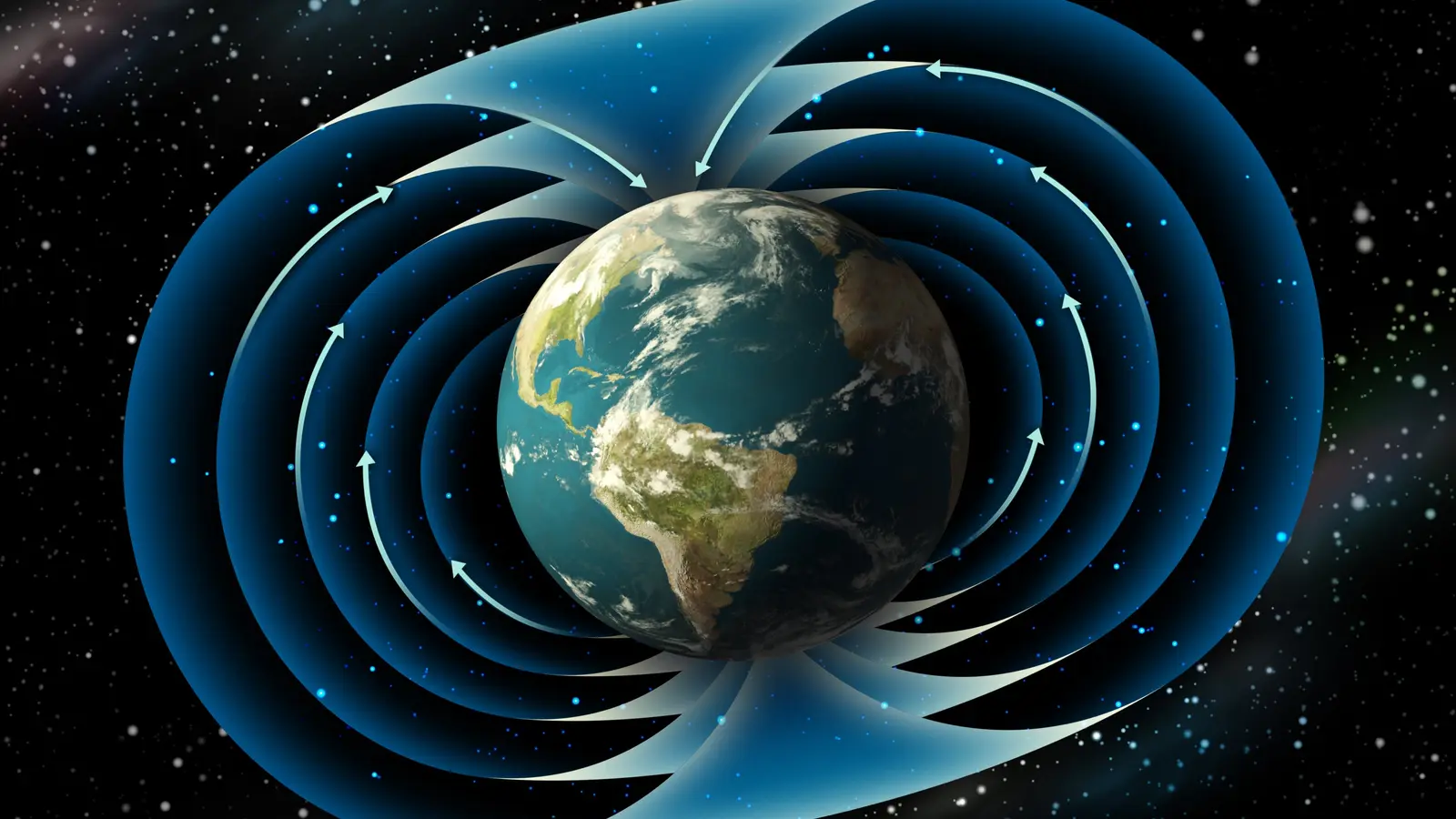
Earth’s magnetic field is often treated as a steady planetary shield, but geological records reveal a far more dynamic and variable system. New research examining ancient ocean sediments suggests that some geomagnetic reversals unfolded much more slowly than scientists once believed. Credit: Shutterstock
Reading the magnetized layers of time
Deep under the sea, each thin layer of sediment is a page in Earth’s history. Minute crystals of magnetite, produced by microbes or carried in dust, align with the magnetic field as the layer forms. Over millions of years these grains become a permanent record of direction and intensity. Paleomagnetists read those records like detectives reading fingerprints.
Most geomagnetic reversals—the moments when north and south swap places—were long assumed to be multi-millennial events that took on the order of ten thousand years. But when a team led by Yuhji Yamamoto (Kochi University) and Peter Lippert (University of Utah) examined cores pulled from up to 300 meters beneath the North Atlantic off Newfoundland, they found something unexpected: intervals where the shift stretched far longer than the textbook case.
One sedimentary package, just eight meters thick, captured a polarity transition that wasn’t a tight flip but a drawn-out wobble. The unstable interval was dispersed over many centimeters of core. That suggested a slow-motion reversal—not a brief storm, but a long season of turbulence in Earth’s magnetic system.
How the team reconstructed slow reversals
Sampling strategy matters. The researchers returned to that suspicious interval and sampled at extremely fine spacing—only a few centimeters between specimens—to raise the temporal resolution. Over several years of laboratory measurements and careful age modeling, they built high-precision timelines for two reversals preserved in the Eocene sediments: one close to 18,000 years and another extending to about 70,000 years.
That work combined paleomagnetic direction and intensity data with sedimentation-rate constraints to convert depth into time. Computer models of the geodynamo—the convecting, electrically conducting outer core that generates the magnetic field—have long predicted that reversals can vary widely in duration. Many are short; some can be much longer. This new rock record supplies hard, empirical evidence that Earth’s magnetic flips can indeed play out like slow-motion films.

Data quality and interpretation
To be confident that the signal reflects the field and not local sediment disturbances, the researchers checked for diagenetic overprints, bioturbation, and changes in mineralogy. The magnetite-bearing grains in these Eocene layers preserved a consistent and coherent magnetic signature. Correlations with other global records and the physical plausibility of the durations—consistent with geodynamo simulations—bolster the interpretation.
Yuhji Yamamoto summarized the surprise plainly: “This finding unveiled an extraordinarily prolonged reversal process, challenging conventional understanding and leaving us genuinely astonished.”
Why duration matters for climate and life
The magnetic field is more than a compass cue. It acts as a filter against charged particles from the Sun and cosmic rays from deep space. When the field weakens and becomes chaotic during a reversal, more energetic particles can penetrate the upper atmosphere. That can change atmospheric chemistry, for example by increasing production of reactive nitrogen and odd oxygen species, and can alter how solar energy is deposited in the system.
Those chemical and radiative perturbations can ripple into climate processes. They can also affect organisms that use magnetic cues for navigation. “The magnetic field provides the safety net against radiation from outer space,” said Peter Lippert. “If that net slackens for tens of thousands of years, you open the door to greater rates and durations of cosmic radiation exposure—potentially influencing mutation rates, atmospheric erosion in small ways, and navigation-dependent behaviors.”
Direct links between slow reversals and mass extinctions are not established. But the possibility that prolonged weak-field intervals could change evolutionary pressures or regional climates gives paleobiologists and climatologists new hypotheses to test.
Scientific and technological context
These results arrive at a time when geodynamo modeling has advanced dramatically. High-performance simulations already produced a spectrum of reversal behaviors: short, chaotic flips and rare, lengthy transitions that can last up to one hundred thousand years. Finding a geological example of the latter helps ground models in reality and provides targets for future simulation work.
Technically, the study leaned on the Integrated Ocean Drilling Program’s Expedition 342 cores, careful magnetometer measurements in specialized clean labs, and sedimentation-rate constraints from biostratigraphy and isotope records. The combined empirical and modeling approach is precisely the kind of cross-disciplinary work that modern Earth sciences require.
Expert Insight
“Geophysics often surprises us by revealing how variable planetary processes really are,” says Dr. Maria Kovalenko, a geophysicist at a national research lab who was not involved in the study. “The idea that a reversal can be stretched across tens of thousands of years reframes how we think about magnetic shielding and its coupling to atmosphere and biosphere. These long transitions provide an extended window for space-weather-driven chemistry to act on the system.”
Kovalenko adds that future work should prioritize high-resolution records from geographically diverse sites. “We need to know whether these slow reversals were global in expression and timing or whether local depositional processes exaggerated the apparent duration in a few locations.”
Yuhji Yamamoto and Peter Lippert’s team focused on the Eocene, 56 to 34 million years ago, a warm period with its own climatic quirks. That context matters. Sedimentation rates, ocean circulation, and biological productivity influence how faithfully a deposit records geomagnetic signals. But when multiple lines of evidence converge, the geological diary becomes persuasive.
For scientists studying Earth’s magnetic past and future, the message is clear: the geodynamo behaves with a larger range of tempos than the simple ten-thousand-year rule of thumb. The magnetic field has an unpredictable streak—sometimes a quick change, sometimes a lingering drift. And when that shield droops, the consequences can ripple through atmosphere, climate systems, and the living world.

Yuhji Yamamoto examines drilling cores on the JOIDES Resolution during the 2012 expedition in the North Atlantic.
The next steps are straightforward in concept though demanding in practice: find more high-resolution records, refine age models, and couple geological observations to improved geodynamo and atmospheric-chemical simulations. That effort will tell us whether the slow reversals found in Newfoundland are rare curiosities, predictable outcomes of core dynamics, or an overlooked chapter in Earth’s long story.
History, it seems, keeps its own slow clock.

“The cosmos has always fascinated me. I write about space missions, astronomy, and the technologies pushing humanity beyond Earth.”

Discussion
Leave a Comment