
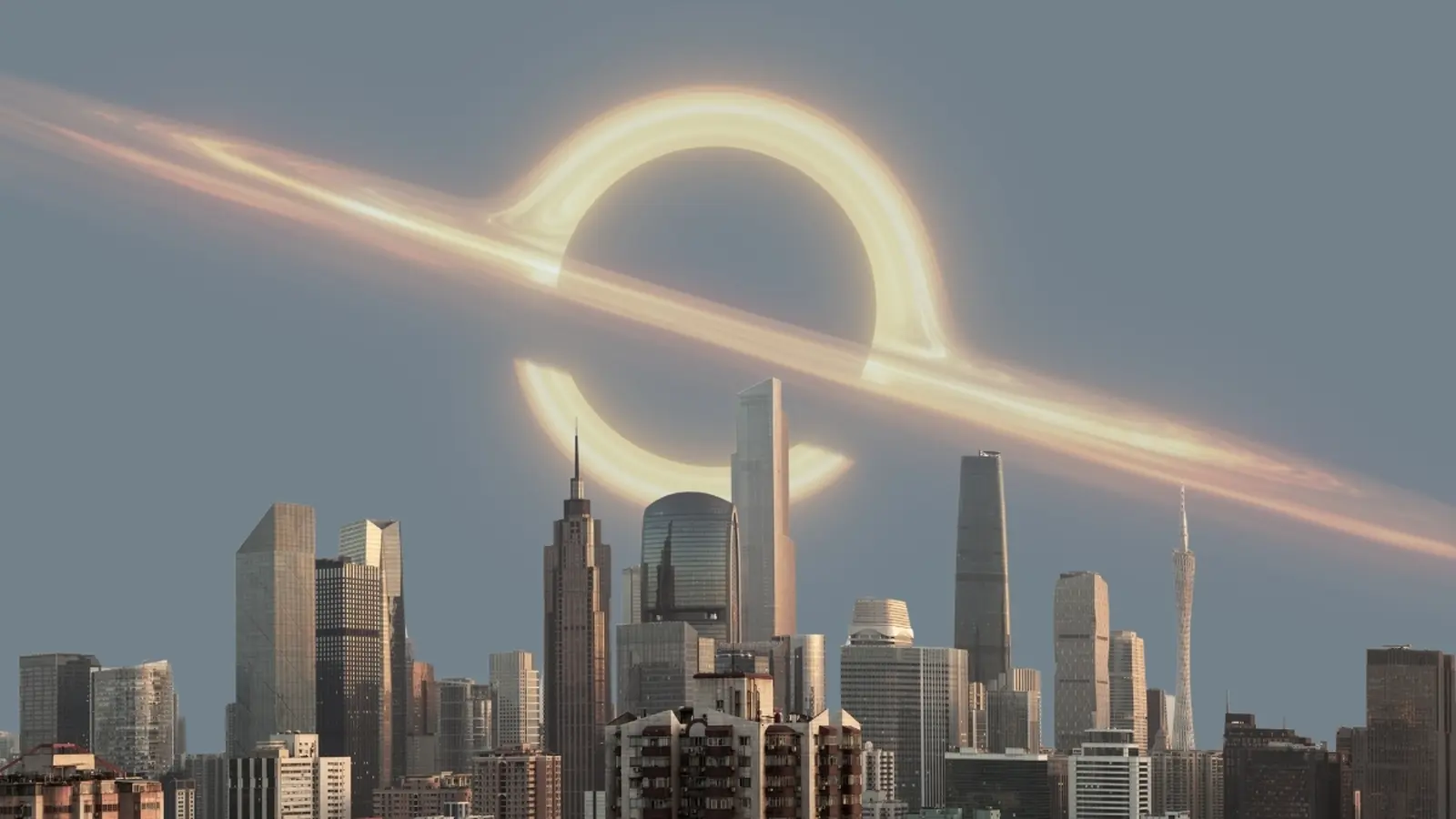
Imagine a dark leviathan hurtling through a galaxy, invisible until its gravity begins to reshape the orbits of nearby stars — a cosmic bullet carving a luminous wake. That is not science fiction anymore. Multiple lines of observation and decades of theoretical work have pushed the idea of runaway black holes from speculative possibility to something astronomers now take seriously.
How a black hole can be launched
The seed of this story lies in math and in energy. In the early 1960s Roy Kerr produced a striking solution to Einstein's field equations describing a rotating black hole. Kerr's geometry teaches us two blunt facts about these objects: black holes are remarkably simple in appearance — defined by mass, spin and charge — and a spinning black hole stores a great deal of energy in its rotation. In extreme cases, nearly a third of a hole's mass-equivalent can sit as rotational energy.
That rotational reservoir is accessible. Roger Penrose and others showed that extractable spin energy can, in principle, be removed from a rotating black hole. Think of it as a tightly wound flywheel in space. When two black holes merge, the encounter is violent and brief. Gravitational waves — ripples in spacetime — carry away energy and momentum. If those waves are emitted asymmetrically, conservation of momentum gives the newly formed black hole a recoil, a gravitational "kick."
Gravitational-wave recoil in plain terms
Picture two dancers spinning and then colliding. If their spins and masses aren't perfectly balanced, the music ejects the partner in a particular direction. In black holes, certain spin configurations can concentrate the gravitational-wave emission preferentially along one axis. The result: a final object that can be launched at hundreds or even thousands of kilometres per second — fast enough to escape a galaxy's gravitational pull.
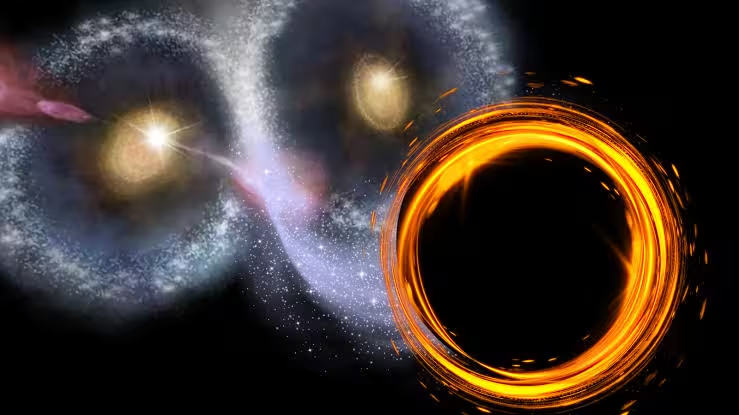
When LIGO and Virgo began hearing the chirps of merging black holes in 2015, theory met data. The observatories recorded ringdowns — the resonant vibration of newborn black holes — which reveal spin and mass. Over the subsequent years, analyses showed that many merging pairs had complex, misaligned spins and substantial rotational energy, conditions ripe for strong kicks. What was once a neat calculation on a blackboard became a plausible outcome of real cosmic events.
Observing the fugitives
Small runaway black holes are almost impossible to spot directly. They emit no light, and unless they accrete gas, they are essentially invisible. But supermassive runaways — those weighing millions to billions of suns — cannot pass through a galaxy without leaving signatures. As a massive black hole streaks through the interstellar medium it compresses gas, triggers star formation, and can light up a bright, linear contrail of young stars stretching for tens to hundreds of thousands of light-years.
Around 2025, several studies made headlines when astronomers presented images of very straight stellar streaks inside galaxies. One high-profile analysis led by Pieter van Dokkum used data from the James Webb Space Telescope to identify a contrail roughly 200,000 light-years long. The properties of that trail — pressure fronts, alignment and luminosity — match expectations for a black hole on the move, likely a few million to ten million times the mass of the Sun and travelling at nearly 1,000 km/s.
Closer to home in morphological studies of NGC 3627, researchers reported a straighter but shorter contrail of about 25,000 light-years. Models suggest the responsible black hole in that case would be on the order of two million solar masses with a speed near 300 km/s. These are headline-grabbing numbers, but the significance lies in agreement across theory, gravitational-wave data and high-resolution imaging.
There is a natural hierarchy to the phenomenon. If galaxy-scale runaways exist, smaller-mass runaways should too. Gravitational-wave catalogs show merging pairs with the spin misalignments and energies needed to generate high-velocity kicks. That implies a population of wandering black holes crossing interstellar space and, occasionally, escaping into intergalactic voids.

A runaway black hole leaves a streak of new stars in its wake.
Why this matters
Runaway black holes change how we think about the growth and evolution of galaxies. A supermassive black hole plucked from a galactic nucleus alters feedback processes — the regulation of star formation and gas dynamics that shape a galaxy's life. It can leave a once-dormant nucleus without its central engine, or seed star formation along a trail where none existed before. On cosmological timescales, these ejections influence how quickly galaxies quench, how central black hole populations assemble, and where heavy elements are redistributed.
Could one appear in our Solar System? The short answer is no. The odds are vanishingly small. A runaway would have to be tiny, unnervingly well-aimed, and on a collision course to produce any local effects. Large runaways have been sighted only through the broad disturbances they create while crossing other galaxies — a clear sign such visitors are rare and distant.
Expert Insight
"These detections close a loop between theory and observation," says Dr. Elena Rivera, an observational astrophysicist at the California Institute for Astrophysics. "Gravitational-wave astronomy predicted the mechanism. High-resolution imaging is now showing its scars on galaxies. Together, they allow us to map a previously hidden population of black holes and to refine models of galaxy evolution."
Dr. Rivera adds: "We still need more multiwavelength follow-up to rule out lookalikes — linear tidal features, projection effects — but the data are compelling. Future surveys with JWST and next-generation radio arrays will either confirm these as genuine runaways or force us to rework the alternative explanations. Either outcome advances our understanding."
A runaway black hole is a dramatic illustration of how energetic and stochastic the Universe can be. The physics lived out in those brief, violent merger events — the extraction of spin, the asymmetry of gravitational radiation, the recoil — ties together the abstract equations of relativity and galaxies you can actually see in the night sky. New surveys will expand the sample. New gravitational-wave observatories will clarify the frequency of killer kicks. And astronomers will keep scanning the heavens for more cosmic fugitives.

“The cosmos has always fascinated me. I write about space missions, astronomy, and the technologies pushing humanity beyond Earth.”

Discussion
Leave a Comment