
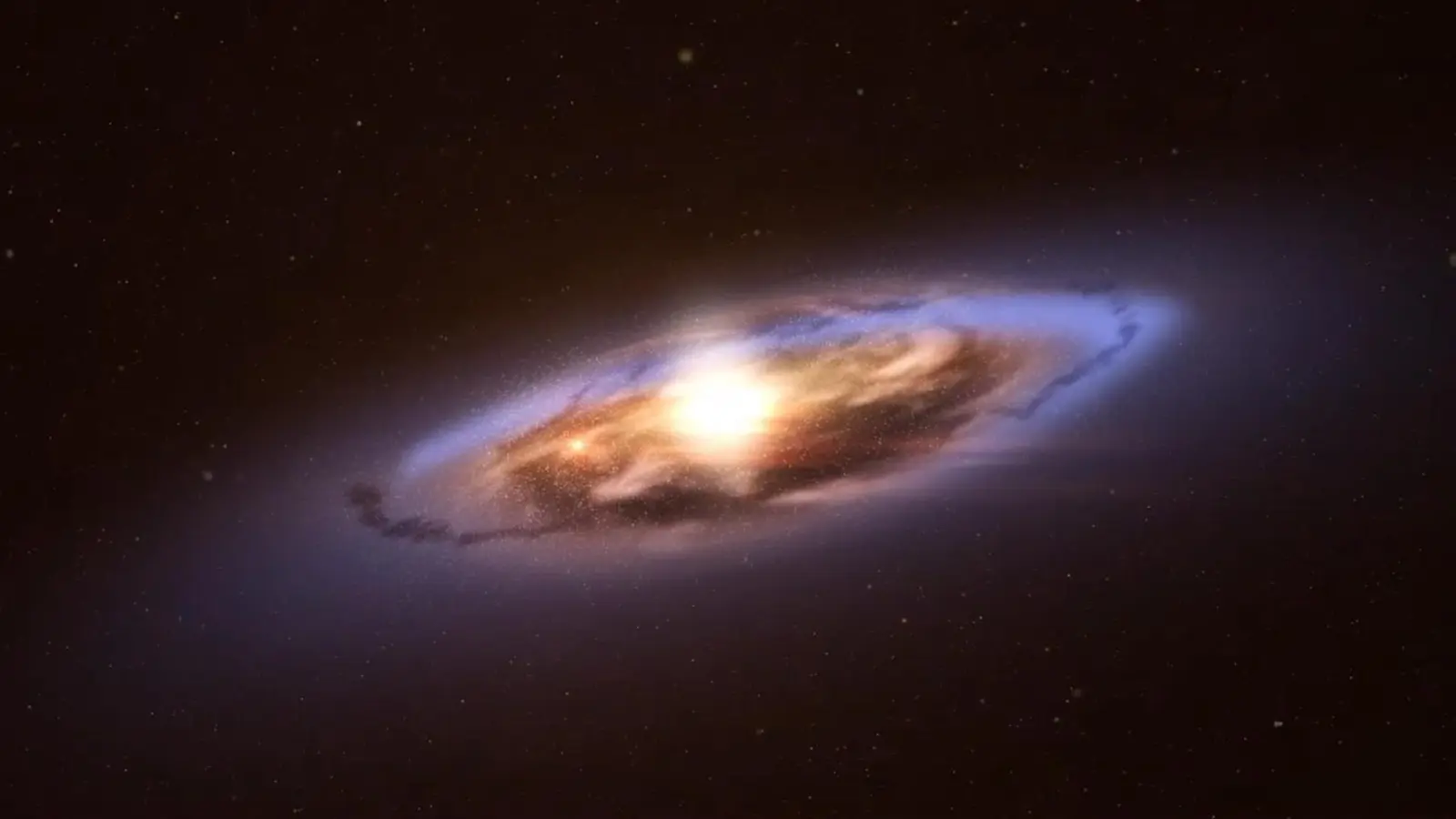
Gaia’s latest maps show the Milky Way is not only spinning and warped — it also hosts a vast, slow-moving wave that sweeps across its stellar disc. This newly identified ripple displaces stars tens of thousands of light-years from the Galactic centre and offers fresh clues about the dynamic history of our home galaxy.
The Milky Way isn’t just spinning – it’s rippling. New data from the European Space Agency’s Gaia telescope reveal a vast wave moving across our galaxy’s disk, displacing stars tens of thousands of light-years from the center of the galaxy.
A sweeping wave across the Galactic disc
For decades astronomers have known our galaxy is a rotating system with a warped stellar disc. Gaia — the European Space Agency’s astrometry mission — has now mapped stars with unprecedented precision in three spatial dimensions and three velocity components, revealing a coherent ripple moving outward from the Galactic centre. Unlike localized perturbations, this structure extends across a major fraction of the outer disc, reaching roughly 30–65 thousand light-years from the centre while the Milky Way as a whole spans about 100 thousand light-years.
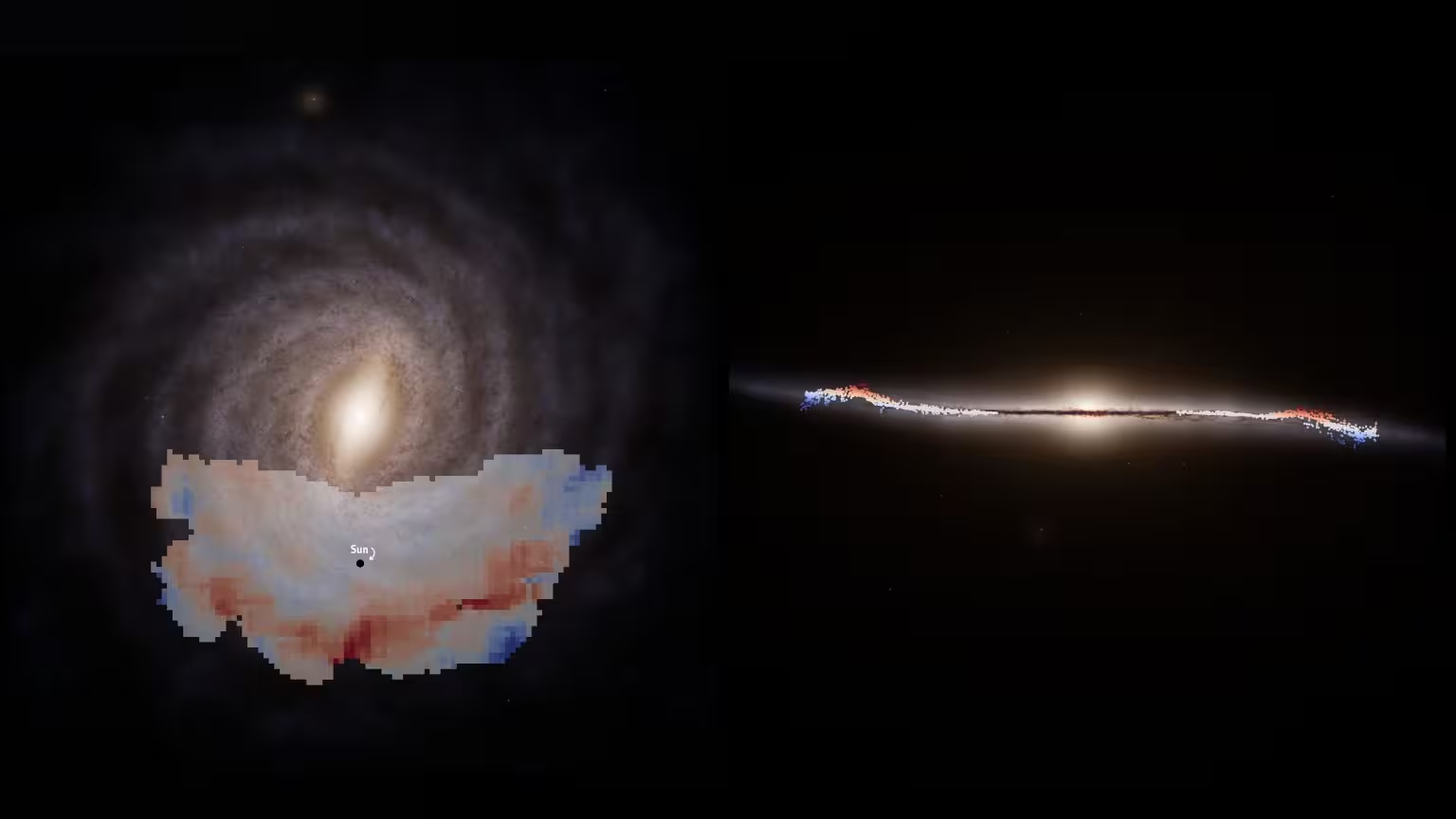
The European Space Agency’s (ESA) Gaia space telescope has revealed that our Milky Way galaxy has a giant wave rippling outwards from its center. In the left image, we look at our galaxy from ‘above’. On the right, we see across a vertical slice of the galaxy and look at the wave side-on. In this perspective, the Sun is located between the line of sight and the bulge of the galaxy. This perspective also reveals that the ‘left’ side of the galaxy curves upward and the other side curves downward (this is the warp of the disc of the galaxy). The newly discovered wave is indicated in red and blue: in red areas, the stars lie above, and in blue areas the stars lie below the warped disc of the galaxy. Credit: ESA/Gaia/DPAC, S. Payne-Wardenaar, E. Poggio et al (2025)
The newly mapped feature looks like the wake from a pebble dropped into a pond: regions where stars sit above the nominal midplane are interleaved with regions where they sit below it. But this is no instantaneous splash — galaxy-scale waves take millions to hundreds of millions of years to evolve, so Gaia effectively takes a long-exposure snapshot of slow, large-scale motion.
How Gaia teased out the motion
Gaia measures positions, distances and motions for more than a billion stars. By combining parallax (distance), proper motions (movement across the sky) and radial velocity (motion toward or away from us), astronomers can reconstruct full 3D locations and velocity vectors for individual stars. The team led by Eloisa Poggio at Italy’s Istituto Nazionale di Astrofisica used this six-dimensional phase-space information to produce face-on and edge-on maps of the disc, revealing the wave’s geometry and the way stars move within it.
The unexpected galactic ripple is illustrated in this figure above. Here, the positions of thousands of bright stars are shown in red and blue, overlaid on Gaia’s maps of the Milky Way.
By tracing Cepheid variables and young giant stars — bright, distant markers whose distances and motions are especially reliable — the researchers were able to follow the wave across large swathes of the outer disc. Those stellar tracers show not only displacement above or below the midplane (red/blue regions), but also a phase shift between position and vertical motion: the highest upward velocities lead the crest in position, just as a travelling wave would exhibit a shift between displacement and velocity.
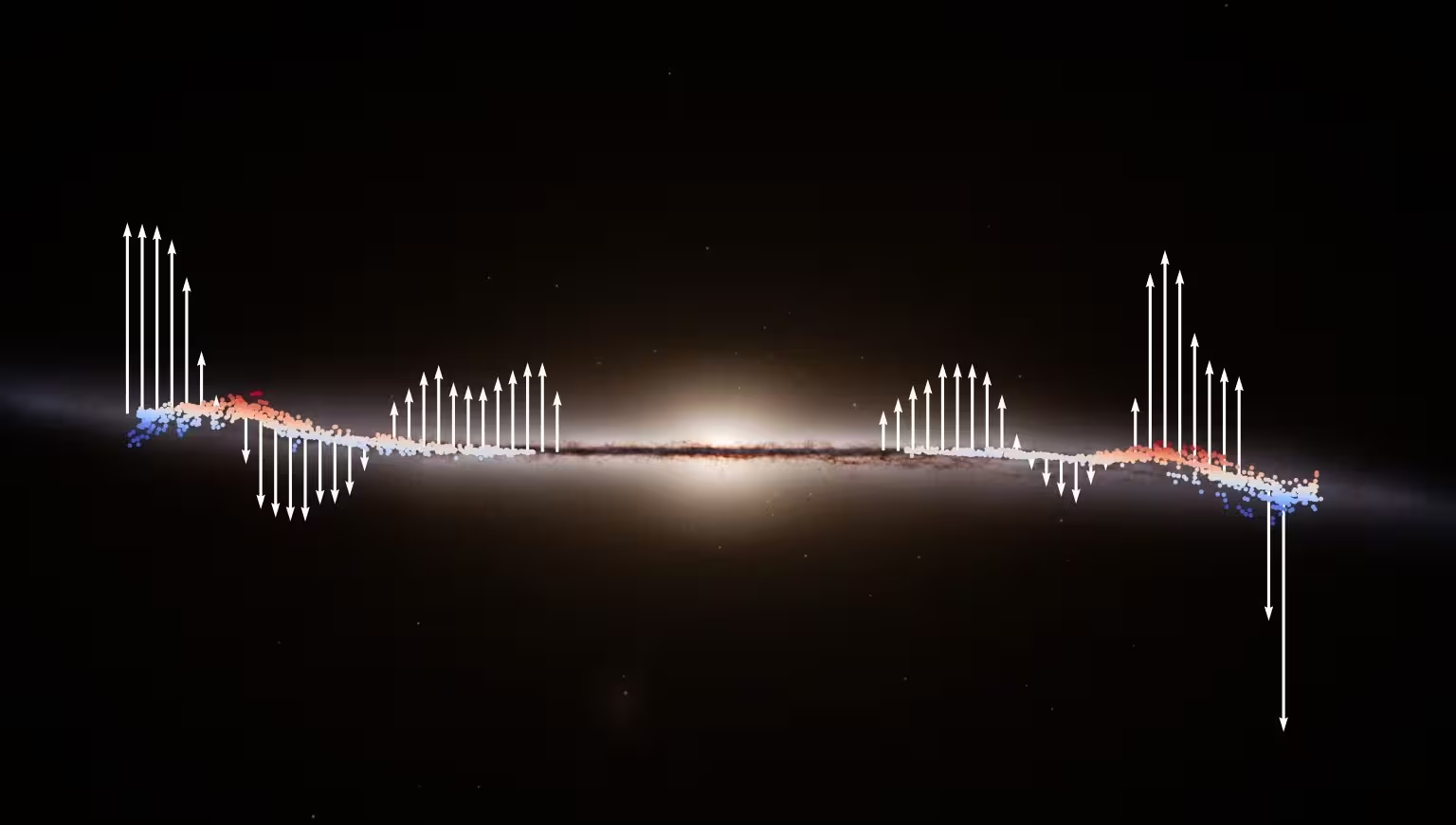
The European Space Agency’s (ESA) Gaia space telescope has revealed that our Milky Way galaxy has a giant wave rippling outwards from its center. This image shows the Mikly Way edge-on. In the red areas, the stars are positioned more ‘upward’, and in blue areas the stars are more ‘downward’ in relation to the disc of the galaxy. Credit: ESA/Gaia/DPAC, S. Payne-Wardenaar, E. Poggio et al (2025)
Interpreting the pattern: ripples, wakes and collisions
What set this great ripple in motion? Several hypotheses are on the table. A close encounter or past collision with a satellite dwarf galaxy — such as the Sagittarius dwarf galaxy, known to have interacted with the Milky Way repeatedly — could have sent gravitational ripples through the disc. Alternatively, internal processes like instabilities in the spiral structure or the Galactic bar might excite large-scale vertical oscillations. Distinguishing between these scenarios requires modelling the timing, amplitude and wavelength of the observed ripple.
The motions of the stars are made visible with the white arrows in the edge-on image of the Milky Way above. What can be noticed, is that the wave pattern of the vertical motions (represented by the arrows) is slightly shifted horizontally relative to the wave pattern formed by the star’s vertical positions (indicated by the red/blue colors).
Since Cepheids and other young stars participate in the wave, the signal likely involves the gaseous component of the disc as well. Stars form from gas, so if the gas itself was perturbed, newborn stars would inherit the imprint of that disturbance. That means the ripple may still be actively shaping stellar populations and star-forming regions in the outer disc.
Is it related to the Radcliffe Wave?
A tempting comparison is the Radcliffe Wave — a much smaller, 9,000-light-year-long gas and dust structure discovered closer to the Sun. However, the newly revealed wave spans a vastly larger area and sits in a different region of the disc, so any connection is uncertain. The Radcliffe Wave is a localized filament; the Gaia wave is a disc-spanning oscillation. Researchers are cautious: the two features may be independent manifestations of common dynamical processes, or they may share a causal link rooted in past galactic interactions.
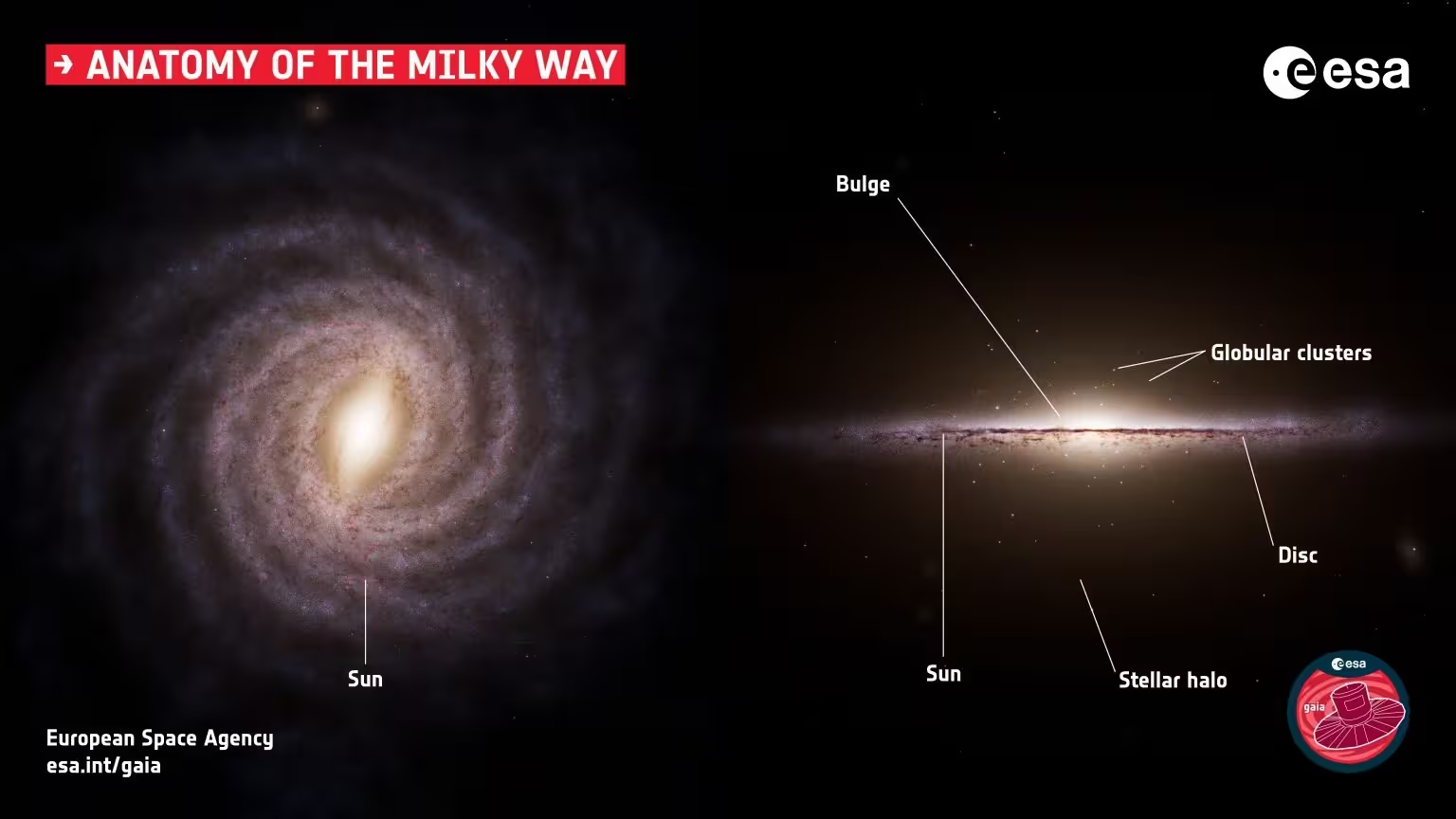
An artist’s impression showing the anatomy of our Milky Way galaxy, a roughly 13 billon-year-old ‘barred spiral galaxy’ that is home to a few hundred billion stars. Credit: ESA/Gaia/DPAC, S. Payne-Wardenaar
Why this discovery matters
Large-scale vertical waves carry information about the Milky Way’s recent dynamical history. By measuring the wave’s wavelength, speed and damping rate, astronomers can infer when and how the disturbance occurred and estimate the properties of any perturbing satellites. Those constraints refine models of mass distribution in the disc and halo, and improve our understanding of how galaxies settle after encounters.
Beyond pure dynamics, the ripple could influence the birthplaces of new stars, the mixing of stellar populations, and the vertical heating of the disc — all factors that shape the Milky Way’s structure over cosmic time. In short, detecting and characterising this wave helps transform the Milky Way from a static backdrop into an evolving system with a detailed, observable history.
Expert Insight
“Gaia gives us a movie of the Galaxy in slow motion,” says Dr. Maria Ortega, a fictional astrophysicist specializing in galactic dynamics. “What appears as a static warp or ripple is actually a dynamic fingerprint of past events. By combining stellar motions with models of gravity and gas dynamics, we can rewind the Milky Way’s recent episodes — a sort of archaeological reconstruction on a truly grand scale.”
Dr. Ortega adds: “Identifying whether the wave arose from a satellite collision or an internal instability will require numerical simulations that reproduce both the spatial pattern and the velocity phase shifts Gaia observes. The forthcoming Gaia data release will tighten those constraints and likely reveal even subtler features.”
What comes next: better maps and deeper models
Gaia’s next data release will provide improved positions and motions for variable stars like Cepheids and a larger sample of distant tracers. That higher-fidelity dataset will let teams refine maps of the wave, measure its propagation speed more accurately, and test competing formation scenarios with more robust statistics.
On the modelling side, researchers will use N-body and hydrodynamic simulations to recreate potential encounters between the Milky Way and dwarf companions and to explore how spiral arms or the central bar might generate similar vertical oscillations. Complementary observations — for example, radio surveys that map cold gas in the outer disc — will check whether the gaseous component follows the stellar wave.
The motions of stars across the galaxy are an open book for astronomers with the right tools. Gaia continues to turn blank pages into detailed chapters of the Milky Way’s biography, and this giant ripple is one of the most striking recent entries.
The motions of the stars are made visible with the white arrows in the edge-on image of the Milky Way above. What can be noticed, is that the wave pattern of the vertical motions (represented by the arrows) is slightly shifted horizontally relative to the wave pattern formed by the star’s vertical positions (indicated by the red/blue colors).
Eloisa and her colleagues were able to track down this surprising motion by studying the detailed positions and movements of young giant stars and Cepheid stars. These are types of stars that vary in brightness in a predicable way, which can be seen by telescopes like Gaia over large distances.
Because young giant stars and Cepheids move with the wave, the scientists think that gas in the disc might also be taking part in this large-scale ripple. It is possible that young stars retain the memory of the wave information from the gas itself, from which they were born.
“The upcoming fourth data release from Gaia will include even better positions and motions for Milky Way stars, including variable stars like Cepheids. This will help scientists to make even better maps, and thereby advance our understanding of these characteristic features in our home galaxy,” says Johannes Sahlmann, ESA’s Gaia Project Scientist.
The unexpected galactic ripple is illustrated in this figure above. Here, the positions of thousands of bright stars are shown in red and blue, overlaid on Gaia’s maps of the Milky Way.

“My work centers on sustainability, energy, and environmental science — examining how innovation can lead to a greener future.”

Discussion
Leave a Comment