
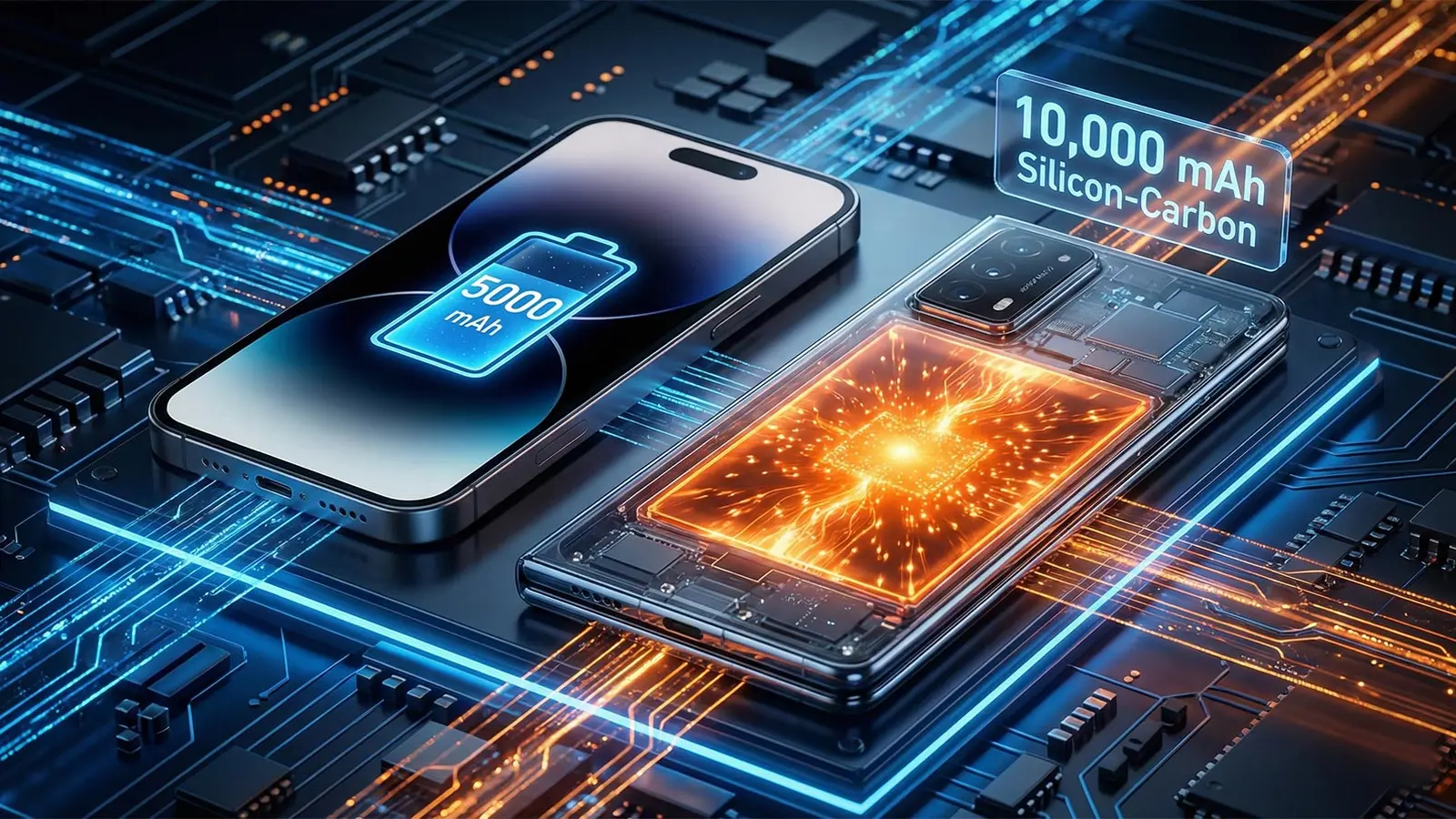
Imagine holding two smartphones. In your left hand, the latest iPhone Pro Max—a marvel of engineering, yet undeniable in its heft, housing a standard ~5,000 mAh battery. In your right hand, the Honor Magic V3 or the OnePlus 13—devices that are often thinner, lighter, yet somehow pack a staggering 6,000 to 10,000 mAh power cell.
This isn’t magic; it’s a quiet revolution in materials science. For the first time in decades, the fundamental chemistry of how our phones hold power is shifting. We are moving from the age of Graphite to the age of Silicon-Carbon.
But this breakthrough brings a glaring question: If this technology allows for thinner phones with double the battery life, why are tech giants like Apple and Samsung sitting on the sidelines? Why are they letting Chinese competitors take the lead in the hardware race?
1. The Energy Density Paradox
For years, battery progress was stagnant. To get more battery life, you needed a bigger battery. It was a simple, brutal law of physics. If you wanted a slim phone, you sacrificed longevity. If you wanted a "battery monster," you carried a brick in your pocket.

Silicon-Carbon technology breaks this rule.
The key metric here is Energy Density—how much energy can be crammed into a specific physical volume.
Traditional Graphite Batteries: Have hit a ceiling. They are fully saturated. We cannot pack lithium ions any tighter without compromising safety.
Silicon-Carbon Batteries: Offer a leap forward. By introducing silicon into the battery anode, manufacturers can store significantly more energy in the same amount of space.
Think of the battery anode as a parking garage for lithium ions. Graphite is a standard single-level lot. It works, but it fills up fast. Silicon, on the other hand, is a multi-story skyscraper. It can theoretically hold 10 times more lithium ions per gram than graphite.
This is why a foldable phone like the Honor Magic V2 can be thinner than a standard iPhone while carrying a larger battery. They aren't just building a bigger tank; they are using a more potent fuel.
2. The Engineering Nightmare: The "Breathing" Battery
If silicon is so superior, why haven’t we been using it for years? The answer lies in a volatile physical property: Swelling.
Silicon is unstable during the charging process. When lithium ions enter a graphite anode, the material expands by about 7-10%. This is manageable and accounted for in phone design. However, when lithium ions flood a silicon anode, the material expands by up to 300% (3x its volume).
Imagine your battery is a lung. Every time you charge it, it tries to inflate to three times its size. Every time you drain it, it shrinks. This violent cycle of expansion and contraction creates massive mechanical stress. Without precise engineering, a pure silicon battery would physically crush the internal components of a smartphone, crack the screen, or rupture its own casing, leading to catastrophic failure.

How Chinese Engineers Tamed the Beast
To make this technology viable for consumer electronics, companies like Xiaomi, Honor, and OnePlus aren't using pure silicon. Instead, they employ a clever hybrid approach:
Nano-structuring: Instead of solid blocks, silicon is ground into microscopic nano-particles to disperse the pressure.
The Carbon Buffer: These silicon particles are wrapped in a graphite/carbon shell. The carbon acts as a cushion or "buffer zone," allowing the silicon to expand safely inside the shell without deforming the entire battery.
Steel Encasement: Some manufacturers are going a step further, encasing the battery cell in a high-strength steel foil rather than the traditional aluminum or pouch material, physically constraining the swelling.
3. The Strategy of Caution: Why Apple & Samsung Are Waiting
While Chinese OEMs (Original Equipment Manufacturers) are pushing the boundaries with "Bleeding Edge" tech, the titans of the industry—Apple and Samsung—are notably absent from the Silicon-Carbon party.
This isn't a lack of capability; it is a calculation of risk.

The Ghost of the Galaxy Note 7
Samsung carries the scars of the 2016 Galaxy Note 7 disaster. That incident cost the company billions of dollars and years of brand reputation. For a company shipping 300 million units a year, a failure rate of even 0.001% is unacceptable. The physics of silicon swelling introduces a variable that conservative engineering teams are hesitant to embrace until it is perfected.
The Missing Long-Term Data
Silicon-Carbon batteries in smartphones are relatively new (mainstream adoption began around 2023-2024).
The Unknown: We know they perform well for a year. But what happens after 3 or 4 years of daily expansion and contraction?
Cycle Life: Does the silicon degrade faster than graphite? Will the battery capacity drop to 80% in just 18 months?
Apple and Samsung typically design phones with a 5-7 year lifespan in mind. They are likely waiting for long-term degradation data before committing their flagship lines to this technology. They prefer to let competitors be the "guinea pigs."
Ecosystem Lock-in vs. Hardware Wars
The market dynamics in the West differ from the East.
In the US: Apple’s dominance is secured by software—iOS, iMessage, and the ecosystem. Users rarely switch to Android just because a competitor has a slightly bigger battery. Apple feels no pressure to take hardware risks to retain users.
In China: The market is hyper-competitive and hardware-driven. Brand loyalty is lower. If a competitor releases a phone that is 2mm thinner with 20% more battery, users will switch. This forces brands like Honor and Xiaomi to innovate aggressively to survive.
4. The Future: 2026 and Beyond
We are currently in a transition period. The "Silicon Era" of batteries has begun, but it is unevenly distributed.
Currently, we have two diverging paths:
The Aggressive Path (Chinese OEMs): Stunningly thin devices with massive 6,000+ mAh capacities, pushing the limits of physics, potentially at the cost of unknown long-term durability.
The Conservative Path (Apple/Samsung): Standard thickness and capacity, relying on efficiency chips (3nm processors) to extend battery life, prioritizing safety and longevity above all else.
However, the industry consensus is that Silicon-Carbon is the future. As the technology matures and the "swelling" issue is fully mastered, we expect the tech giants to adopt it—likely around the iPhone 18 or Galaxy S27 cycle (circa 2026-2027).
Until then, if you want a glimpse of the future of battery tech, you’ll have to look East. The revolution is already here; it just hasn't arrived in every box yet.
What do you think? Would you trade long-term reliability for a 10,000 mAh battery today? Let us know in the comments below.

“I love exploring gadgets, apps, and trends that redefine how we connect, work, and play in a digital world.”

Discussion
Leave a Comment