
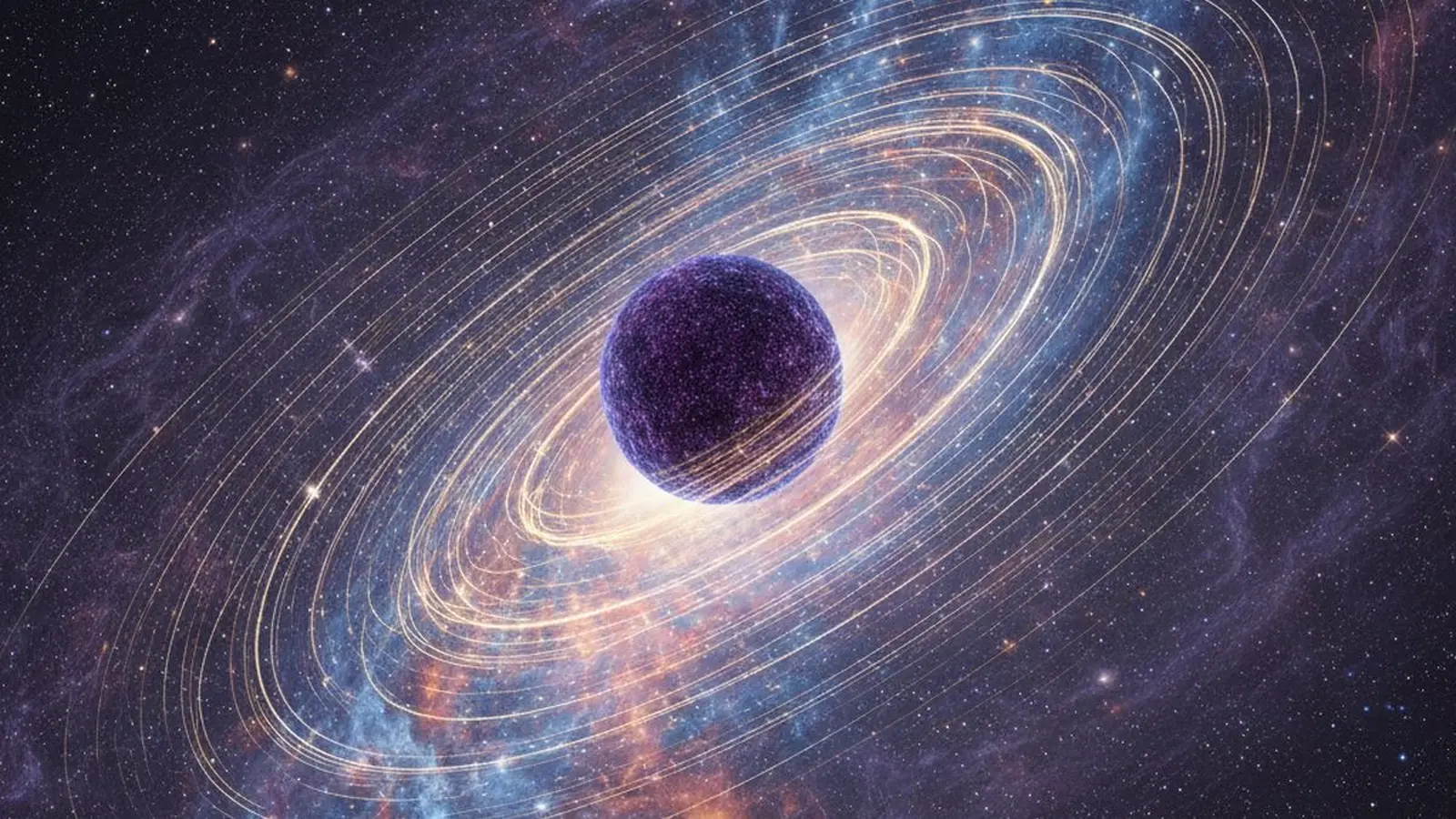
Imagine the center of our galaxy without an event horizon — no point of no return, no swallowed light. Strange, isn’t it? For decades, astronomers have pointed to a single, compact explanation for the extreme gravity at the Milky Way’s heart: a supermassive black hole called Sagittarius A*, weighing roughly four million Suns. But a recent study pushes us to widen that view. What if the mass we infer from orbiting stars is not an abyssal singularity, but a dense, horizonless lump of dark matter?
The data that led to the black hole interpretation are elegant and simple: stars near the galactic center whip around on tight, fast orbits. Track those paths and you map the gravitational potential. The star S2, with its 16-year, highly elliptical trajectory, has been the Rosetta stone. Its motions, measured with exquisite precision, point to a compact mass sitting where Sgr A* is supposed to be. In 2022 the Event Horizon Telescope added visual drama with an image that resembles a black hole’s shadow. Compelling. Convincing. Not necessarily unique.

The Event Horizon Telescope image of Sagittarius A*.
Fermions, pressure, and a different kind of core
Dark matter is the invisible scaffolding of the cosmos. It doesn’t glow. It doesn’t absorb light in ways we can measure. Yet its gravitational pull sculpts galaxies and bends light at scales we can observe. Most dark matter models picture a diffuse halo around galaxies. But not all theories are diffuse. One class — fermionic dark matter — proposes particles that obey the Pauli exclusion principle, the quantum rule preventing identical fermions from sitting in the same state. The consequence? A kind of degeneracy pressure, familiar from white dwarfs and neutron stars, that can support a compact, stable configuration made entirely of dark particles.
Under the right mass and interaction parameters, fermionic dark matter can clump into an ultradense core whose gravitational influence mimics that of a black hole across the range probed by current observations. Crucially, such a core would lack an event horizon. Light could still escape, but its path and the appearance of the surrounding accreting gas might differ in subtle ways from the black hole case.
How stars and telescopes test the idea
Valentina Crespi and colleagues modeled the central region of the Milky Way using a compact fermionic core as the central mass and compared the predicted motions to those observed for S2 and several other so-called S stars. The result: both the black hole and the dark core reproduce the stellar orbits with nearly identical fidelity. That doesn’t prove the dark core exists. Rather, it exposes a blind spot in our current measurements. The observations are necessary but not yet decisive.
There is, however, an intriguing additional piece of evidence. The Gaia mission’s map of stellar motions across the Milky Way shows that rotation speeds decline in the outskirts in a way that matches a Keplerian drop. The researchers argue a large-scale fermionic halo, continuous with a dense central core, can naturally produce this rotation curve — effectively linking the nucleus and the halo as two expressions of the same dark matter substance. If true, that would be a conceptual shift: the central massive object and the broader dark halo would not be separate entities but part of a single distribution governed by the same physics.
That is not a throwaway claim. As astrophysicist Carlos Argüelles of the Institute of Astrophysics La Plata puts it: "We are not just replacing the black hole with a dark object; we are proposing that the supermassive central object and the galaxy's dark matter halo are two manifestations of the same, continuous substance." The language is deliberate. It frames the hypothesis as an economy of explanation rather than a contrived alternative.
Where will the test come from? One route is improved stellar astrometry. Track stars that orbit even closer than S2. Subtle pericenter shifts or small deviations from predicted trajectories could reveal whether the central mass has an absorbing horizon or a pressure-supported surface. Another route is imaging. The Event Horizon Telescope is not done. Higher-fidelity images might reveal a well-defined photon ring and shadow morphology that are signatures of light trapped near an event horizon. In contrast, a horizonless dark core could alter or soften those features.
Expert Insight
"We are at the edge of decisive measurement," says Dr. Lina Morales, a fictional astrophysicist and instrument scientist who studies compact objects. "The difference between a horizon and a surface shows up in details: the timing of flares, the fine structure of the photon ring, and how gas behaves as it approaches the center. Each observation narrows the model space. If a fermionic core fits every new limit, we have to take that seriously. If not, the black hole model keeps its throne."
There are practical consequences beyond taxonomy. A horizonless central mass would change how we model accretion flow, jet launching, and energy feedback into the inner galaxy. It would alter predictions for gravitational wave emission from extreme inspirals and shift constraints on dark matter particle properties. The stakes are high because the interpretation feeds back into how we model galaxy formation and evolution.
None of this should be read as a denial of black hole physics. General relativity predicts black holes robustly. The black hole hypothesis remains the simplest fit to many datasets. What the fermionic-core models do is expand the set of viable physical explanations and ask for sharper data: closer-in stellar orbits, higher-resolution millimeter-wave imaging, and deeper surveys of galactic rotation.
We live in a data-rich era. Instruments are improving. Gaia will refine the Milky Way map. The EHT will push for finer detail. Infrared interferometers will track stars ever closer to the center. Within a decade or two, the difference between an event horizon and a compact dark core may no longer be philosophical. It will be an observational fact — one way or the other.
For now, the Milky Way keeps its secret. But the more we look, the more likely we are to learn whether the central engine is an invisible star of dark fermions or an all-consuming hole. Either reveal would reshape our picture of galaxies and dark matter in ways we are only beginning to imagine.

“My work centers on sustainability, energy, and environmental science — examining how innovation can lead to a greener future.”

Discussion
Leave a Comment