
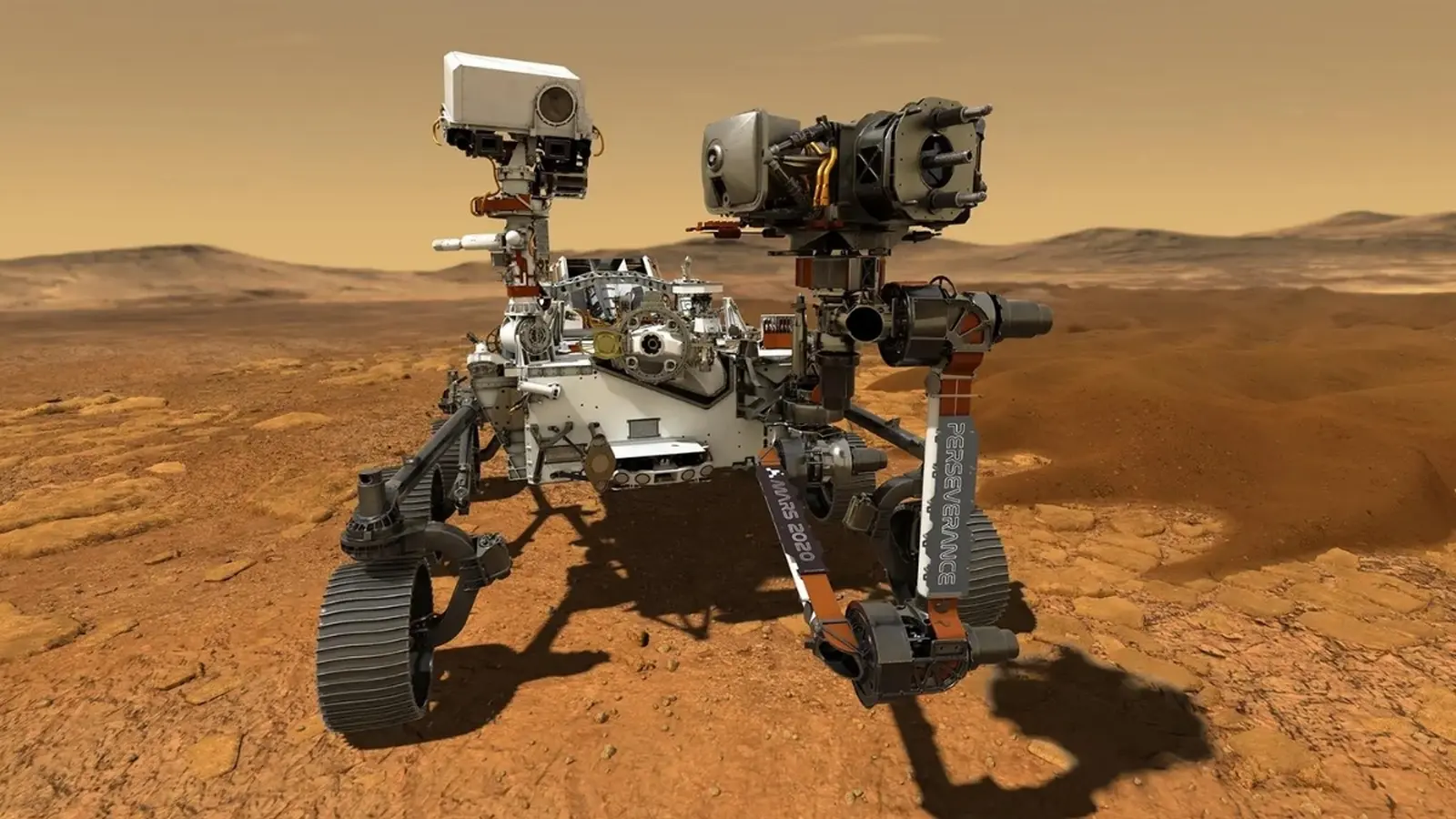
The rover kept going. Alone, in a sense. For two days in December 2025, NASA's Perseverance traversed 456 meters across Martian terrain using waypoints generated by artificial intelligence, without direct human control at the wheel. That distance, nearly one and a half football fields, is modest for a car but significant for a vehicle operating across tens of millions of kilometers of empty space and a 12- to 25-minute communication delay.
What happened on Mars
The experiment married two kinds of autonomy. Ground teams used an AI system trained to analyse high-resolution orbital imagery and digital elevation models, tasking it to identify hazards and propose a route. The resulting chain of waypoints was uplinked to Perseverance, and the rover's own auto-navigation software handled the driving while capturing new images and adjusting in real time.
This is not the first time a Mars rover has driven itself; Perseverance already uses autonomous navigation routinely. What changed here is the AI-generated planning step. Instead of human operators on Earth marking intermediate goals spaced roughly 100 meters apart, the AI evaluated HiRISE orbital photos and elevation data to map out a continuous hazard-avoiding path that Perseverance could follow for longer stretches.
How the team reduced risk
Every off-Earth test starts with caution. Before any AI-generated route reached Mars, engineers ran the plan against a terrestrial twin of the rover: the Vehicle System Test Bed (VSTB) in JPL's Mars Yard. The VSTB is an engineering model used to reproduce problems, validate software, and rehearse novel procedures in a controlled environment. JPL has built similar twins for other missions, including Curiosity.
This hardware-in-the-loop step gave operators confidence. The AI had already filtered out obvious hazards — sand traps, boulder fields, exposed bedrock, and rocky outcrops — and marked waypoints that thread between them. Once those waypoints passed ground testing, Perseverance took over on Mars and executed the drive across two days, covering 456 meters (1,496 feet) without human teleoperation.

This annotated orbital image shows Perseverance's route during its second day of autonomous driving on 10 December 2025. The magenta line shows the AI-planned route, and the orange line shows the actual route.
Why this matters
Distance is only part of the story. The real advance is about scaling exploration while coping with time delays and limited operator bandwidth. Signals to and from Mars take minutes. That latency forces mission teams to pre-plan drives, then trust the rover to follow instructions. The longer and more complex those drives are, the more the rover’s uncertainty about its exact position can grow, a problem engineers call localization drift.
To push drives from hundreds of meters to kilometres, a rover must re-localize itself more often, matching ground-level images to orbital maps and adjusting position estimates accordingly. Today humans still perform much of that matching. AI promises to accelerate the process by learning to pair ground photos and orbital views with greater speed and robustness, reducing operator workload and enabling longer, safer traverses.

The blue in this image shows how the rover's uncertainty about its position on the surface grows the further it follows a set of instructions.
Scientific and engineering context
Autonomous navigation rests on three pillars: perception (seeing hazards and useful features), localization (knowing where the rover is), and planning and control (choosing and following a safe path). Generative AI helps primarily with perception and planning by rapidly ingesting and interpreting large mosaics of orbital imagery, then proposing routes that steer clear of danger and favour scientifically interesting terrain.
Perseverance’s on-board autonomy then adds a second layer, taking imagery as it drives and making fine-scale decisions to avoid immediate obstacles. Combining onboard and groundside intelligence creates a loop that could let future missions attempt longer driving sequences with fewer uplinks.
Importantly, this demonstration used an AI model derived from Anthropic's Claude, integrated into a rigorous engineering workflow. NASA emphasises careful validation: every suggested route was checked against the Mars Yard twin and tested in simulation before sending commands across interplanetary space. This is deliberate, incremental progress — not a reckless leap.
Where this leads next
Expect AI to play a bigger role in upcoming missions. Concepts already exist for rovers that can deploy swarms of drones to survey terrain beyond line-of-sight, with onboard systems coordinating multiple vehicles. NASA's Dragonfly mission to Titan, a rotorcraft tasked with sampling a complex, moon-sized world, plans to use autonomous navigation and on-board data curation to manage observations during flights between science stops.
NASA engineers see a future where edge computing and curated AI models carry the accumulated judgement of mission teams into the field: smart systems that prioritize targets, flag unusual rocks for scientists back home, and stitch together multi-day traverses while keeping risk low. The payoff is both more ground covered and more science returned per mission dollar.
Expert Insight
'This kind of demonstration is the next logical step,' says Dr. Elena Marconi, a planetary robotics engineer with decades of fieldwork experience. 'We’ve taught machines to see at different scales — from orbit to rover cameras — and now we’re teaching them to plan in ways that mimic human caution but operate at machine speed. The result is a multiplier for exploration: smarter, longer drives that free scientists to focus on the most compelling discoveries.'
Vandi Verma, a JPL space roboticist involved with Perseverance, has noted that generative AI shows promise in streamlining perception, localization, and planning for off-planet driving. NASA's exploration managers frame the effort as building the technological base for sustained human and robotic presence beyond Earth. As Matt Wallace, manager of JPL's Exploration Systems Office, has suggested, lighting our path to the Moon and Mars will require intelligent systems operating both on the ground and at the edge.
Perseverance’s two-day, 456-meter autonomous drive is neither a finish line nor a gimmick. It is a measured advance in capability, validated against engineering twins and conservative procedures. The experiment demonstrates not only that AI can propose viable routes from orbital data, but also that a well-tested integration of groundside and onboard autonomy can safely extend how far a rover can roam between uplinks, while flagging scientifically interesting features for closer study.
Every meter on another planet counts. With each successful autonomous kilometer, our robotic explorers buy us more time to think, plan, and make discoveries that will shape future missions — and, eventually, the humans who follow them into the solar system.

“The cosmos has always fascinated me. I write about space missions, astronomy, and the technologies pushing humanity beyond Earth.”

Discussion
Leave a Comment