

Wide conversion spreads across African corridors
New data from payments infrastructure provider Borderless.xyz shows Africa recorded the highest median stablecoin-to-fiat conversion spreads in January. The study analyzed 66 currency corridors and nearly 94,000 rate observations, revealing that conversion costs on the continent ranged from roughly 1.5% to nearly 19.5% depending on the corridor and local market conditions.
Across Africa the regional median spread was 299 basis points (about 3%), markedly higher than Latin America (≈1.3%) and Asia (≈0.07%). These spreads measure the gap between a provider’s buy and sell rate for a stablecoin-to-fiat pair — essentially the execution cost to convert stablecoins into local fiat. For crypto users and remittance senders, those differences translate directly into the real cost of turning digital assets into cash.

Regional median spreads for stablecoin conversions.
Why spreads vary: liquidity and provider competition
Borderless.xyz’s analysis suggests that local market dynamics — liquidity availability and the number of competing providers — explain most of the variance in conversion costs. Markets with multiple active providers typically showed spreads in the 1.5%–4% range, while corridors served by a single provider often experienced spreads above 13%.
Country examples and outliers
Botswana recorded the highest median conversion cost in January at about 19.4%, although pricing improved later in the month. Congo also registered median spreads above 13%. At the other end of the spectrum, South Africa — with a deeper, more competitive foreign exchange market — saw conversion costs near 1.5%.
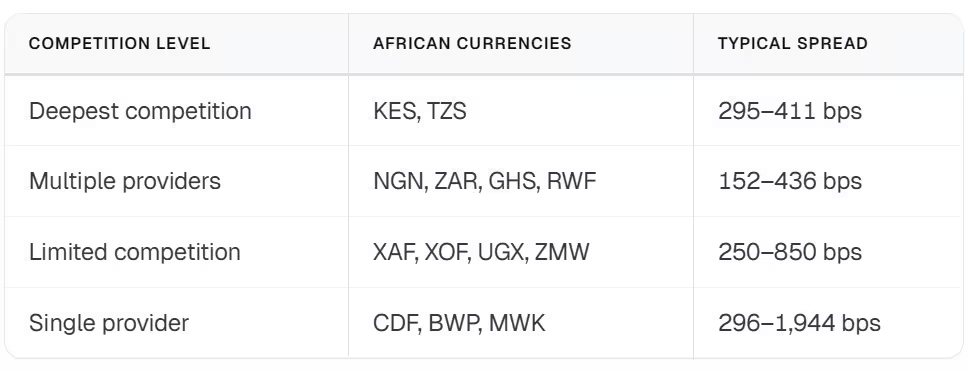
Conversion costs in different competition levels.
Stablecoins versus traditional FX: the TradFi premium
The report compared stablecoin mid-rates with traditional interbank FX mid-market rates to calculate a “TradFi premium.” Across a sample of 33 currencies globally, the median difference was close to 5 basis points (0.05%), meaning stablecoin and interbank mid-rates were largely aligned on average. In Africa, however, the median TradFi premium widened to about 119 basis points (1.2%), with significant variation by country and corridor.
That divergence highlights a key nuance for crypto remittances: while stablecoins can enable faster settlement and, in many cases, lower overall costs than legacy remittance rails, local stablecoin-to-fiat conversion fees can erode savings in specific markets where liquidity is thin or competition is limited.
Implications for remittances and crypto payments
For remittance senders and businesses using crypto rails, the findings stress the importance of corridor-level pricing intelligence. Stablecoin adoption can reduce reliance on slow legacy rails and offer transparent settlement times, but users should evaluate conversion spreads, local liquidity, and provider competition when estimating final costs.
As economist Vera Songwe noted at Davos, stablecoins are helping reduce remittance costs in Africa, where traditional services can charge about $6 per $100 sent. The Borderless.xyz data adds context: savings are achievable, but conversion spreads in some corridors remain elevated until markets attract more liquidity and competitive FX providers.

Discussion
Leave a Comment