
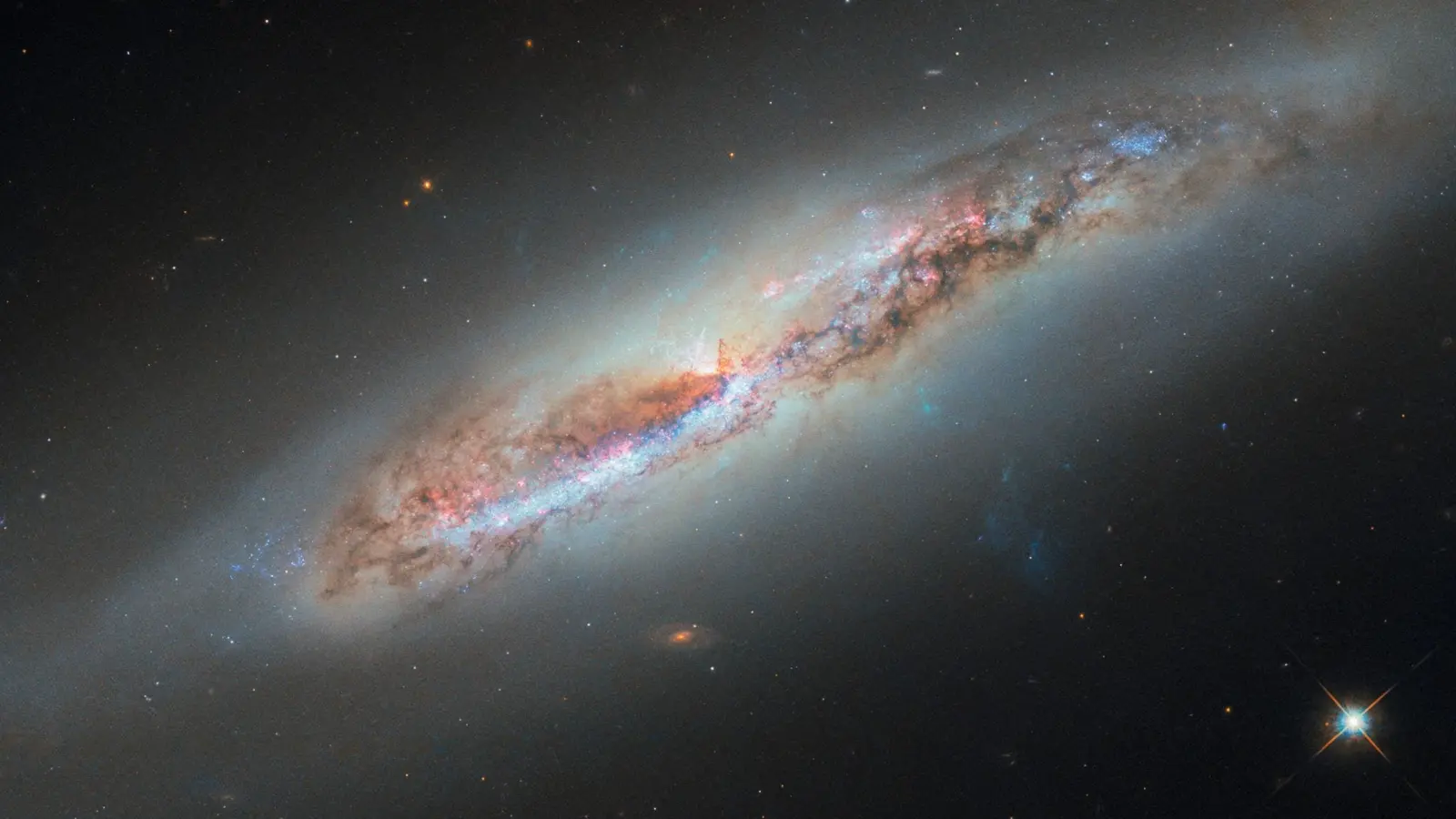
Seen almost edge-on, NGC 4388 looks like a galaxy in flight: a thin, dark disk with a luminous tail trailing behind it. Hubble’s latest observations pull that tail into sharp relief — not merely a visual curiosity, but a clear record of a galaxy being reshaped by its surroundings. What appears as a gentle plume is actually the aftermath of violent forces at work across tens of thousands of light-years.
What the image reveals
NGC 4388 lies roughly 60 million light-years away in Virgo, the nearest large galaxy cluster to the Milky Way. From our vantage point the galaxy is tilted nearly edge-on, which exposes structures hidden in more face-on views. New multiwavelength Hubble data show a stream of ionized gas extending from the galaxy’s center toward the lower-right of the frame — a long, luminous wake that was not apparent in earlier releases.
Why does a spiral galaxy leave a trail? The simplest explanation begins with the cluster’s invisible atmosphere. The space between Virgo’s member galaxies isn’t empty: it’s filled with an extremely hot, diffuse plasma called the intracluster medium. As NGC 4388 barrels through this medium at high speed, the surrounding pressure strips interstellar gas from the galaxy’s disk — a process astronomers call ram-pressure stripping. The removed gas doesn’t vanish; it forms a trailing cloud that records the galaxy’s motion and recent history.
Why the gas glows and why it matters
The glow of the stripped material is more than pretty light. Close to the galaxy’s center, radiation from an active nucleus — a supermassive black hole feeding on nearby gas — can ionize and heat the surrounding material. Farther out, the glow likely arises from shock heating as the stripped gas collides with the intracluster medium. Those shocks excite atoms and cause them to emit at optical and ultraviolet wavelengths, which Hubble can capture when images are combined across filters.
This single scene carries implications for how galaxies evolve inside clusters. When a galaxy loses its cold gas, it also loses the raw material for future star formation. Over time, repeated stripping events can transform a once-star-forming spiral into a gas-poor, quiescent system. Observations of NGC 4388 therefore offer a live-action glimpse of environmental quenching — the gradual shutdown of star formation driven by a galaxy’s surroundings.
These Hubble observations come from programs targeting galaxies with active central black holes, a strategic choice: the interplay between nuclear activity and environmental forces can shape how and where gas is removed or ionized. Combining imaging across wavelengths helps astronomers disentangle contributions from black-hole radiation and shock processes, revealing a fuller picture of the physics at work.
NGC 4388’s luminous tail is a vivid reminder that galaxies are not isolated islands but actors in a dense, interactive cosmic ecosystem.
As instruments continue to probe clusters like Virgo, each new image refines our sense of how large-scale environments sculpt the life cycles of galaxies — and how, sometimes, motion through space leaves a luminous record of past violence.

“My work centers on sustainability, energy, and environmental science — examining how innovation can lead to a greener future.”

Discussion
Leave a Comment