
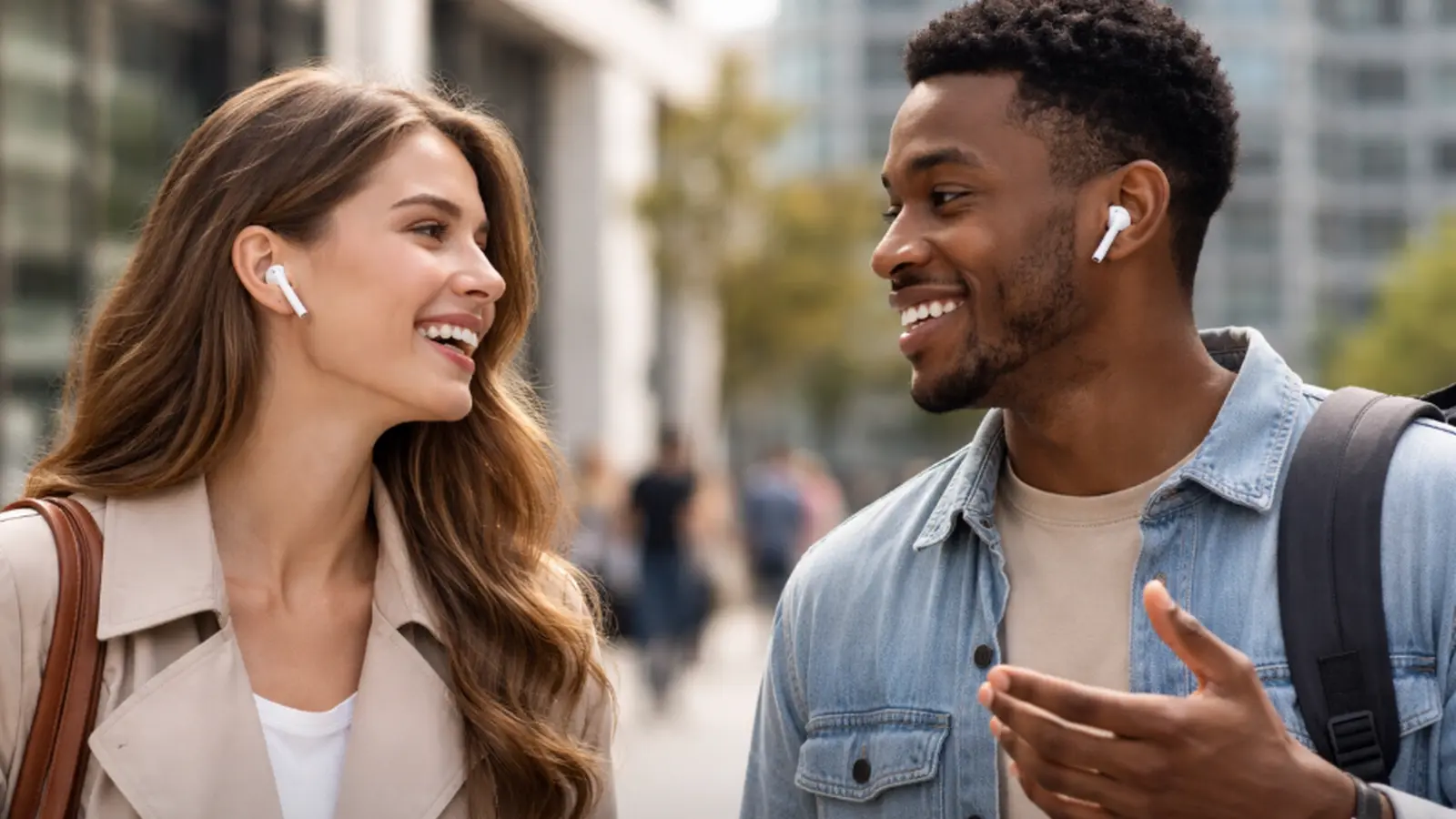
Imagine mouthing a sentence and your earbuds obeying—no sound, no wake word, no one the wiser. That image is suddenly less science fiction and more boardroom reality. Reports say Apple has shelled out roughly $2 billion for an Israeli startup called Q.ai, a deal that industry watchers are calling Apple’s biggest since Beats.
Q.ai isn’t a buzzword factory. The company builds machine learning models that watch the subtlest skin shifts, lip quirks and muscle tugs on the face and turn them into interpretable signals. Think silently mouthed words, tiny emotional tells and even hints about breathing or heart rate. Small movements. Big data.
Combine that software with a camera-packed AirPods design—analysts have been predicting camera-enabled earbuds as soon as 2026—and you get a very different kind of interface. Instead of shouting “Hey Siri,” you might simply mouth “play” and the earbuds will do the rest. Infrared and depth sensors similar to Face ID could map micro-expressions in low light and depth-sense lips in crowded places, which is why some insiders link Q.ai’s acquisition to future AirPods and Apple’s mixed-reality Vision Pro line.
There’s historical DNA here. Q.ai’s founder, Aviad Maizels, helped build PrimeSense years ago—the team whose 3D sensing tech ultimately fed into the Face ID systems we now take for granted. This deal looks like Apple seeding the next interaction model: less vocal commands, more invisible gestures and sensor-driven conversation.

So what would daily life look like? Picture checking messages on the commute without disturbing anyone. Or adjusting a playlist in a crowded cafe without saying a word out loud. It’s appealing. Quiet. Discreet.
But quiet technologies bring loud questions. Continuous monitoring of micro-expressions and lip movements creates a dense trail of biometric data. Left unguarded, that trail could reveal emotional states, health markers or even snippets of private speech. Who stores that data? For how long? And under what legal umbrellas? The potential for misuse—unauthorized tracking, covert emotion detection, remote profiling—raises new privacy alarms that regulators and civil liberties groups will likely scrutinize.
Apple’s history of pitching privacy as a feature will be tested here. Sensor fusion—blending camera input, depth maps and machine learning—can be done on-device, reducing cloud exposure. But on-device processing isn’t a cure-all. Models may still require updates, diagnostics or telemetry, and every server call is an opportunity for data leakage.
Companies and consumers will need clearer guardrails. Technical safeguards like ephemeral data windows, strict on-device-only processing, and transparent user controls are part of the answer. Policy guardrails are another. Will regulators treat silent facial input the same way they treat voice assistants or wearable health sensors? Questions multiply fast.
This acquisition suggests Apple wants to make silence a first-class input method across wearables. If successful, the change would ripple from earbuds to smart glasses and mixed-reality headsets, altering not just how devices listen, but how they watch.
Quiet interactions could become the next interface frontier—but only if privacy, transparency and control keep pace.
Either way, the coming years will tell whether we’ve traded a wake word for a watchful sensor, or gained a discreet, humane way to use technology when the world demands silence.

“I love exploring gadgets, apps, and trends that redefine how we connect, work, and play in a digital world.”

Discussion
Leave a Comment