
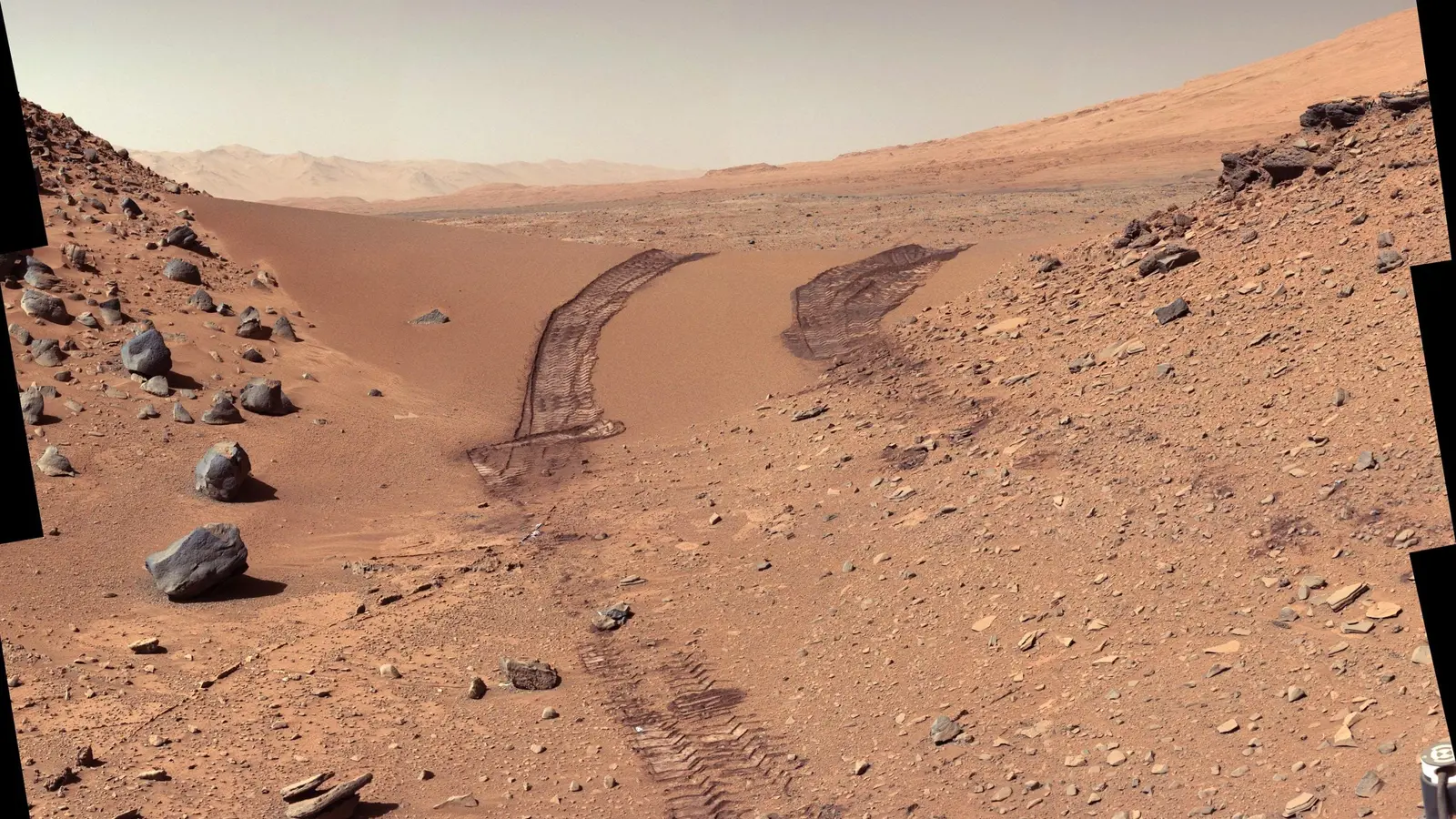
When scientists first announced traces of long-chain organic molecules in Martian mudstone in 2025, the reaction was cautious excitement. Small concentrations of alkanes—hydrocarbon chains that, on Earth, often come from the breakdown of fatty acids—had been detected. Not smoking-gun levels. Not dramatic. Just tens of parts per billion. Yet a fresh analysis led by Alexander Pavlov at NASA's Goddard Space Flight Center has flipped the question: could Mars once have harbored far more organics than those low readings suggest, and if so, could non-biological processes reasonably explain that abundance?
Short answer: maybe not. The team modeled how ionizing radiation slowly destroys organic molecules over geologic time. Radiation is relentless on Mars because the planet lacks the magnetic field and dense atmosphere that shield Earth. Rocks that sit near the surface get bombarded. Over millions of years, organics erode away chemically—split apart, oxidized, or broken into fragments. Pavlov and colleagues used lab-based radiolysis rates to rewind that clock. Their calculations point to an original concentration of long-chain alkanes or fatty acid fragments in the Cumberland mudstone that could have been hundreds to thousands of parts per million—orders of magnitude higher than the 30–50 parts-per-billion range Curiosity measured.
How they tested the hypothesis
Estimating what once was requires two things: a model for destruction, and a list of plausible sources. The destruction model draws on controlled experiments where organics are exposed to ionizing radiation and the decay is measured. Applying those decay curves to a rock exposed on Mars for roughly 80 million years produces that startling inferred range—roughly 120 to 7,700 parts per million before radiation took its toll.

Then the team considered known abiotic pathways. Meteorites and interplanetary dust deliver organics; atmospheric haze can deposit simple hydrocarbons; hydrothermal systems and water-rock reactions such as serpentinization can synthesize organics in situ. Each mechanism contributes some carbon. But when the researchers added up plausible fluxes and reaction yields, the numbers fell far short of the reconstructed original concentration.
This mismatch doesn't equal a declaration of life. The authors stress caution. Models can be incomplete. Mars may host chemical processes we're unaware of. And experimental radiolysis rates measured on Earth may not capture every nuance of Martian conditions. Still, the finding reframes the debate. If the Cumberland mudstone really started with thousands of ppm of long-chain organics, that level more closely resembles deposits associated with biological production on Earth than with known abiotic reservoirs.
What does this imply for habitability? It doesn't prove past life. It does highlight locations and questions worth prioritizing. The detected alkanes could be remnants of long-chain fatty acids—molecules that on Earth are frequently linked to biology, though abiotic routes exist. The presence of any concentrated organic inventory suggests that early Mars had the chemical raw materials potentially relevant to prebiotic chemistry, and perhaps to life.
Pavlov's paper, published in Astrobiology, invites further tests: deeper sampling to escape radiation-processed surfaces, refined lab experiments that better simulate Martian mineral matrices and radiation spectra, and continued comparisons with meteoritic and atmospheric contributions. Curiosity provided a tantalizing data point. This work asks a sharper question: where did the rest go?
The search continues, now with fresh purpose and a clearer map of what to look for beneath the rusty dust.

“The cosmos has always fascinated me. I write about space missions, astronomy, and the technologies pushing humanity beyond Earth.”

Discussion
Leave a Comment