
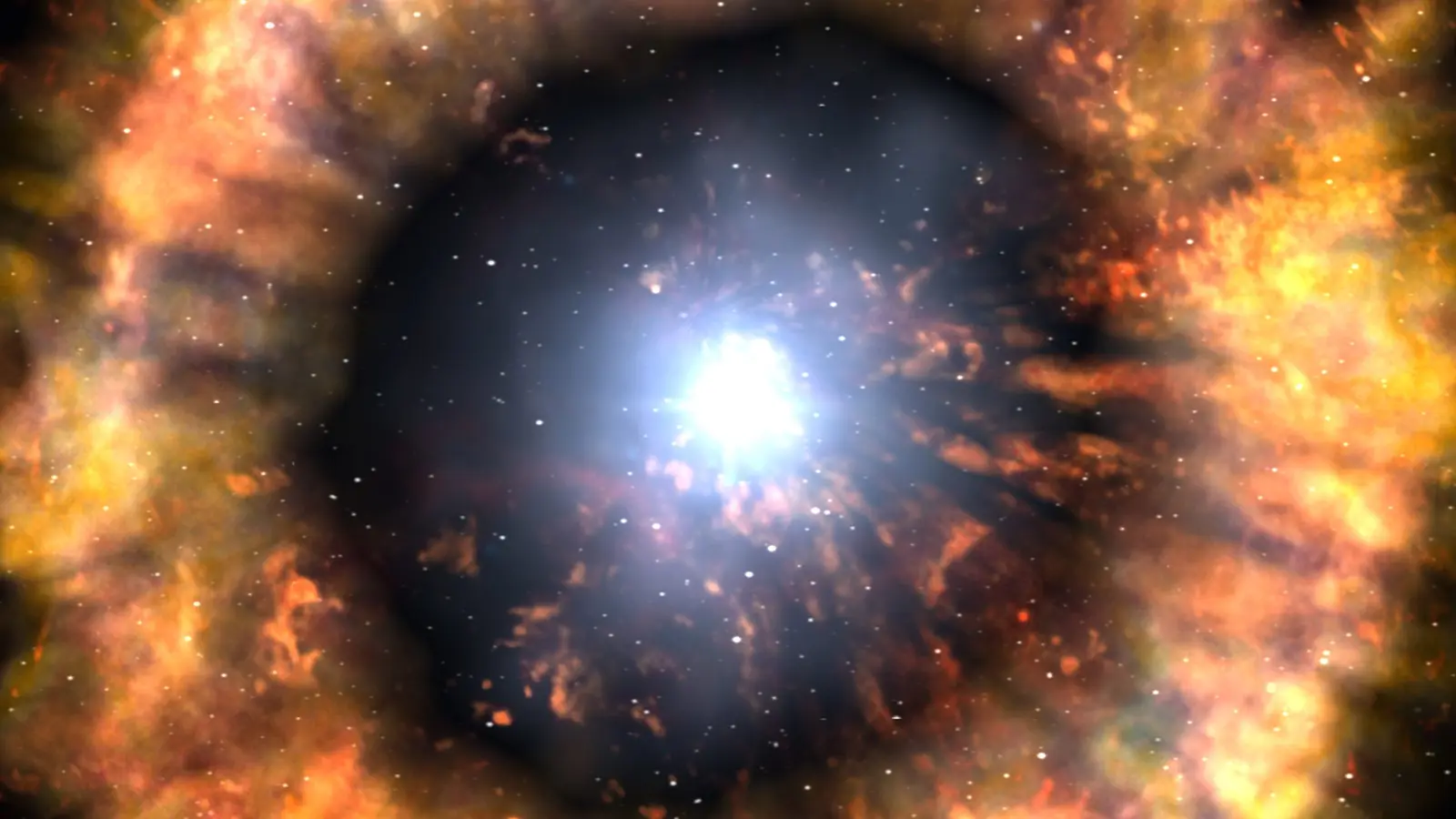
Astronomers have long expected massive stars to go out with a bang. Instead, one of Andromeda’s brightest supergiants simply faded away — quietly, without the fireworks. The discovery reads like a detective story: a familiar object that stopped behaving like a star, archival images that hid a crucial clue for years, and a team that followed the faint trail to a startling conclusion: the star likely collapsed directly into a black hole after a failed supernova.
The disappearing act and what the data revealed
The object, cataloged as M31-2014-DS1, began life as a blue-white supergiant roughly 13 times the mass of the Sun. From Earth it was a luminous pinprick across the 2.5 million light-year gulf separating the Milky Way and Andromeda. Then something changed. Between 2014 and 2016 NASA’s NEOWISE infrared telescope recorded a roughly 50 percent rise in the star’s infrared emission, a slow brightening that persisted for about two years. After that, the light fell off a cliff. Over 2016–2022 the star dimmed dramatically, and by 2023 it had vanished in optical surveys.
That disappearance, however, was not merely a case of dust hiding a still-glowing star. When astronomers compared measurements across the electromagnetic spectrum they found the total radiative output had plunged by at least an order of magnitude. Infrared emission, which cuts through dust more effectively than visible light, also dropped to roughly one-tenth of the object’s former mid-infrared brightness. In short: the star’s energy production shut down, not just its visibility.
Kishalay De of Columbia University, who led the analysis, described the find as a shock. He and his colleagues dug into public archival images and photometric records — the sort of treasure trove that can be overlooked for years — and teased out a timeline that fits a particular, rare end-stage: a failed supernova followed by direct collapse into a black hole.

Physics of a failed supernova: how a star dies quietly
When a massive star exhausts nuclear fuel in its core, gravity wins. In the typical scenario, core collapse launches a powerful shock that rips outward and expels the star’s envelope in a supernova. But the physics inside the dying core is messy and fickle. In some cases the outward-going shock can stall. If the shock lacks sufficient energy, it never unbinds the outer layers; instead, material reverses course and falls back onto the compact remnant. The result is a faint, failed explosion and a newborn black hole quietly swallowing infalling gas.
This fallback pathway leaves observational fingerprints. The initial infrared brightening seen by NEOWISE is consistent with dust being produced or redistributed close to the star — creating a transient warm cocoon — rather than being violently blown away. But if dust alone were responsible for the optical dimming, mid-infrared brightness would remain steady or even increase. M31-2014-DS1 did not behave that way: its bolometric (total) luminosity fell sharply, which points to cessation of internal fusion and the collapse of the core.
The team’s calculations suggest the new compact object has a mass near five times that of the Sun. That would imply an event horizon measuring on the order of thirty kilometers across — tiny on cosmic scales, but a definitive black hole nonetheless. Such compact remnants are familiar from X-ray binaries and gravitational-wave detections, but witnessing the parent star’s quiet disappearance gives us a rare view of one route to their formation.
Implications for stellar death rates and black hole demographics
Why does this matter beyond the novelty of a vanishing star? For one, it changes how astronomers inventory stellar deaths. Supernova surveys are biased toward dramatic explosions that can outshine their host galaxies for weeks. If a non-negligible fraction of massive stars end their lives quietly, conventional supernova counts understate the true rate of core collapse. That in turn affects estimates of heavy-element production, neutron-star versus black-hole birthrates, and even the expected population of compact-object mergers that produce gravitational waves.
There’s a second reason to care. Finding two strong candidate failed supernovae within a relatively short interval — the earlier case was recorded around 2010 in a galaxy about 22 million light-years away — hints that this pathway may be more common than previously thought. Or it could simply reflect how our observational reach and archival mining have improved: telescopes like NEOWISE, and persistent reanalysis of stored data, give us sensitivity to subtler changes across time.
Expert Insight
“We used to think stars of this mass always exploded,” says Dr. Elena Márquez, an observational astrophysicist not involved in the study. “Now we see that the interior dynamics — how shock waves, neutrinos, and turbulent gas interact — can tip the outcome one way or the other. Observations like this force theorists to refine explosion models and help observers design searches that catch quiet deaths.”
Dr. Márquez’s point gets to the heart of the matter: theory and observation must advance together. Models of core collapse rely on detailed physics at extreme densities and temperatures, and small changes in initial conditions can yield very different outcomes. Real examples of failed supernovae let modelers test whether their codes predict fallback, weak explosions, or direct collapse under realistic conditions.
From an instrumentation viewpoint, these events reinforce the value of wide-field infrared monitoring and long-duration sky surveys. Mid-infrared sensitivity allowed the NEOWISE team to spot the early dust signature; long-term optical surveys documented the decline. As time-domain astronomy matures, astronomers will be better equipped to detect more of these stealthy deaths and build a statistical sample large enough to influence models of stellar evolution and black hole formation.
There is a human element, too. Imagine if Betelgeuse had simply winked out. The public reaction would be seismic. For now, these quiet disappearances remind us that the universe does not always keep to the script we expect. They invite us to look harder, to re-read archival data with new questions, and to accept that cosmic endings can be as diverse and surprising as their beginnings.
What else is hiding in the archives? We’ll find out by watching, patiently, and by listening to the faintest of whispers the stars leave behind.

“My work centers on sustainability, energy, and environmental science — examining how innovation can lead to a greener future.”

Discussion
Leave a Comment