

Researchers at Auburn University have proposed a new family of materials that trap and guide free electrons across solid surfaces. These "Surface Immobilized Electrides" promise tunable electronic properties that could accelerate quantum computing and transform catalytic chemistry.
A fresh class of electrides: what changed
Electrides are unusual solids in which electrons act like anions—free to occupy open sites instead of being bound to atoms. Historically, electrides have fascinated scientists because free electrons can enable high conductivity, unusual magnetism, and exotic chemical reactivity. But until now, practical electrides have been plagued by instability and difficult fabrication, limiting their real-world use.
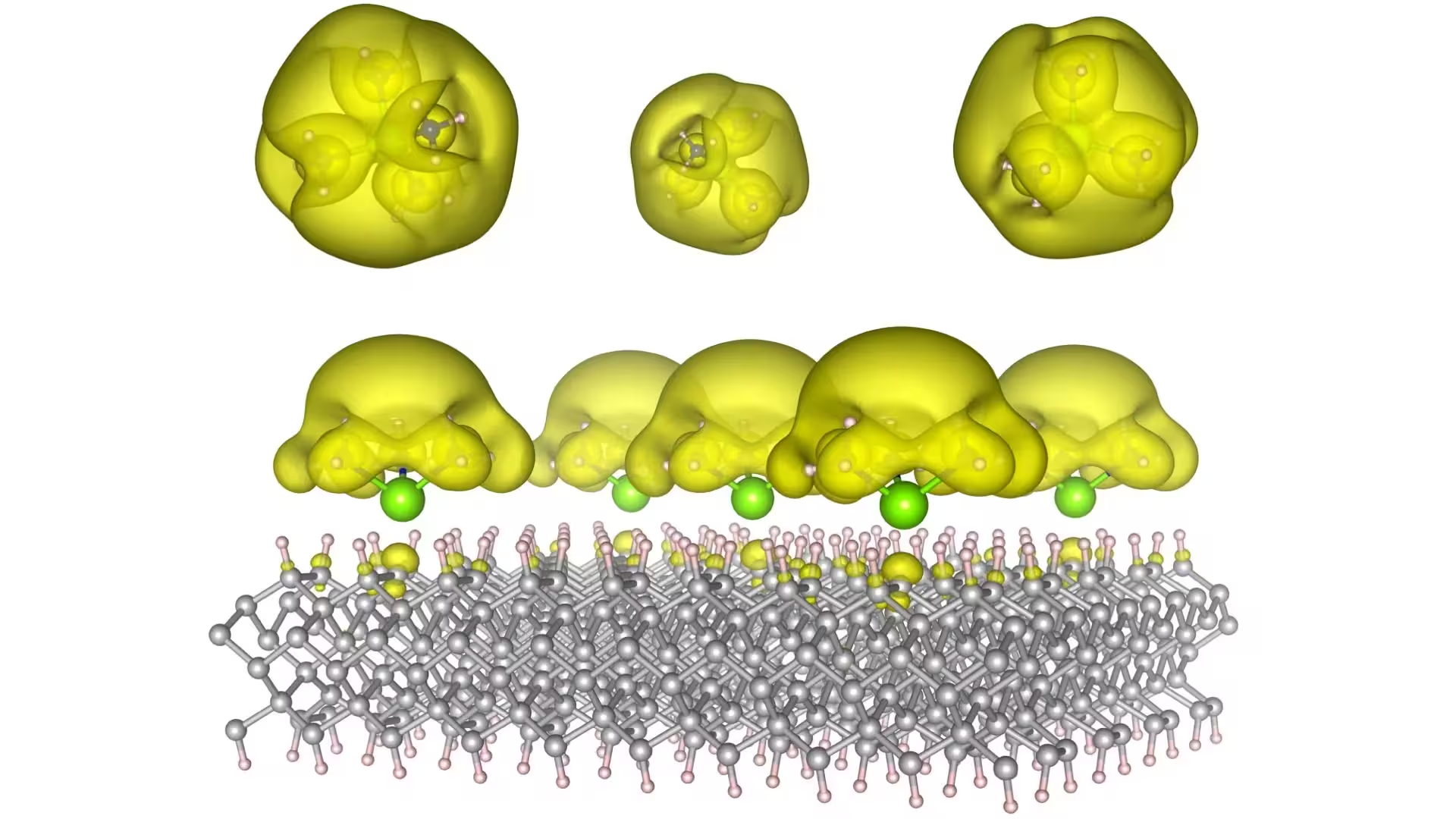
The Auburn team introduces "Surface Immobilized Electrides," a design that anchors solvated electron precursors—molecular complexes that host loosely bound electrons—directly onto robust surfaces such as diamond and silicon carbide. By fixing the precursors on a solid support, researchers gain control over how tightly electrons are localized and how they couple to neighboring sites. That tunability addresses two persistent problems: stability under ambient conditions and the ability to scale the material for devices.
How the new materials work and why they matter
At the heart of the discovery is control over electron delocalization. When electrons remain confined to small pockets they behave like isolated quantum islands; when they spread out, they form an extended electronic sea. Both regimes have valuable applications. Localized electrons can function as quantum bits (qubits) with discrete states suitable for quantum computing, while delocalized electrons can catalyze complex chemical transformations by facilitating multi-electron processes.
Tunable coupling
- By altering molecular spacing and surface choice, the researchers can adjust coupling strength between electron-hosting sites.
- Stronger coupling produces extended electronic states useful for driving chemical reactions; weaker coupling isolates electrons for quantum control.
- Surface immobilization improves robustness compared with earlier, bulk electrides that degraded quickly outside laboratory conditions.
According to lead computational chemist Dr. Evangelos Miliordos, the work relied on advanced modeling to predict how electrons behave when solvated precursors are tethered to solid supports. The result is a theoretically grounded materials platform that bridges basic science and engineering-ready concepts.
Potential applications: from quantum processors to greener chemistry
The implications are broad. In quantum information science, materials that host well-separated electron islands could act as qubit arrays with engineered interactions—an alternative route to superconducting circuits or trapped ions. In catalysis, surfaces that supply delocalized electrons could enable new low-energy routes to synthesize fuels, pharmaceuticals, or specialty chemicals, potentially simplifying production and reducing waste.
"As our society pushes the limits of current technology, the demand for new kinds of materials is exploding," says Dr. Marcelo Kuroda, an Auburn physicist involved in the study. "Our work shows a new path to materials that offer both opportunities for fundamental investigations on interactions in matter as well as practical applications."
Previous electrides often required extreme conditions to exist. By contrast, surface-immobilized designs aim for stability and manufacturability. Depositing electron-hosting molecules on common semiconductor surfaces provides a clear pathway to integrating these materials with existing device fabrication techniques.
Study details and collaborative approach
The findings appear in ACS Materials Letters under the title "Electrides with Tunable Electron Delocalization for Applications in Quantum Computing and Catalysis." The theoretical study was driven by faculty across chemistry, physics, and materials engineering at Auburn University and coauthored by graduate students Andrei Evdokimov and Valentina Nesterova. Computational resources and funding came from Auburn University and the U.S. National Science Foundation.
Assistant Professor of Materials Engineering Dr. Konstantin Klyukin highlights the translation angle: "This is fundamental science, but it has very real implications. We're talking about technologies that could change the way we compute and the way we manufacture." That blend of theory, simulation, and materials design gives the proposal credibility as a next-step target for experimental labs.
Expert Insight
"What makes this approach exciting is the level of control it offers," says a fictional materials scientist, Dr. Elena Park, director of a quantum materials group. "By engineering the interface between molecular precursors and hard surfaces, researchers can tune whether electrons behave like isolated qubits or collective carriers. That flexibility could shorten the path from concept to device, provided experimental teams can match the computational predictions in the lab."
Real-world challenges remain: fabricating defect-free layers, measuring electron localization at the nanoscale, and integrating these structures into functioning circuits or catalytic reactors. Yet the pathway is clearer than for earlier electride concepts, making the discovery a notable step toward practical quantum and chemical technologies.
Where research could go next
Near-term goals include experimental synthesis of surface-immobilized electrides, spectroscopic validation of free-electron behavior, and device prototypes that test qubit coherence or catalytic performance. Longer term, the team envisions hybrid platforms that combine localized quantum elements with electron-rich catalytic zones on the same chip—a provocative idea that blurs the line between computing and chemical manufacturing.
By reframing free electrons as a design variable rather than an inconvenient byproduct, Auburn's proposal opens fresh directions for researchers aiming to harness quantum behavior for applied technologies.

“My work centers on sustainability, energy, and environmental science — examining how innovation can lead to a greener future.”

Discussion
Leave a Comment