
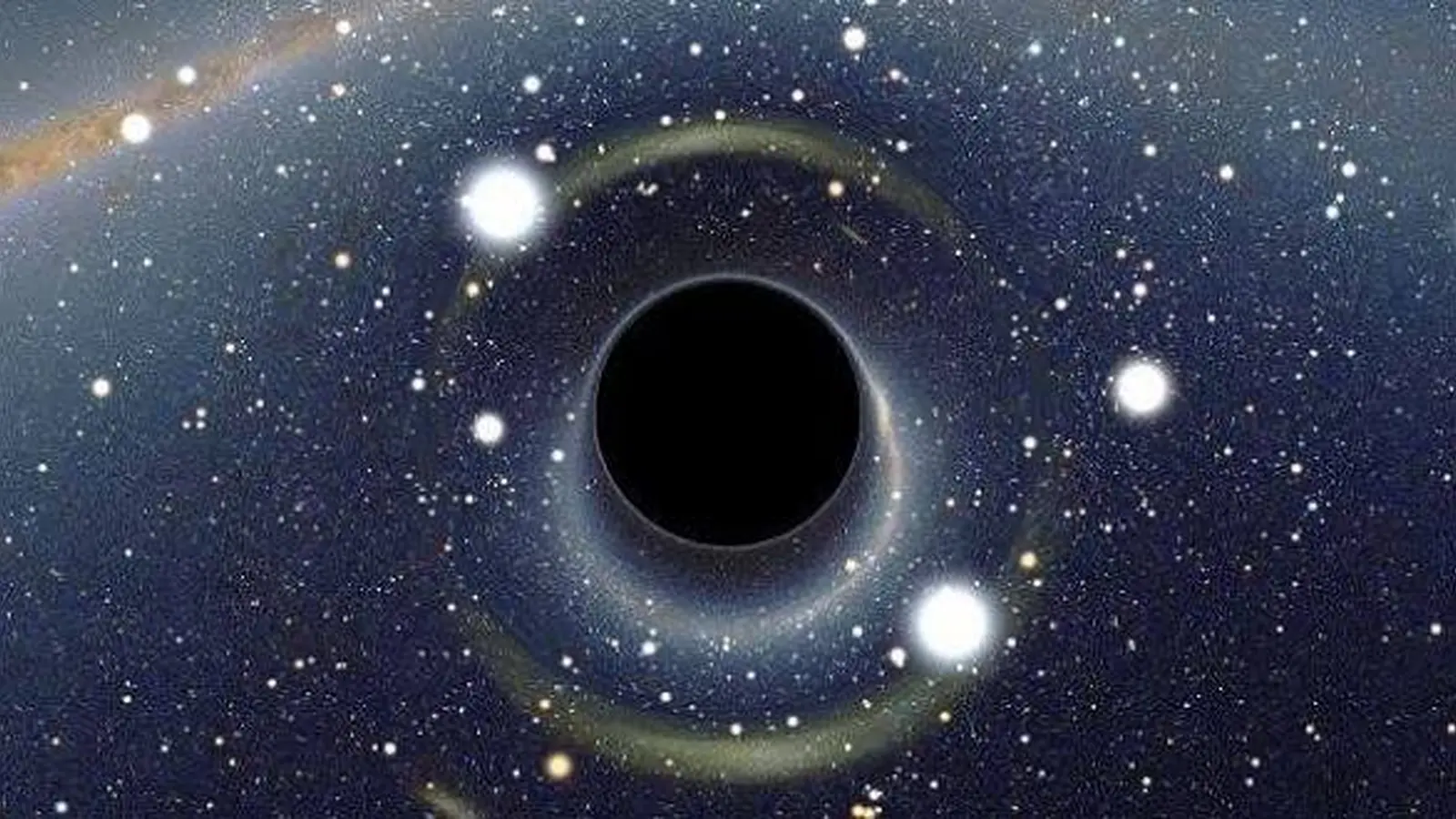
There’s a stubborn shadow at the center of our galaxy that refuses to be simple. For thirty years, the short answer has been a supermassive black hole named Sagittarius A*—a compact, invisible object whose gravity slings nearby stars into razor-thin, high-speed orbits. But what if that shadow is being cast by something subtler: a compact core of exotic dark matter that mimics a black hole’s pull without the event horizon?
A radical alternative for Sgr A*
Astronomers watching the galactic center have long relied on the S-stars, a group of stars on close, eccentric paths, as a kind of dynamical litmus test. These stars race so rapidly—thousands of kilometers per second—that only a very large, compact mass can hold them in such tight loops. Traditionally, that mass has been labeled a supermassive black hole. Yet an international team of researchers has proposed a different actor: fermionic dark matter that piles up into an ultra-dense central core while also forming a diffuse halo further out.
The idea rests on particle physics plus gravity. Fermions are particles that follow the Pauli exclusion principle—the familiar family includes electrons and protons—but in this model the fermions are hypothetical, extremely light dark-matter particles. Under gravity they can form a two-part structure: a dense, degenerate core that generates strong central gravity and a surrounding halo that shapes the galaxy’s rotation on larger scales. In other words, one continuous dark substance might explain both the local chaos of the S-stars and the sweeping calm of the Milky Way’s rotation curve.
It’s an elegant unification. Instead of two distinct phenomena—an isolated black hole up close and a separate dark halo at kiloparsec scales—you get a single framework that reproduces the key observables. The dense fermionic core can bend light and pull starlight into paths that imitate the motions produced by a classical black hole. Even G-sources—dusty, infrared-bright objects near the center—could be shepherded by the same gravitational field.

How the model matches the Galaxy at large
Matching the central dynamics is necessary but not sufficient. A viable model must also reproduce the rotation curve of the Milky Way: how orbital velocity changes with distance from the center. Recent release of Gaia DR3 data has sharpened that rotation map, revealing a broadly Keplerian decline in orbital speeds at large radii. That decline is precisely the kind of signature a more truncated, fermionic halo would produce when combined with the known mass of the bulge and disk.
Conventional cold dark matter (CDM) halos tend to be extended, with long, slow-falling tails described by power laws. The fermionic alternative predicts a more compact halo, with a steeper cut‑off at large radii. When the team fed the Galaxy’s luminous mass (stars and gas) into their calculations and added the fermionic halo, the result was a rotation curve that sits comfortably alongside Gaia’s measurements.
That match is the paper’s selling point: the same distribution of dark matter explains both microscopic and macroscopic behaviors. Dr. Carlos Argüelles, a co-author of the study, framed it plainly: the bright, hectic motions near the center and the gentle orbital decline far away could be two faces of the same substance, not two separate structures.
Observational fingerprints and the black hole shadow
Perhaps the most provocative claim is that a dense dark core can produce a shadow-like feature when lit by an accretion disk. The Event Horizon Telescope’s image of Sgr A*—a central dim region ringed by emission—has been touted as direct evidence for an event horizon. Yet follow-up modeling suggests that a compact, non-relativistic dark matter concentration can also bend light intensely enough to cast a central darkness encircled by a bright ring.
Lead author Valentina Crespi emphasizes the subtlety: “We are not simply swapping labels. The fermionic configuration reproduces stellar orbits, matches rotation data, and can produce an EHT-style shadow. These are non-trivial coincidences.” However, the models also differ in measurable ways. A true black hole produces stacked photon rings—narrow, highly lensed light paths very close to the event horizon—that should persist even as observational fidelity improves. The dark core scenario does not generate identical photon-ring signatures.
That difference gives observers a route to test the idea. Instruments like GRAVITY on the Very Large Telescope and future EHT upgrades will aim to resolve photon rings and measure the fine structure of the black hole shadow. If the distinctive, nested photon-ring pattern appears, it will favor the black hole interpretation. If it does not, or if other anomalies arise, the fermionic core hypothesis gains credence.
Expert Insight
“Skepticism is healthy in this field,” says Dr. Laila Moreno, a theoretical astrophysicist unaffiliated with the study. “The strength of this work is not that it demolishes the black hole idea overnight; it’s that it forces us to examine the assumptions behind how we infer compact mass. If a single dark matter distribution can account for both inner and outer dynamics, we must take it seriously and design observations that decisively distinguish the scenarios.”
Modelers are also quick to point out the implications. If fermionic dark matter forms compact cores, then galaxy centers across cosmic history might host similar structures. That would reshape predictions for galactic evolution, tidal interactions, and the growth of central objects. It would also constrain particle physics: the required mass, interaction properties, and formation history of fermionic dark matter would become targets for laboratory and cosmological tests.
What comes next?
The path forward is observational. High-resolution interferometry, longer-baseline mm‑wave arrays, and more precise stellar astrometry will push the envelope. GRAVITY can track the S-stars with microarcsecond precision, searching for subtle deviations from Keplerian orbits. The Event Horizon Telescope and next-generation very-long-baseline networks will hunt for photon rings and time-variable substructure in the shadow. And Gaia and spectroscopic surveys will continue to tighten the outer rotation curve that any viable halo model must reproduce.
In parallel, theorists must refine the fermionic models—exploring stability, formation channels, and how such cores co-exist with baryonic (ordinary matter) processes like star formation, gas inflows, and accretion physics. A single, coherent explanation for the Milky Way’s inner and outer dynamics would be revolutionary, but the burden of proof remains high.
The question now is not merely academic: the instruments are coming online to test these competing visions. Will the central darkness prove to be an event horizon, or a dense, exotic congregation of dark particles? Either answer will teach us something deep about gravity, matter, and the architecture of galaxies.

“My work centers on sustainability, energy, and environmental science — examining how innovation can lead to a greener future.”

Discussion
Leave a Comment